• HOME
  • NEWS
  • EXPLORE
    • CAREER
      • Companies
      • Jobs
    • EVENTS
    • iGEM
      • News
      • Team
    • PHOTOS
    • VIDEO
    • WIKI
  • BLOG
  • COMMUNITY
    • FACEBOOK
    • INSTAGRAM
    • TWITTER
Sunday, May 17, 2026
BIOENGINEER.ORG
No Result
View All Result
  • Login
  • HOME
  • NEWS
  • EXPLORE
    • CAREER
      • Companies
      • Jobs
        • Lecturer
        • PhD Studentship
        • Postdoc
        • Research Assistant
    • EVENTS
    • iGEM
      • News
      • Team
    • PHOTOS
    • VIDEO
    • WIKI
  • BLOG
  • COMMUNITY
    • FACEBOOK
    • INSTAGRAM
    • TWITTER
  • HOME
  • NEWS
  • EXPLORE
    • CAREER
      • Companies
      • Jobs
        • Lecturer
        • PhD Studentship
        • Postdoc
        • Research Assistant
    • EVENTS
    • iGEM
      • News
      • Team
    • PHOTOS
    • VIDEO
    • WIKI
  • BLOG
  • COMMUNITY
    • FACEBOOK
    • INSTAGRAM
    • TWITTER
No Result
View All Result
Bioengineer.org
No Result
View All Result
Home NEWS Science News Chemistry

Quantum Hall effect and the third dimension

Bioengineer by Bioengineer
September 6, 2025
in Chemistry
Reading Time: 1 min read
0
IMAGE
Share on FacebookShare on TwitterShare on LinkedinShare on RedditShare on Telegram

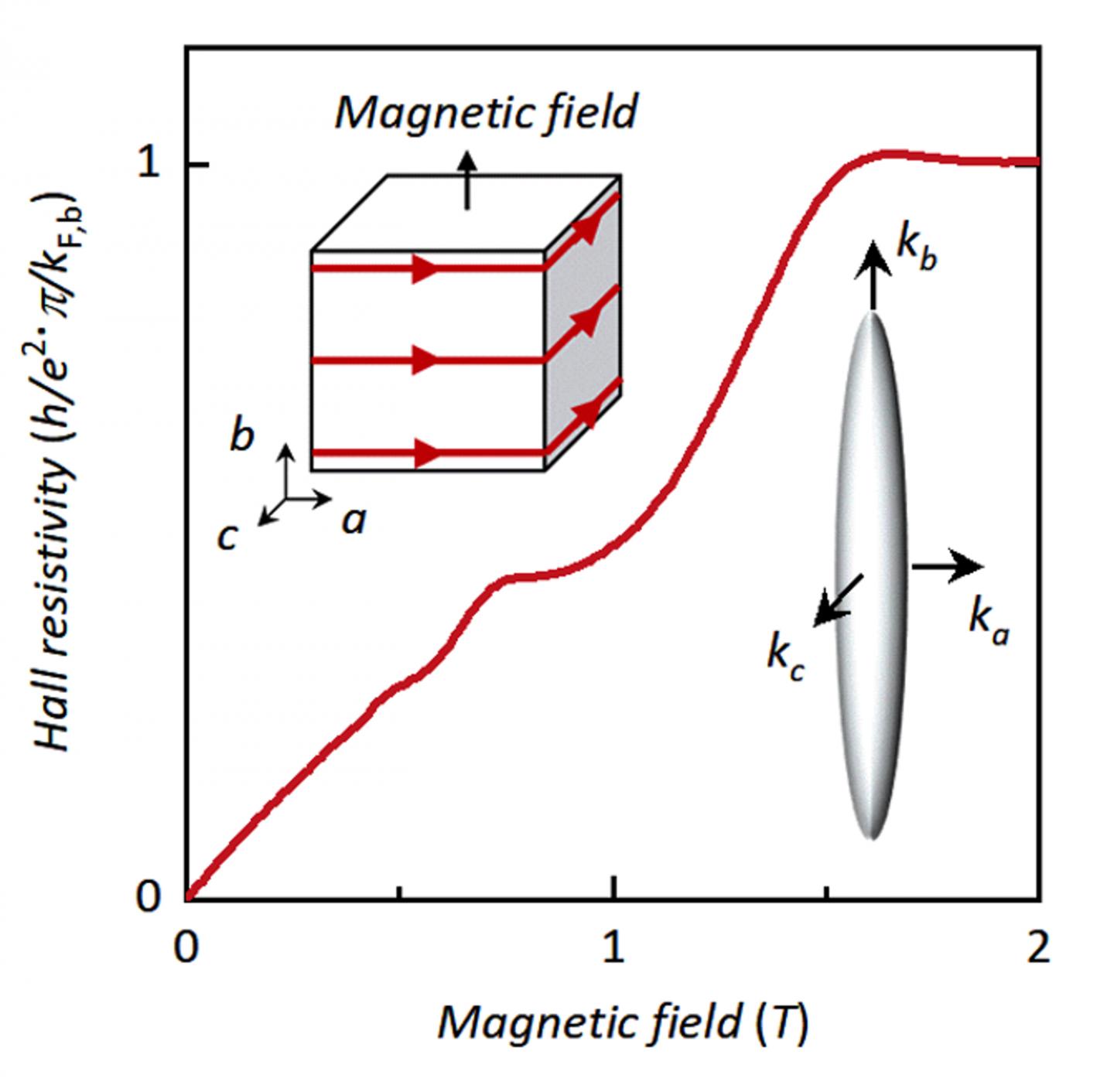
The quantum Hall effect traditionally only plays a role in two-dimensional electron systems. Recently, however, a three-dimensional version of the quantum Hall effect was described in the Dirac semimetal ZrTe5. It has been suggested that this version results from a magnetic field-induced Fermi surface instability that transforms the original three-dimensional electron system into a stack of two-dimensional electron systems. Now scientists at the Max Planck Institute for Chemical Physics of Solids in Dresden, at the Technical University of Dresden, at the Brookhaven National Laboratory in New York, at the Helmholtz Center Dresden-Rossendorf, the Max Planck Institute for Microstructure Physics in Halle and at the Würzburg-Dresden Cluster of Excellence ct.qmat were able to show that the electron system of ZrTe5, contrary to the original explanation, remains three-dimensional even in strong magnetic fields and that the quasi-quantization of the Hall effect is nevertheless directly linked to quantum-Hall physics.

The findings from the study of quantum Hall physics in the third dimension can be universally applied to conventional metals and promise a unified explanation of the plateaus that have been observed in Hall measurements in many three-dimensional materials, which were often puzzling in the past. In addition, the concept can be directly applied to generalize the two-dimensional quantum anomalous Hall effect to generic three-dimensional magnets.

The results were published in Nature Communications.

###

Media Contact
Johannes Gooth
[email protected]

Related Journal Article

http://dx.doi.org/10.1038/s41467-021-23435-y

Tags: Chemistry/Physics/Materials SciencesDirac semimetalsHall measurementsMaterialsQuantum anomalous Hall effectQuantum Hall effectThree-dimensional physics
Share13Tweet8Share2ShareShareShare2

Related Posts

New Drexel Study Reveals Key to Keeping Students on Track in Physics Learning — Chemistry

New Drexel Study Reveals Key to Keeping Students on Track in Physics Learning

May 15, 2026
Reversible Glue Technology Powers Up with Electric Activation — Chemistry

Reversible Glue Technology Powers Up with Electric Activation

May 15, 2026

Sweet as Honey: Unveiling a New Heat Transport Regime in Ultrathin Semiconductors

May 15, 2026

High-Precision Boltzmann Luminescent Nanothermometry Achieved Through Predictive Rules

May 15, 2026
Please login to join discussion

POPULAR NEWS

  • Research Indicates Potential Connection Between Prenatal Medication Exposure and Elevated Autism Risk

    844 shares
    Share 338 Tweet 211
  • New Study Reveals Plants Can Detect the Sound of Rain

    730 shares
    Share 291 Tweet 182
  • Salmonella Haem Blocks Macrophages, Boosts Infection

    62 shares
    Share 25 Tweet 16
  • Breastmilk Balances E. coli and Beneficial Bacteria in Infant Gut Microbiomes

    58 shares
    Share 23 Tweet 15

About

We bring you the latest biotechnology news from best research centers and universities around the world. Check our website.

Follow us

Recent News

Tau T205 Phosphorylation Controls Memory and Engrams

Phocaeicola dorei Eases Liver Fibrosis via Efferocytosis

Boosting Aging Positivity and Activity in Older Couples

Subscribe to Blog via Email

Success! An email was just sent to confirm your subscription. Please find the email now and click 'Confirm' to start subscribing.

Join 82 other subscribers
  • Contact Us

Bioengineer.org © Copyright 2023 All Rights Reserved.

Welcome Back!

Login to your account below

Forgotten Password?

Retrieve your password

Please enter your username or email address to reset your password.

Log In
No Result
View All Result
  • Homepages
    • Home Page 1
    • Home Page 2
  • News
  • National
  • Business
  • Health
  • Lifestyle
  • Science

Bioengineer.org © Copyright 2023 All Rights Reserved.