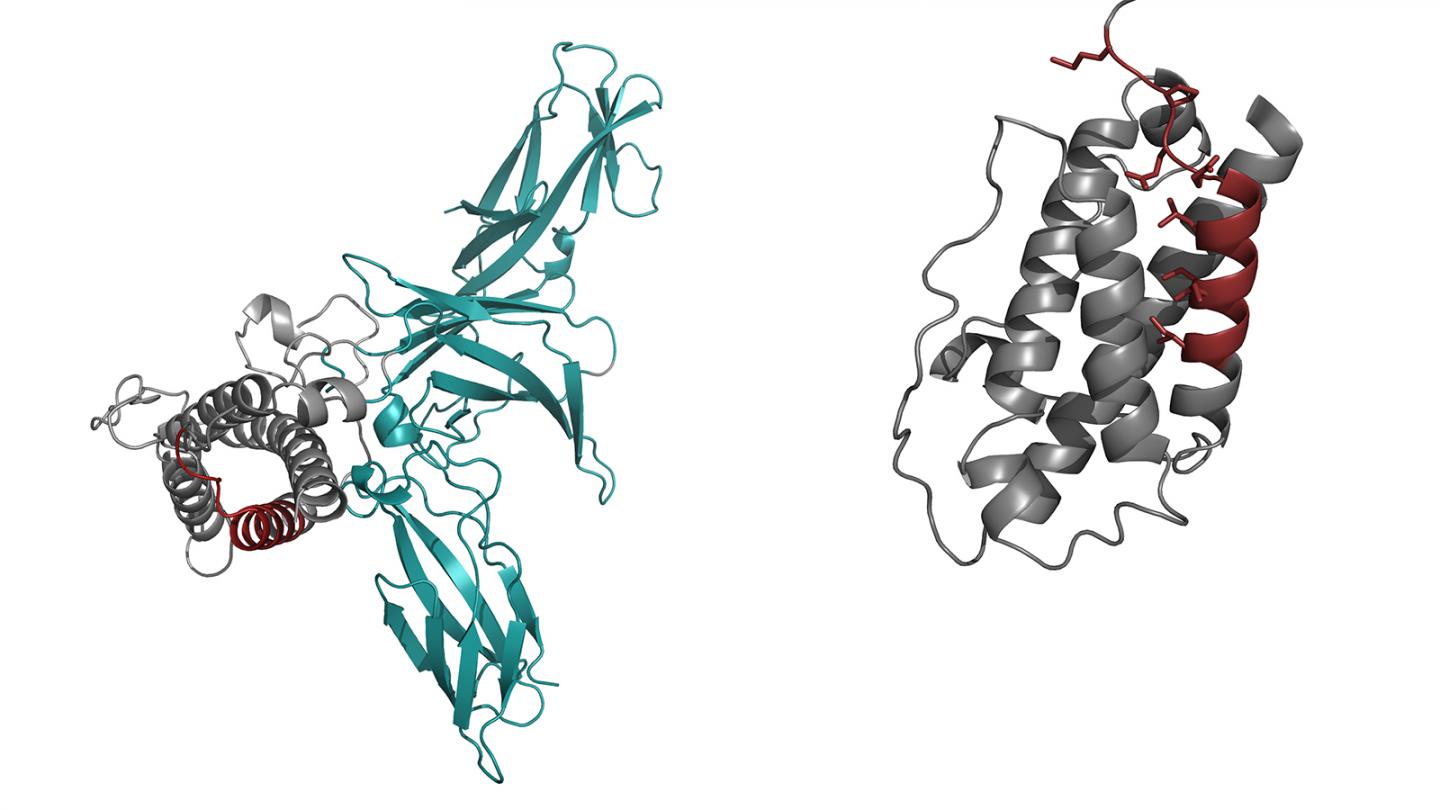
Credit: Sina Bohnacker / Technical University of Munich
Based on: Protein Data Base ID 3DUH.
The cells of our immune system constantly communicate with one another by exchanging complex protein molecules. A team led by researchers from the Technical University of Munich (TUM) has now revealed how dedicated cellular control proteins, referred to as chaperones, detect immature immune signaling proteins and prevent them from leaving the cell.
The body’s defenses systems have to react quickly whenever pathogens enter the organism. Intruders are identified by white blood cells which pass on the information to other immune cells. Information is transmitted via secreted signaling proteins, the interleukins, which dock onto the matching receptors on the recipient cells and for example make the target cells divide and release antibodies.
Quality control holds back immature signaling molecules
Researchers from TUM, the Helmholtz Zentrum München and Stanford University have, by studying interleukin 23, been able to show how cells ensure that the interleukin signalling proteins are built correctly. “Intensive research is currently devoted to Interleukin 23, not only because of its central role in the defense against pathogens, but also because it can trigger autoimmune diseases,” says Matthias Feige, Professor for Cellular Protein Biochemistry at TUM and head of the research project.
Interleukin 23 is composed of two proteins, which have to combine in the cell to form an active complex in order to be able to trigger the desired signals. As the scientists have demonstrated in their study, molecules referred to as chaperones retain one part of the interleukin known as IL23-alpha in the cell until it has been incorporated into the complete complex. This way the cell makes sure that it does not secrete any unpaired IL23-alpha and thus controls the biosynthesis of this important interleukin and accordingly of the messages it sends. Chaperones are molecular protein machines that ensure that other proteins are built correctly.
“We were able to show that unbound IL23-alpha has chemical bonds which are prone to interaction with chaperones,” Feige explains. In the completed interleukin 23 these bonds are closed, so that the chaperon no longer is able to interact and hence the complete molecule can leave the cell.
Targeted interventions in immune cell communication
Since normally isolated IL23-alpha is not present outside of the cell, it was not clear whether it could influence the immune system by itself. The researchers were able to test this with a slightly modified version of the molecule created in the laboratory, which was based on computer-aided design. In this new molecule variant, the bonds which could have connected to the chaperone were closed.
“The modified molecules can leave the cell freely,” says Susanne Meier, first author of the study. “They then dock to the same receptors as the complete interleukin 23 and trigger a similar but weaker reaction.” Accordingly, IL23-alpha can be made a functional signalling protein by molecular engineering, which allows it to bypass the cell’s quality control systems.
“It is possible that the engineered IL23-alpha can interact with even further receptors in immune cells and influence them in an as yet unknown manner,” Feige says. “That is one of the next questions we will investigate.” The results may serve as the basis for future drugs that use engineered interleukins to modulated the immune system in a desired manner.
###
Contact:
Prof. Dr. Matthias Feige
Technical University of Munich
Cellular Protein Biochemistry
Tel.:+49 89 289 13667
E-Mail: [email protected]
Web links:
Profile of Professor Matthias Feige
https:/
Cellular Protein Biochemistry
https:/
Institute of Advanced Study at TUM
https:/
Center of Allergy & Environment (ZAUM)
https:/
Bavarian NMR Center
http://www.
Media Contact
Matthias Feige
[email protected]
Original Source
https:/
Related Journal Article
http://dx.