A five-month-old male puppy treated at a veterinary teaching hospital in Bishoftu, Ethiopia, recovered fully from suspected canine parvovirus hemorrhagic gastroenteritis after four days of intensive supportive therapy, according to a case report published in the journal Companion Animal Health and Genetics. The report, authored by Dessalew Habte, Kifle Wondimagegnehu and Degu Fhetanegest, describes the clinical course of the disease in a young, unvaccinated dog and the combination of fluid therapy, antibiotics and antiemetic treatment that was associated with its recovery. Because no rapid or specific diagnostic kits for the virus were available at the facility, the diagnosis remained tentative, based on the animal’s history, age and clinical signs rather than laboratory confirmation of the virus itself.
The puppy, a locally bred male from kebele 14 in Bishoftu, was brought to the Veterinary Teaching Hospital of Addis Ababa University’s College of Veterinary Medicine and Agriculture on December 20, 2024. Its owner reported that the animal, normally alert and playful, had become suddenly lethargic and withdrawn three days before admission. Loss of appetite followed, and within the 24 hours before presentation the puppy began vomiting and developing diarrhea. On arrival, the animal’s body temperature was recorded at 38.7 degrees Celsius, with a pulse rate of 92 beats per minute and a respiratory rate of 28 breaths per minute. The puppy had no history of previous deworming and had never received any vaccination, including the rabies vaccine or the polyvalent vaccine covering distemper, hepatitis, leptospirosis, parainfluenza and parvovirus.
Over the following hours the clinical picture became more severe. The puppy developed dullness, anorexia and cachexia, along with rapid dehydration that manifested as prolonged skin tenting and sunken eyes. It retched and vomited repeatedly, and it passed bloody, projectile, foul-smelling diarrhea that ranged from mucoid to purely hemorrhagic. These signs were documented photographically in the case report. The authors note that this constellation of findings matches the classical gastrointestinal presentation of canine parvovirus infection, which typically includes lethargy, loss of appetite, abdominal pain, vomiting and severe, often bloody diarrhea that can rapidly lead to dehydration, electrolyte imbalance and, in advanced cases, septic shock.
To rule out other causes of the bloody diarrhea, the veterinary team collected a fecal sample directly from the rectum and subjected it to microbiological investigation using culture, sedimentation and flotation techniques. The results were negative for bacterial and parasitic infection, narrowing the differential diagnosis. The remaining possibilities considered by the clinicians were coronavirus infection, colibacillosis, parasitism and campylobacteriosis. Given the puppy’s young age, its complete lack of vaccination, the negative parasitological and bacteriological findings and the characteristic clinical signs, the team reached a tentative diagnosis of canine parvovirus hemorrhagic gastroenteritis. The authors emphasize that confirmatory laboratory tests such as enzyme-linked immunosorbent assay, polymerase chain reaction, virus isolation or hemagglutination were not performed in this case because the necessary rapid and specific kits were not available.
Canine parvovirus type 2, the etiologic agent described in the report, is a small, single-stranded, negative-sense, non-enveloped DNA virus of roughly 5.2 kilobases belonging to the family Parvoviridae. The virus is notably resistant to drying, heat, humidity and cold, allowing it to persist in the environment for extended periods. It is considered one of the most pathogenic viruses of dogs, causing highly contagious acute enteritis and, in some cases, myocarditis. Severe disease typically occurs in dogs younger than six months of age, although adults with insufficient immunity may also be affected. The virus spreads primarily through direct dog-to-dog contact and through contact with contaminated feces, environments or people, via the fecal-oral route and possibly the fecal-nasal route. After ingestion, it replicates in the oropharynx, thymus and mesenteric lymph nodes within about two days, then enters the bloodstream, producing marked viremia within one to five days of exposure before reaching the intestinal crypts. Viral shedding begins on the third day after infection and continues for seven to ten days.
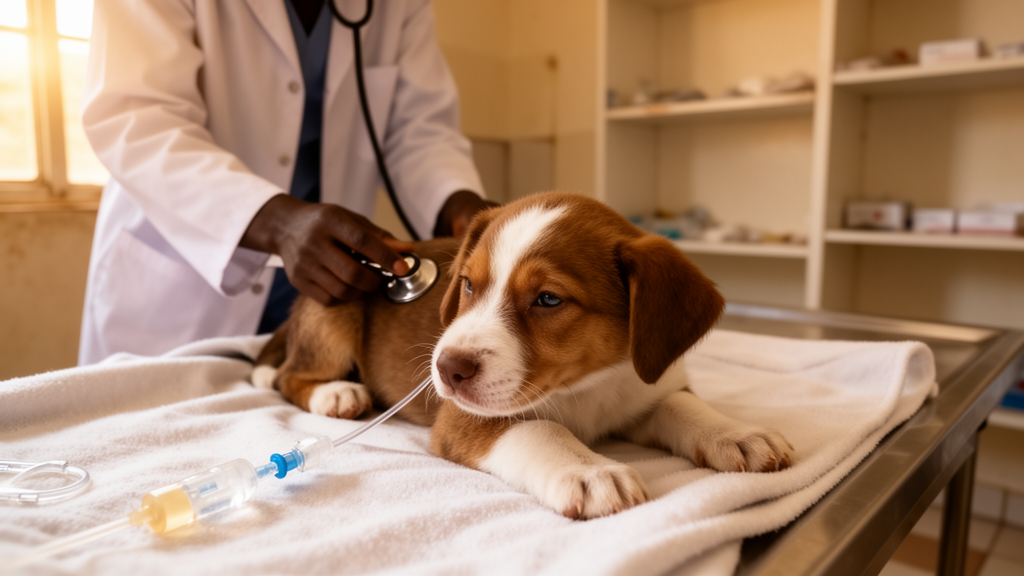
Because no specific antiviral agent is approved for treating canine parvovirus 2 infections, management consists of supportive care aimed at sustaining the animal until its immune system can clear the virus, while preventing secondary complications. In this case, the puppy was treated symptomatically and aggressively. It received gentamicin sulfate injection at a dose of 4 milligrams per kilogram of body weight every 12 hours for four successive days, intended to prevent secondary bacterial infections. Intravenous infusion of lactated Ringer’s solution was used to restore the fluid and electrolyte losses caused by severe vomiting and diarrhea. For the vomiting, the antiemetic metoclopramide was administered intramuscularly at 0.5 milligrams per kilogram of body weight three times daily at eight-hour intervals on the first day; the drug blocks the chemoreceptor trigger zone and produces a prokinetic effect in the upper intestinal tract. Vitamin B complex therapy was also given as part of the supportive regimen.
The response to treatment was rapid. At the follow-up visit on the second day, both vomiting and diarrhea had decreased in frequency and consistency. By the third day, the puppy had recovered from most of the signs of the disease, and its physiological parameters had returned to normal, which the authors interpreted as indicating improvement and recovery from the infection. Photographs taken three days, two months and three months after treatment document the animal’s sustained recovery. The owner was advised to provide clean food and fresh water, maintain hygienic conditions, and have the dog dewormed and vaccinated regularly, and to seek veterinary care early in any future illness.
The authors place this case in a broader context of parvovirus epidemiology. They report that more cases with similar clinical signs and a similar age profile had been arriving at the Veterinary Teaching Hospital of Addis Ababa University at the College of Veterinary Medicine and Agriculture, and they describe canine parvovirus hemorrhagic gastroenteritis as a very common problem causing high morbidity and mortality among puppies in the study area and other regions of Ethiopia. They also note that canine parvovirus was first recognized in 1978 as a new pathogen of dogs, and that the first genetic detection and characterization of canine parvovirus type 2 in southwestern Ethiopia was carried out by Tegegne and coauthors. Detailed confirmatory diagnosis of the disease, they write, is seldom employed in most developing countries, which is why the present case was diagnosed tentatively on the basis of history and clinical examination findings.
On the preventive side, the report reviews measures that can reduce the risk of infection. Canine parvovirus hemorrhagic gastroenteritis can be prevented and controlled through indoor and outdoor decontamination that renders the virus non-infectious; potassium peroxymonosulfate has moderately effective activity even in the presence of organic matter in feces and can be sprayed on contaminated areas. Active immunization is described as important for protecting both individual pets and susceptible dog populations. Modified live vaccines, currently used worldwide, afford prolonged immunity of seven years or longer and confer protection against both disease and infection. The initial puppy vaccination series normally starts at six to eight weeks of age and is repeated every two to four weeks until the puppy is 16 weeks of age or older. The authors also recommend reducing stress, regular deworming, and routine cleaning and disinfection of pet bedding as part of disease control.
The case report carries clear limitations that readers should keep in view. It describes a single animal, the diagnosis was never laboratory-confirmed, and the recovery cannot be attributed with certainty to any specific component of the treatment regimen, since no controlled comparison was made. The authors themselves acknowledge that further laboratory confirmation was not performed due to the lack of rapid and specific diagnostic kits, and that the case was treated based on history and clinical signs. Nonetheless, they conclude that timely and intensive intervention with appropriate pharmacological agents, complemented by supportive care, may result in complete recovery, and that treatment aimed at symptomatic supportive care, aggressive fluid therapy, antiemetics, antibiotic therapy and nutritional support can increase the survival rate of affected dogs. With proper treatment, they note citing the literature, survival rates can approach 90 percent, while untreated disease is often life-threatening due to severe fluid losses and electrolyte derangements secondary to anorexia, vomiting and diarrhea.
Subject of Research: A case report of suspected canine parvovirus hemorrhagic gastroenteritis in a five-month-old unvaccinated puppy in Ethiopia, diagnosed tentatively from clinical signs and treated with supportive care.
Article Title: Parvoviral hemorrhagic gastroenteritis and its therapeutic intervention in a case of 5-month-old puppy
Article References: Habte, D., Wondimagegnehu, K., & Fhetanegest, D. (2026). Parvoviral hemorrhagic gastroenteritis and its therapeutic intervention in a case of 5-month-old puppy. Companion Animal Health and Genetics, 13(1), Article 2. https://doi.org/10.1186/s40575-026-00151-8
Image Credits: AI Generated
DOI: 10.1186/s40575-026-00151-8
Keywords: canine parvovirus, hemorrhagic gastroenteritis, puppy, case report, Ethiopia, supportive care, fluid therapy, gentamicin, metoclopramide, vaccination, tentative diagnosis, veterinary medicine
News Source: Ophelia Keating. (October 29, 2026). Puppy in Ethiopia Recovers From Suspected Parvovirus After Supportive Care. Scienmag.