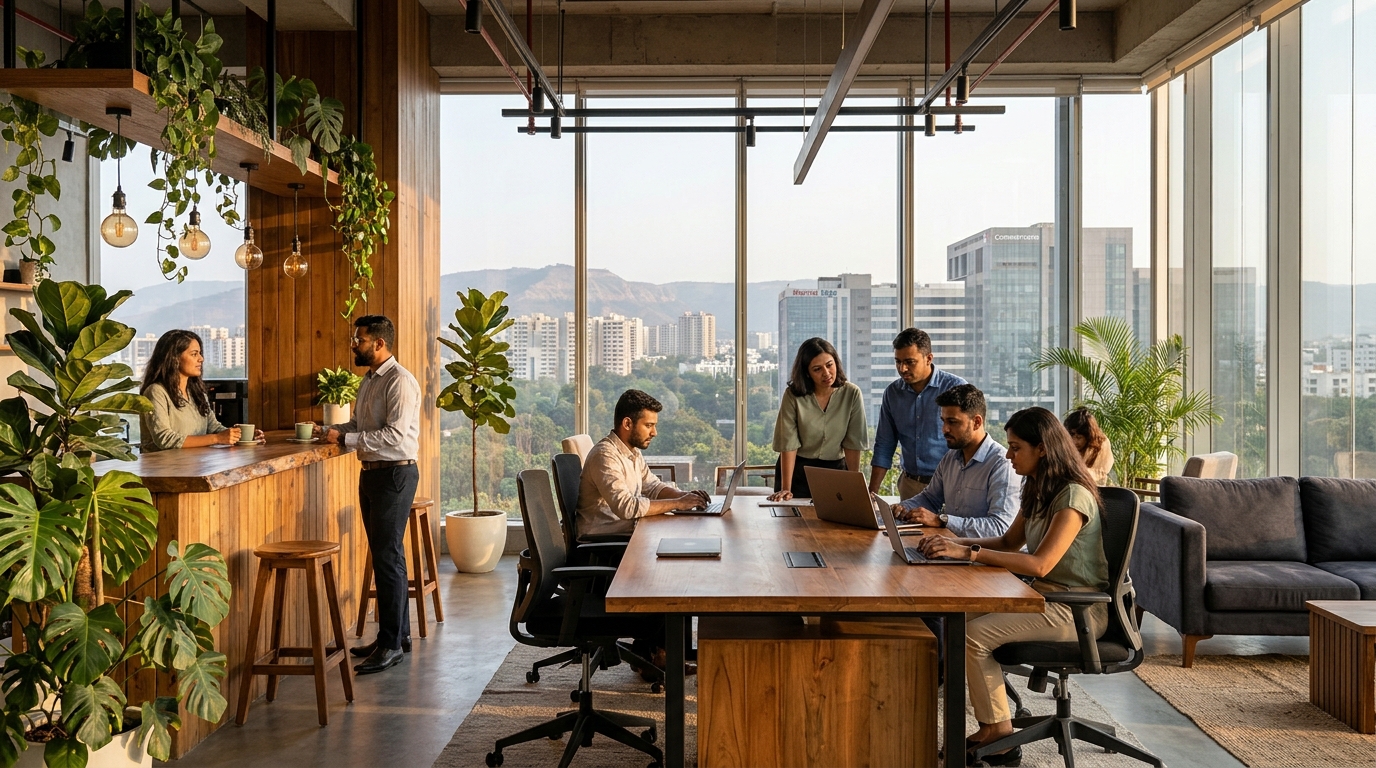
Coworking spaces in Pune have multiplied dramatically over the past decade, and a new study has mapped exactly where they cluster and why. Researchers Pragya Meena and Vibhore Bakshi analyzed the transformation of coworking geography before and after COVID-19 across 335 locations in the Indian city, using kernel density estimation to select two clusters for detailed investigation. Their findings, published in Frontiers of Urban and Rural Planning, reveal that lifestyle choice factors, hotel locations, and urban built growth rate have significant impacts on where these shared workspaces take root.
The study presents an empirical investigation of socioeconomic determinants and lifestyle factors in conjunction with coworking spaces, along with the behavioral choice factors identified in the literature and primary surveys. Using Geographically Weighted Regression (GWR) and Ordinary Least Squares (OLS) models for two knowledge clusters in Kalyani Nagar and Baner, the researchers drew on variables from Census data, OpenStreetMap, Open Government data, and PCMC data. The analysis focused on infrastructure, socio-geography, lifestyle, tourism, economic activities, land use, and land values as predictors of coworking space location.
Pune’s transformation into a coworking hub did not happen overnight. The city, historically known as Poona until its official renaming in 1978, saw significant transformations between the 1990s and 2005 during India’s Economic Liberalisation era. Between 2005 and 2019, coworking spaces accelerated, driven in large part by the global rise of platforms like WeWork. The years 2021 to 2024 revealed a notable shift in workspace dynamics as organizations adapted to new work models in the aftermath of the pandemic. Research highlights how COVID-19 expedited suburbanization trends in coworking location choices, reshaping traditional urban clustering patterns.
The research methodology involved collecting data on coworking spaces from Google Maps, which initially identified 355 locations. After eliminating invalid entries, datasets for 271 locations were retrieved from Google metadata. This approach enabled the development of a space-time map of Pune reflecting three distinct periods: Pre-COVID (2015–2019), During COVID (2019–2022), and Post-COVID (2022–2024). Three maps depicting changes over nine years show a significant rise in the number of coworking spaces post-COVID, nearly doubling the number available from 2015 to 2019, with concentrations evident in Baner and Kalyani Nagar.
The quantitative analysis proceeded in three stages. First, kernel density estimation identified two prominent coworking clusters—Kalyani Nagar and Baner—out of 335 initially recorded locations, with rigorous data cleaning reducing the dataset to 271 validated points. Second, multicollinearity tests refined variables to ensure robustness of regressions. Third, the dual application of OLS and GWR allowed understanding of both global and local spatial effects. The OLS model, constructed using geographical datasets in ArcMap 10.7.1 and supplemented with R Studio for diagnostics, assessed global relationships between coworking space density and selected variables, with multicollinearity controlled through Variance Inflation Factor thresholds.
The OLS regression model exhibited a strong fit, with an Adjusted R² value of 0.888 and a Multiple R² of 0.900, indicating that the explanatory variables explained approximately 89 percent of the variance in coworking space concentration. The Joint F-statistic (F = 76.74, p < 0.001) and Joint Wald statistic (χ² = 2875.69, p < 0.001) confirmed the statistical significance of the model. The Koenker (Breusch–Pagan) statistic indicated the presence of heteroskedasticity, requiring the application of robust standard errors for coefficient interpretation. The Jarque–Bera statistic demonstrated that residuals were not normally distributed, which may suggest model specification errors or the presence of spatial effects.
The GWR model, which allows regression coefficients to vary across space, achieved an accuracy of up to 93 percent in locations characterized by significant clustering of coworking spaces. Drawing on 102 neighboring observations, the model reported residual squares of 8.96, an effective number of parameters of 27.77, and a sigma value of 0.277. The high R² value of 0.937 and adjusted R² of 0.923 suggest the model captures most of the underlying patterns in the data reliably. Spatial autocorrelation of residuals was examined via Moran’s I statistic, indicating no significant clustering or dispersion and confirming that model errors are spatially random.
Among the significant predictors, urban growth rate emerged as the most influential factor, with coefficients ranging from −0.29 to 2.02. Wards such as Baner and Kalyani Nagar, including Koregaon Park, with higher density clusters exhibit a notably high coefficient of 0.516, showing that new business districts are attractive hotspots for coworking spaces. Unlike cities such as Milan and Seoul, coworking spaces in Pune are largely developed in new buildings rather than repurposing existing or underutilized structures. Large organizations like Awfis and WeWork choose new properties in these areas, and the 2022 JLL Research Report indicates that about 90 percent of flexible workspace by area is managed by large operators running facilities with over 5,000 seats.
Hotel locations also proved significant, with a maximum coefficient value of 0.79 in the growth corridors of the North East and North Western regions of Pune. The intersection of travel, leisure, and work has become increasingly relevant in light of hybrid work models, and Pune’s connectivity with Mumbai and Bangalore is instrumental in the growth of the hospitality sector and the proliferation of coworking spaces. Lifestyle factors, including restaurants, bars, and cafés, showed coefficient values ranging from 0.24 to 0.44, more pronounced in the northern region within the Kalyani Nagar and Koregaon Park clusters. Since the pandemic, there has been heightened demand for social interaction, leading to increased need for accessibility to these social nodes.
Metro station access showed coefficients ranging from 0.15 to 0.21 in the eastern region, corresponding to the operational Blue Line, while the metro line extending toward the west remains under construction and does not exhibit a statistically significant impact. Commercial land values reflected demand and supply dynamics, with coworking spaces strategically positioned in areas with high land values that signify enhanced desirability and superior built environments. However, this spatial preference perpetuates existing urban hierarchies, leaving lower-income or peripheral areas underserved. The growth of coworking spaces both reflects and fuels larger trends of urban inequality, resulting in more segregated access to networking opportunities, amenities, and necessary infrastructure.
Subject of Research: Spatial determinants of coworking space clustering in Pune, India
Article Title: Evolving geography of coworking spaces in Pune: drivers of growth in knowledge clusters
Article References: Meena, P., & Bakshi, V. (2026). Evolving geography of coworking spaces in Pune: drivers of growth in knowledge clusters. Frontiers of Urban and Rural Planning, 4(1), Article 6. https://doi.org/10.1007/s44243-026-00075-8
Image Credits: AI Generated
DOI: 10.1007/s44243-026-00075-8
Keywords: coworking spaces, Pune, urban geography, Geographically Weighted Regression, kernel density estimation, knowledge clusters, COVID-19, transit-oriented development, urban inequality, spatial analysis, India, hybrid work
News Source: Denise Maddox. (November 5, 2026). Pune’s coworking boom follows urban growth, hotels and lifestyle hotspots. Scienmag.