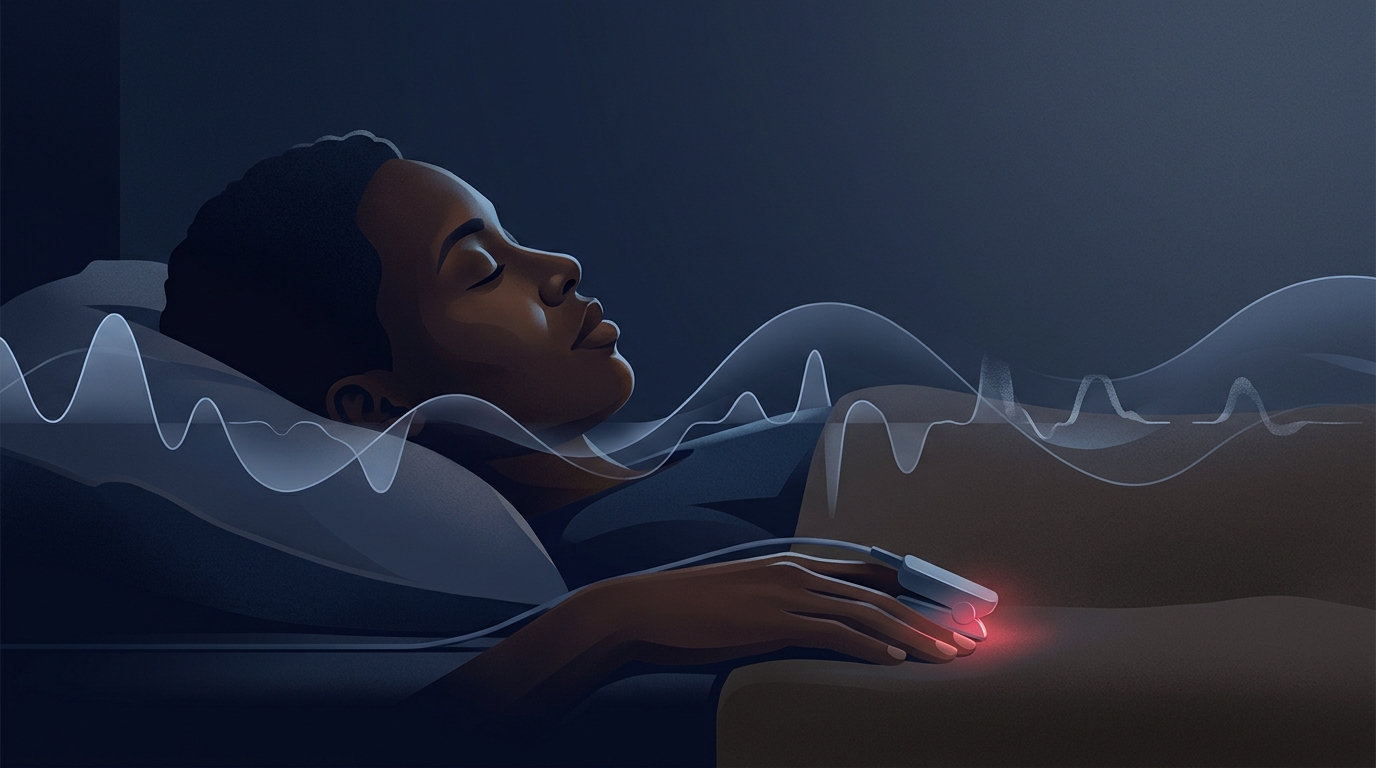
Sleep studies often use drops in blood oxygen, measured by pulse oximetry, to determine which breathing disturbances count toward sleep apnea severity. But new research from investigators at Mass General Brigham suggests that this approach may systematically undercount breathing events in Black patients, potentially leading to inaccurate severity classifications. The study, published in the American Journal of Respiratory and Critical Care Medicine, found that the proportion of airflow-defined breathing events meeting a standard oxygen-desaturation criterion was roughly 20 percent lower in Black than in white participants across two large, independent cohorts.
“Our findings raise concern that pulse oximetry–based sleep apnea scoring may under detect clinically relevant events in some Black individuals, with potential implications for diagnosis and severity classification,” said first author Ali Azarbarzin, PhD, of the Division of Sleep and Circadian Disorders in the Department of Medicine at Mass General Brigham.
The concern is rooted in how pulse oximeters work. These devices emit light through a part of the body and measure how much of that light is absorbed. Research has shown that the readings may be biased based on an individual’s skin pigmentation, because melanin and other pigments in darker skin can absorb some of the emitted light, potentially affecting the accuracy of the measurement. Such racial biases have recently been documented in other clinical settings, including in patients presenting with Covid-19 infection, but until now it was unknown to what extent the bias might affect how obstructive sleep apnea is diagnosed or scored.
To close that gap, the team analyzed data from two independent cohorts: the Multi-Ethnic Study of Atherosclerosis, known as MESA, and the Sleep Heart Health Study, known as SHHS. Rather than relying on a single measurement, the researchers compared severity scores built on blood oxygen desaturation monitored by pulse oximetry against two metrics that do not depend on oxygen saturation at all: airflow and heart rate response. This design allowed them to ask whether any racial difference they observed reflected the oxygen-based scoring process itself or something else entirely.
The results were strikingly consistent. The proportion of airflow-defined events meeting the 4 percent oxygen-desaturation criterion was 21 percent lower in Black than in white participants in MESA and 20 percent lower in SHHS. In other words, when the same breathing disturbances were scored using the conventional oxygen-based rule, a substantial fraction of them simply failed to register in Black participants. Because the two cohorts were analyzed independently, the replication of the finding across both datasets strengthens the conclusion that this is not a statistical fluke confined to a single study population.
Crucially, heart-rate-based scoring showed no comparable racial difference. That detail matters, because it suggests the disparity may relate to the oxygen-based scoring process rather than to fewer breathing disturbances themselves. If Black participants had genuinely experienced fewer or milder apnea events, a scoring method that tracks heart rate responses to those events would be expected to show a similar gap. It did not. The heart-rate-based severity measure was also associated with cardiovascular events or death in Black participants in both cohorts, whereas oxygen-based severity measures were not significantly associated with these outcomes, a pattern that hints the events missed by oximetry may be clinically meaningful.
The implications reach beyond the sleep laboratory. Obstructive sleep apnea severity scores guide decisions about diagnosis, referral and treatment. If the standard scoring method undercounts events in some patients, those patients may appear less severe on paper than their physiology suggests. The finding that a non-oxygen-based measure tracked hard outcomes in Black participants while the oxygen-based measure did not adds weight to the concern that the measurement problem, not the underlying disease pattern, is driving the discrepancy.
The researchers are careful about what they are and are not proposing. “We are not suggesting different diagnostic thresholds based on race; rather, we think the underlying measurements need to be accurate and reliable across all patients,” Azarbarzin said. That distinction is important: the goal is not to recalibrate disease definitions by demographic group, but to ensure that the instruments and scoring rules used to detect apnea events perform equitably for everyone who undergoes a sleep study.
The work also fits into a broader scientific reckoning with pulse oximetry. Because the devices infer oxygen saturation from light absorption, any factor that alters absorption patterns, including skin pigmentation, can in principle shift the reading. The Covid-19 pandemic brought renewed attention to this issue when racial biases were documented in patients presenting with Covid-19 infection. The new study extends that concern into sleep medicine, where oximetry is not merely a monitoring tool but a gatekeeper that determines which breathing disturbances count toward a diagnosis.
In addition to Azarbarzin, the Mass General Brigham author team included Scott A. Sands, Ludovico Messineo, Neda Esmaeili, Daniel Vena, David P. White, Susan Redline and Andrew Wellman. The study was funded in part by the National Institutes of Health and the American Academy of Sleep Medicine. For now, the message for clinicians and researchers is that the numbers produced by a routine sleep study may not mean the same thing for every patient, and that making those measurements accurate and reliable across all patients is a prerequisite for fair diagnosis and severity classification in obstructive sleep apnea.
Subject of Research: Racial differences in pulse oximetry-based scoring of sleep apnea breathing events
Article Title: Study suggests pulse oximetry-based scoring may miss sleep apnea events in Black patients
Article References: Study suggests pulse oximetry-based scoring may miss sleep apnea events in Black patients. Original publication (Bibliographic details unavailable.)
Image Credits: AI Generated
DOI: Not provided
Keywords: sleep apnea, pulse oximetry, health disparities, sleep studies, oxygen desaturation, obstructive sleep apnea, MESA, Sleep Heart Health Study, cardiovascular risk, medical devices, diagnosis, Mass General Brigham
News Source: Ophelia Keating. (November 4, 2026). Pulse oximeters may undercount sleep apnea severity in Black patients. Scienmag.