Heating iron-based Prussian blue analogue cathode materials beyond two hundred degrees Celsius triggers a severe framework distortion and structural collapse around two hundred and forty degrees Celsius that is accompanied by oxidation into iron oxide, according to comprehensive in-situ investigations. Prussian blue analogues, or hexacyanoferrates with the chemical formula NaxFe[Fe(CN)6], represent highly promising cathode materials for sustainable and cost-effective sodium-ion battery applications owing to their abundant elemental precursors and their open three-dimensional interstitial diffusion channels. However, because standard commercial and laboratory preparation routes rely on aqueous precipitation, the materials inherently absorb significant quantities of water that occupy crystal vacancies and interstitial voids. While this residual moisture stabilizes the open coordination framework under ambient storage, retaining water in non-aqueous sodium-ion battery cells produces detrimental electrochemical reactions, irreversible gas generation, and device swelling during sodium extraction cycles. Consequently, thermal drying is an unavoidable processing requirement before these cathodes can be integrated into operational batteries, but removing the tightly bound crystal water alters internal bonding networks and prompts irreversible material breakdown.
To decipher the precise structural transitions and electronic consequences of this dehydration process, researchers conducted simultaneous temperature-dependent powder X-ray diffraction and iron-57 Mössbauer spectroscopy across two distinct compositions up to three hundred degrees Celsius. The study evaluated both a sodium-poor cubic phase formulated near Na0.6 and a sodium-rich monoclinic phase formulated near Na1.8 to observe how initial stoichiometry impacts dehydration behavior. Synthesized via controlled hydrothermal co-precipitation and citrate-assisted chelation routes, both powdered batches were initially dried under vacuum at eighty degrees Celsius for twenty-four hours to eliminate surface moisture while preserving structural crystal water. The crystallographic tracking utilized transmission-geometry Debye-Scherrer powder diffraction with copper K-alpha radiation inside an environmental oven chamber heated at ten degrees per minute with two-hour isothermal dwells. Complementing the long-range structural diffraction patterns, in-situ Mössbauer spectroscopy probed the local electronic charge density and electric field gradients of the active iron nuclei using a cobalt-57 source and a custom resistive-heating sample stage sealed with high-temperature Kapton tape.
Prussian blue analogues exhibit a double perovskite framework where iron centers reside within two distinct octahedral environments: low-spin iron coordinated directly to carbon atoms and high-spin iron coordinated to nitrogen atoms. In a fully sodiated state where x equals two, the compound presents a high theoretical electrochemical capacity of one hundred and seventy milliampere-hours per gram alongside an average cell voltage output of approximately 3.2 volts. However, achieving this performance in practical electrodes requires full removal of crystal water because the low-spin iron redox couple activates only after dehydration. Across the framework, water is distributed among surface layers, uncoordinated interstitial channels, and iron hexacyanoferrate vacancy sites where water molecules coordinate directly to open metal sites. While surface water desorbs below one hundred degrees Celsius and interstitial moisture departs between one hundred and seventy and two hundred degrees Celsius without destroying reversible absorption capacity, coordinated water remains chemically bonded until temperatures exceed two hundred degrees Celsius, where its eventual departure damages the surrounding coordination architecture.
For the sodium-poor Na0.6 specimen, ambient powder X-ray diffraction identified a face-centered cubic structure with a lattice constant of 10.2777 angstroms, accompanied by roughly twenty-four mole percent of residual sodium chloride impurity from the synthesis. As temperature climbed to two hundred degrees Celsius, this cubic framework demonstrated standard positive thermal expansion with intact lattice symmetry. At two hundred degrees Celsius, diffraction reflections shifted toward lower diffraction angles alongside notable peak broadening, revealing unit cell expansion coupled with localized structural disorder. When the temperature reached two hundred and twenty degrees Celsius, the diffraction pattern abruptly reversed this trend, shifting reflections toward higher angles beyond room-temperature values. This sharp contraction coincided with the direct appearance of reflections associated with the dehydrated rhombohedral phase, distinguished by its characteristic reflection near eighteen degrees two-theta. The dehydrated rhombohedral structure continued to expand at the expense of the cubic phase up to three hundred degrees Celsius, establishing that the narrow window between two hundred and two hundred and twenty degrees Celsius marks the removal of coordinated water and the onset of framework collapse.
The sodium-rich Na1.8 material displayed a far more intricate sequence of structural transformations across the heating profile due to its higher initial sodium content and lower crystallographic symmetry. At room temperature, diffraction refinements revealed an eighty-five to fifteen mole percent mixture of monoclinic and hydrated rhombohedral phases, respectively. The monoclinic phase, characterized by lattice constants of a equaling 10.384 angstroms, b equaling 7.310 angstroms, c equaling 7.293 angstroms, and a beta angle of 91.41 degrees, features pronounced peak splitting caused by in-phase octahedral tilting. Heating the sample to fifty degrees Celsius accelerated the transition into the hydrated rhombohedral phase, where out-of-phase octahedral tilting establishes a more symmetric local environment. By one hundred degrees Celsius, the splitting collapsed into single reflections denoting a transition to the cubic phase, which progressively intensified to reach maximum reflection intensity at one hundred and fifty degrees Celsius. Beyond this point, diffraction intensity steadily declined, and reflections shifted toward higher angles at two hundred degrees Celsius as crystal water escaped, forming a contracted dehydrated cubic intermediate.
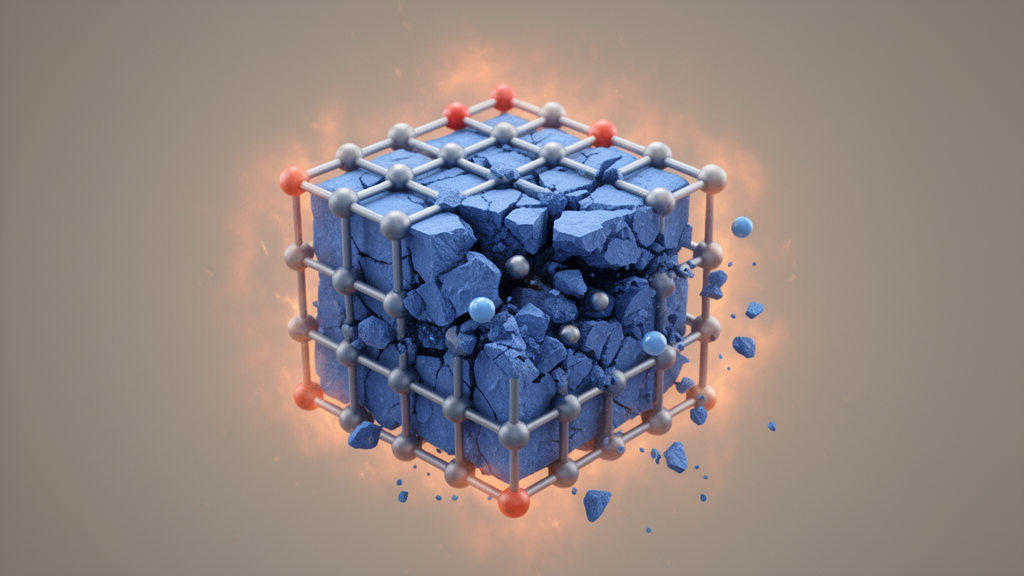
At two hundred and forty degrees Celsius, the dehydrated cubic intermediate in the Na1.8 sample gave way to the dehydrated rhombohedral phase, matching the critical breakdown temperature observed in the sodium-poor material. This high-temperature rhombohedral structure shares the R-3 space group with the low-temperature hydrated rhombohedral phase but possesses substantially smaller unit cell parameters reflecting severe framework contraction. The transition is driven by sodium cation migration along the crystallographic c-axis toward the electronegative nitrogen positions of the FeN6 octahedra as coordinated water departs. This ionic displacement elongates iron-nitrogen chemical bonds and forces rigid octahedral cages to tilt drastically, with tilt angles increasing by 22.60 degrees for FeN6 octahedra and 17.44 degrees for FeC6 octahedra relative to the hydrated framework. Coupled with an overall unit cell volume contraction of approximately twenty percent, these severe angular distortions destabilize the three-dimensional cyanide network, generating extensive internal mechanical strain, particle cracking, and partial thermal decomposition evidenced by concurrent evolutions of hydroxyl species, water, hydrogen cyanide, and carbon dioxide gases.
Complementary iron-57 Mössbauer spectroscopy provided essential atomic-scale evidence regarding the local valence dynamics of the two distinct metal sites during these structural transformations. In the cubic Na0.6 material at ambient conditions, the absorption spectrum resolved into two non-overlapping doublets of roughly equal area: a low-spin divalent iron-carbon component with an isomer shift of minus 0.131 millimeters per second and a quadrupole splitting of 0.112 millimeters per second, and a high-spin trivalent iron-nitrogen component with an isomer shift of 0.415 millimeters per second and a quadrupole splitting of 0.217 millimeters per second. The balanced fifty-percent spectral areas confirmed a low concentration of hexacyanoferrate vacancies in the lattice. Throughout continuous heating up to two hundred degrees Celsius, the hyperfine parameters for both iron sites remained remarkably stable, displaying only the anticipated minor downward drift in isomer shift caused by the second-order Doppler effect. This electronic stability proved that the cubic local coordination remained resilient against thermal motion until crystal water dehydration began increasing quadrupole splitting values at two hundred degrees Celsius.
In sharp contrast to the cubic sample, Mössbauer spectroscopy of the monoclinic Na1.8 material revealed pronounced electronic reconfigurations at very mild temperatures, reflecting high sensitivity to coordinated tilting. At room temperature, the spectrum exhibited a low-spin divalent iron doublet covering forty-five percent of total area and a broad high-spin divalent iron-nitrogen doublet covering fifty-five percent of total area, possessing an isomer shift of 1.096 millimeters per second and a wide quadrupole splitting of 0.887 millimeters per second. Heating to fifty degrees Celsius induced a steep drop in this high-spin quadrupole splitting down to 0.590 millimeters per second while maintaining the isomer shift near 1.1 millimeters per second, tracking the transformation into the more symmetric hydrated rhombohedral phase. Further heating to one hundred degrees Celsius caused the quadrupole splitting to decline steeply to 0.264 millimeters per second, confirming the evolution into the cubic structure. The local octahedral coordination thus progressed from severe distortion at room temperature to intermediate symmetry at fifty degrees, achieving high structural regularity in the cubic phase between one hundred and one hundred and eighty degrees Celsius.
Once temperatures exceeded two hundred degrees Celsius, both Prussian blue compositions underwent irreversible chemical degradation during the extended duration of the Mössbauer acquisitions. At two hundred and twenty degrees Celsius, a distinct third doublet emerged in the Mössbauer spectra characterized by an isomer shift of approximately 0.15 millimeters per second and a quadrupole splitting of 0.70 millimeters per second. This signature, corresponding to high-spin trivalent iron, expanded rapidly with increasing temperature and completely dominated the spectral profile by three hundred degrees Celsius with parameters of 0.15 and 0.82 millimeters per second. Upon cooling back to room temperature, this component exhibited an isomer shift of 0.32 millimeters per second, perfectly matching the known hyperfine parameters of iron oxide, Fe2O3. While the shorter two-hour diffraction measurements inside sealed capillary tubes avoided visible oxide formation, the day-long Mössbauer measurements allowed structural collapse to culminate in complete oxidative decomposition of the cyanide framework into iron oxide.
These combined experimental observations demonstrate that while thermal treatment successfully removes surface and interstitial moisture below two hundred degrees Celsius, eliminating coordinated crystal water inevitably triggers lattice collapse and catastrophic chemical oxidation. Despite beginning from opposite ends of the structural and compositional spectrum—a sodium-poor cubic lattice and a sodium-rich monoclinic lattice—both Prussian blue variants converge upon the same dehydrated rhombohedral structure around two hundred and forty degrees Celsius. The resulting twenty-percent volume contraction and severe octahedral bond tilting introduce immense mechanical strain that breaks the cyanide framework apart, precluding stable cycling if drying protocols exceed safe thermal limits. For battery engineers seeking to commercialize Prussian blue cathodes, these findings establish an upper thermal processing ceiling below two hundred degrees Celsius, confirming that cathode synthesis must optimize vacancy reduction and low-temperature interstitial drying rather than attempting aggressive high-temperature thermal dehydration to achieve water-free sodium-ion battery cells.
Subject of Research: High-temperature dehydration and phase evolution of iron-based Prussian blue analogues for sodium-ion batteries
Article Title: High temperature behavior of NaxFe[Fe(CN)6] Prussian blue analogues probed by in-situ Mössbauer spectroscopy
Article References: Novak, E., Inaba, S., & Smith, H. (2026). High temperature behavior of NaxFe[Fe(CN)6] Prussian blue analogues probed by in-situ Mössbauer spectroscopy. Journal of Materials Science: Materials in Energy, 2(1), Article 19. https://doi.org/10.1007/s44308-026-00032-3
Image Credits: AI Generated
DOI: 10.1007/s44308-026-00032-3
Keywords: Prussian blue analogues, Sodium-ion batteries, Mössbauer spectroscopy, X-ray diffraction, Cathode materials, Thermal dehydration, Crystal water removal, Structural collapse, Phase transitions, Iron oxidation, Rhombohedral phase, Monoclinic phase, Cubic phase, Octahedral tilting, Hyperfine parameters, Isomer shift, Quadrupole splitting
News Source: Faith Mcneil. (November 18, 2026). Prussian Blue Battery Cathodes Suffer Structural Collapse and Oxidation Near 240 Degrees. Scienmag.