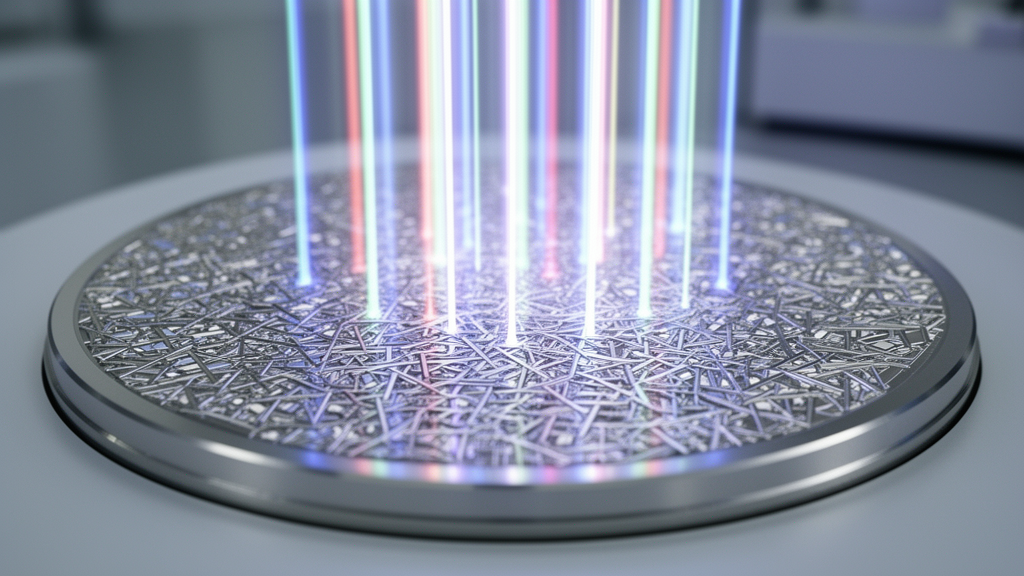
Researchers at TU Wien have demonstrated surface-emitting terahertz quantum cascade random lasers fabricated in unconventional cavity geometries, establishing that the spatial arrangement and density of scattering centers govern emission rather than resonator boundary shapes. By etching lithographic holes completely through the semiconductor active region, the team achieved coherent, multimodal surface emission across diverse outlines, including silhouettes modeled after Bender, Mickey Mouse, an ice skate, Darth Vader, and turtles. Conventional terahertz quantum cascade lasers depend on Fabry-Pérot cavities or periodic structures that enforce lateral emission and narrowband performance. The findings confirm that distributed optical feedback from disordered scattering centers decouples laser behavior from cavity geometry, providing a flexible framework for generating broadband terahertz radiation without conventional resonator symmetries.
Quantum cascade lasers serve as electrically driven coherent sources capable of delivering high output powers across terahertz frequencies. However, standard terahertz quantum cascade lasers inherently emit light horizontally through cleaved or etched side facets, producing divergent beams distorted by interference effects. While past efforts incorporated periodic second-order distributed feedback gratings, non-periodic structures, micro-mirrors, or patch arrays to redirect radiation vertically, such approaches are typically limited to single-mode emission, restricting their utility in broadband systems.
Quantum cascade random lasers overcome conventional resonator limitations by distributing optical feedback across the device surface rather than confining light between fixed mirrors. Optical gain is supplied by the electrically pumped active medium, while coherent feedback originates from multiple in-plane scattering off etched holes penetrating the top contact and active layers. These scattering centers locally perturb the effective refractive index and optical losses, directing light along complex randomized trajectories. Lasing occurs when optical gain compensates for combined internal, radiative, and scattering losses. Because distributed scattering encompasses paths of varying effective lengths, constructive interference selects localized modes without requiring a predetermined cavity dimension, enabling broadband multimode emission across the gain profile while outcoupling radiation out of plane for surface emission.
The experimental devices were fabricated from a heterostructure grown via molecular beam epitaxy on a gallium arsenide substrate. The laser core features a resonant-phonon three-well active region composed of alternating gallium arsenide and aluminum gallium arsenide layers, with 24 percent aluminum content in the barriers. This structure comprises 177 periods to achieve a total active region thickness of 8.02 micrometers, configured to provide gain across 2.3 to 2.8 terahertz. To ensure effective optical waveguiding and electrical injection, the samples were processed using a double metal waveguide architecture, cleaved into ten-millimeter square chips, and mounted onto copper mounts. These mounts provide electrical connectivity and mechanical support, enabling PCB attachment where two gold bonding wires were connected to withstand operating currents exceeding two amperes.
Fabricating the unconventional shapes required high-precision lithography and deep reactive ion etching through the active heterostructure. Masks were patterned using a Heidelberg MLA 150 laser writer, maintaining a minimum spacing of one micrometer between adjacent features to avoid lithographic errors. Sputtered gold served as a hard mask during reactive ion etching in an Oxford Plasmalab System 100 chamber. The lift-off step proved critical: using only AZ 5214E photoresist produced a layer too thin to prevent gold accumulation on sidewalls, leaving residual metal that blocked hole openings. To resolve this, an optimized process introduced two layers of LOR3a beneath the AZ 5214E resist, ensuring clean lift-off. This improvement was highlighted by two turtle devices: Turtle 1 from the initial run retained a covered head, whereas Turtle 2 achieved fully opened apertures.
The evaluated designs incorporated diverse geometric outlines to assess the influence of physical area, hole arrangements, and filling fractions on lasing performance. Device areas ranged from 0.066 square millimeters in Turtle 2 to 0.372 square millimeters in the ice skate, with hole counts varying from 10 to 146 per device. Circular holes with a ten-micrometer radius were utilized wherever possible to provide effective scattering. Non-circular apertures were implemented to preserve distinctive features: the turtle geometries used hexagonal holes for the shell, Bender incorporated square holes for the eyes and mouth, the ice skate combined circular holes with elongated blade slots, and Darth Vader featured clustered apertures across the mask and saber. Mickey Mouse utilized circular holes restricted solely to its ears. Device filling fractions ranged from 10 percent to 45 percent.
Optical and electrical characterization was performed inside a cryo-flow cryostat cooled to 5 Kelvin under pulsed electrical pumping. The lasers were driven using an Avtech AVR-3HF-B pulse generator operated at a 5-kilohertz repetition rate with a 0.5 percent duty cycle and one-microsecond pulse widths. Current was monitored using a Rohde and Schwarz MXO4 oscilloscope synchronized with the pulser, while voltage was recorded in a two-wire configuration. Emitted radiation was collected using off-axis parabolic mirrors and directed onto a pyroelectric detector connected to a Stanford SR830 DSP lock-in amplifier for power measurements, or into a Bruker Vertex v80 Fourier transform infrared spectrometer with 2.25-gigahertz resolution. Data collection and analysis were carried out using Python scripts employing libraries including numpy, scipy, matplotlib, pandas, and opusFC.
Light-current-voltage measurements confirmed that all unconventional geometries lased successfully, exhibiting threshold current densities between 0.83 kiloamperes per square centimeter for Bender and 0.95 kiloamperes per square centimeter for both turtle designs. Mickey Mouse, the ice skate, and Darth Vader exhibited thresholds of 0.89, 0.90, and 0.92 kiloamperes per square centimeter, respectively. Notably, these three larger devices displayed gradual increases in light output rather than the sharp threshold kinks seen in Bender and the turtles. The authors ruled out filling fraction, hole count, and hole shape as primary causes, as circular reference devices displayed clear kinks. Instead, the behavior was attributed to device area: larger areas support numerous spatially distinct optical modes where competition and spatial hole burning smooth the lasing transition.
Detected signal amplitudes varied across shapes, with the highest peak lock-in readings recorded in devices that paired large active areas with lower filling fractions. The ice skate generated the maximum amplitude of 39.90 millivolts, followed by Mickey Mouse at 26.17 millivolts and Bender at 24.41 millivolts, whereas Turtle 1 and Turtle 2 produced peak amplitudes of 12.73 and 18.21 millivolts, respectively. Physically, a larger total area provides a greater volume of electrically pumped active medium, directly enhancing achievable gain. Conversely, a higher filling fraction removes a larger proportion of the active region and introduces greater scattering losses, reducing peak lock-in amplitude. The low filling fractions of Mickey Mouse (10 percent) and the ice skate (11 percent) preserved substantial active volume, allowing strong optical feedback without excessively penalizing gain.
High-resolution spectral measurements demonstrated that every geometry generated multimodal emission spanning the 2.3 to 2.8 terahertz active region gain spectrum. Mickey Mouse supported the largest number of simultaneous lasing modes, producing 24 discrete lines across a 465-gigahertz bandwidth at 3.72 amperes, while the ice skate exhibited 22 modes over 485 gigahertz at 4.20 amperes. Bender achieved a 558-gigahertz bandwidth with 15 modes at 1.16 amperes, and Darth Vader yielded 17 modes over 504 gigahertz at 3.16 amperes. Comparing the two turtle devices demonstrated the direct impact of scattering center layout: Turtle 1, affected by an unopened head hole, produced 10 modes across 284 gigahertz at 0.84 amperes, whereas Turtle 2 generated 9 modes across 558 gigahertz at 0.76 amperes. Despite identical boundaries, their distinct hole configurations produced non-overlapping spectral modes.
To evaluate spatial frequency characteristics, the authors conducted two-dimensional fast Fourier transform analyses on binary representations of device lithography masks. Geometries with periodic elements, including the square patterns in Bender’s mouth and the hexagonal lattice of the turtles, produced structured Fourier maps reflecting anisotropic scattering pathways. Conversely, designs with randomized hole positions, such as the ice skate, Mickey Mouse, and Darth Vader, exhibited quasi-continuous reciprocal-space distributions. Even among random distributions, subtle structural correlations emerged, such as vertical features from the ice skate’s blade slots and interference stripes between Mickey Mouse’s ears, confirming that geometrical scattering configurations establish the available momentum-transfer components for optical feedback.
These findings confirm that emission characteristics of terahertz quantum cascade random lasers are determined primarily by the arrangement and density of scattering centers rather than external cavity boundaries. Among tested designs, Mickey Mouse and the ice skate demonstrated the most favorable overall performance, delivering dense multimode spectra across broad bandwidths alongside the highest emitted signal amplitudes. The authors suggest that exploring adaptive or reconfigurable scattering center arrangements could eventually enable dynamic control over laser emission, creating new opportunities for customizable, broadband surface-emitting terahertz sources in advanced spectroscopy, wireless communications, and imaging technologies.
Subject of Research: Surface-emitting terahertz quantum cascade random lasers with unconventional cavity geometries
Article Title: Unconventional shapes of THz quantum cascade random lasers for enhanced radiation manipulation
Article References: Invernici, A., Schock, D., Jaidl, M., Ertl, M. C., Giparakis, M., Grandits, L., Schönhuber, S., Andrews, A. M., Darmo, J., & Unterrainer, K. (2026). Unconventional shapes of THz quantum cascade random lasers for enhanced radiation manipulation. Frontiers in Photonics, 7, Article 1975003. https://doi.org/10.3389/fphot.2026.1975003
Image Credits: AI Generated
DOI: 10.3389/fphot.2026.1975003
Keywords: terahertz radiation, quantum cascade lasers, random lasers, surface-emitting lasers, optical scattering centers, distributed optical feedback, resonant phonon active region, molecular beam epitaxy, filling fraction, multimode emission, cryogenic measurements, Fourier transform infrared spectroscopy, light-current-voltage characteristics, threshold current density, reciprocal space FFT analysis, gallium arsenide, reactive ion etching, double metal waveguides
News Source: Denise Maddox. (November 18, 2026). Unconventional Terahertz Random Laser Cavities Achieve Surface Emission Through Distributed Scattering. Scienmag.