• HOME
  • NEWS
  • EXPLORE
    • CAREER
      • Companies
      • Jobs
    • EVENTS
    • iGEM
      • News
      • Team
    • PHOTOS
    • VIDEO
    • WIKI
  • BLOG
  • COMMUNITY
    • FACEBOOK
    • INSTAGRAM
    • TWITTER
Sunday, May 10, 2026
BIOENGINEER.ORG
No Result
View All Result
  • Login
  • HOME
  • NEWS
  • EXPLORE
    • CAREER
      • Companies
      • Jobs
        • Lecturer
        • PhD Studentship
        • Postdoc
        • Research Assistant
    • EVENTS
    • iGEM
      • News
      • Team
    • PHOTOS
    • VIDEO
    • WIKI
  • BLOG
  • COMMUNITY
    • FACEBOOK
    • INSTAGRAM
    • TWITTER
  • HOME
  • NEWS
  • EXPLORE
    • CAREER
      • Companies
      • Jobs
        • Lecturer
        • PhD Studentship
        • Postdoc
        • Research Assistant
    • EVENTS
    • iGEM
      • News
      • Team
    • PHOTOS
    • VIDEO
    • WIKI
  • BLOG
  • COMMUNITY
    • FACEBOOK
    • INSTAGRAM
    • TWITTER
No Result
View All Result
Bioengineer.org
No Result
View All Result
Home NEWS Science News Chemistry

Proverbial wolf can’t blow down modern timber high-rises, says UBCO researcher

Bioengineer by Bioengineer
December 3, 2020
in Chemistry
Reading Time: 2 mins read
0
IMAGE
Share on FacebookShare on TwitterShare on LinkedinShare on RedditShare on Telegram

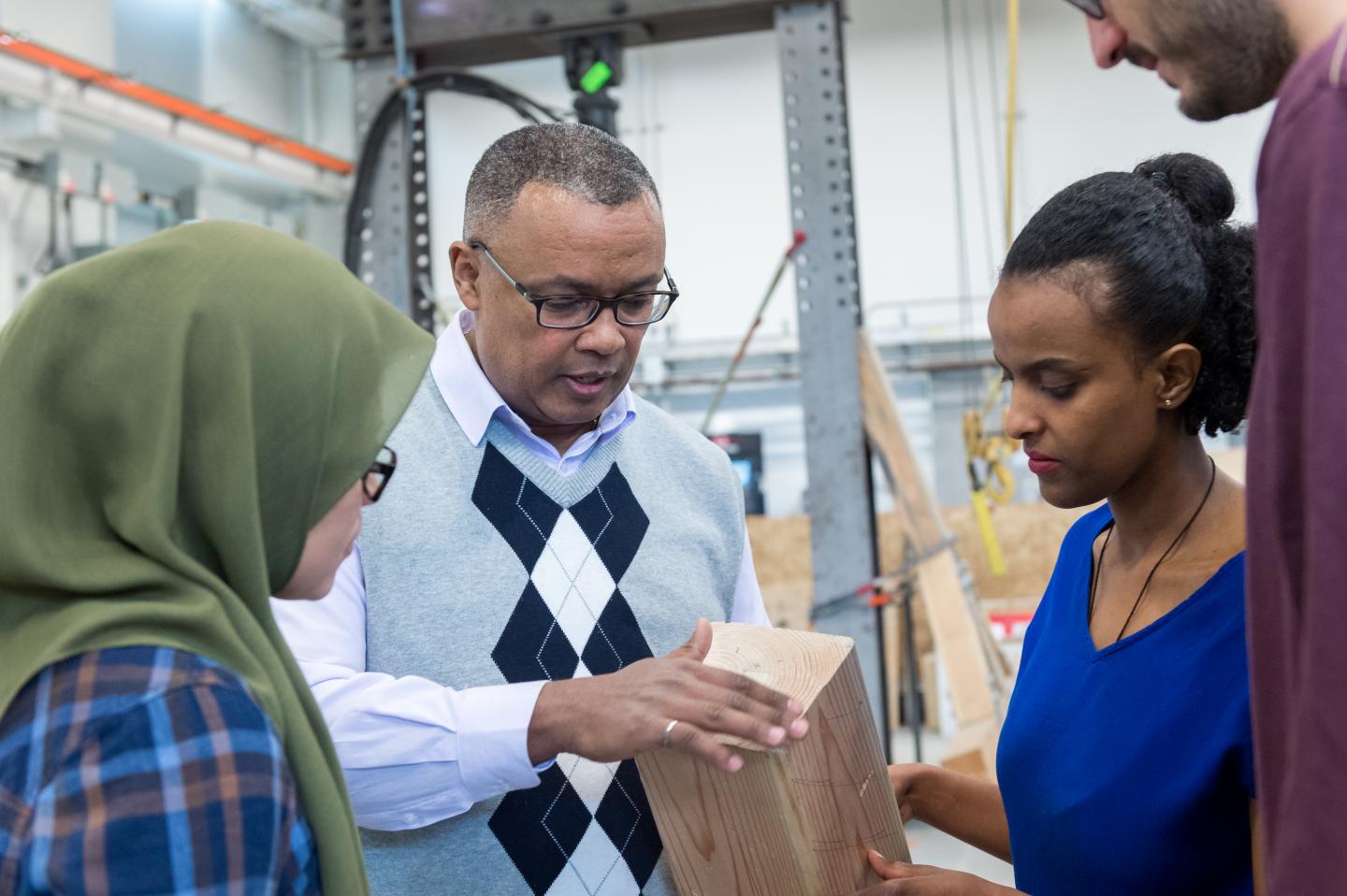
Tall mass-timber buildings are a safe and sustainable alternative for high-rise construction
IMAGE

Credit: UBC Okanagan

With an increasing demand for a more sustainable alternative for high-rise construction, new research from UBC Okanagan, in collaboration with Western University and FPInnovations, points to timber as a sustainable and effective way to make tall, high-density, and renewable buildings.

“Many people have trouble imagining a timber high-rise of up to 40 storeys when we’re so used to seeing concrete and steel being the norm in today’s construction,” explains Matiyas Bezabeh, a doctoral candidate at the UBCO School of Engineering. “But we’re starting to demonstrate that the proverbial wolf can’t knock over the pig’s wooden building when they’re built using modern techniques.”

Bezabeh and his supervisors, Professors Solomon Tesfamariam from UBC Okanagan and Girma Bitsuamlak from Western University, conducted extensive wind testing on tall mass-timber buildings of varying height between 10 and 40-storeys at Western University’s Boundary Layer Wind Tunnel Laboratory.

“We found that the studied buildings up to 20-storeys, using today’s building codes, can withstand high-wind events,” says Bezabeh. “However, in the cases we studied, once we get up to 30 and 40 storeys, aerodynamic and structural improvements would be needed to address excessive wind-induced motion–something that would impact the comfort of those inside.

In 2020, the National Building Code of Canada doubled the height allowance of timber buildings from six storeys to twelve. The 2021 edition of the International Building Code (IBC) will include provisions to allow mass-timber buildings up to 18-stories.

“What’s exciting about our findings is that while additional engineering is required for these taller timber buildings, the problems are absolutely solvable, which opens the door to new architectural possibilities,” adds Tesfamariam. “And with a shift towards sustainable urbanization across North America and Europe, the use of timber as a structural material addresses both the issues of sustainability and renewability of resources.”

Tesfamariam, an engineering professor at UBCO, also sits on the Systems Design and Connections Subcommittee of the Canadian Wood Council, which is responsible for setting building code and engineering standards nationally.

According to Bezabeh, there is a growing acceptance of using mass-timber products such as cross-laminated timber because of its higher strength-to-weight ratio, aesthetics, and construction efficiency.

“We hope our research will continue the design and structural innovation in this area and perhaps one day soon many of us will be living in mass-timber high-rise apartments.”

The School of Engineering offers a new course in advanced design of timber structures, led by Tesfamariam, geared for students and industry professionals interested in understanding timber products, design of timber structural elements, the fundaments of structural dynamics for timber buildings, and the design of low-, mid- and high-rise timber and timber-hybrid buildings.

###

The research is published in the Journal of Structural Engineering.

Media Contact
Nathan Skolski
[email protected]

Original Source

https://news.ok.ubc.ca/2020/12/03/proverbial-wolf-cant-blow-down-modern-timber-high-rises-says-ubco-researchers

Related Journal Article

http://dx.doi.org/10.1061/(ASCE)ST.1943-541X.0002746

Tags: Civil EngineeringIndustrial Engineering/ChemistryTechnology/Engineering/Computer ScienceUrbanization
Share12Tweet8Share2ShareShareShare2

Related Posts

Miniature Sensor Uses Light to Detect Touch — Chemistry

Miniature Sensor Uses Light to Detect Touch

May 8, 2026
Iron Minerals Determine Whether Dissolved Organic Matter Fuels Microbes or Becomes Long-Term Carbon Storage — Chemistry

Iron Minerals Determine Whether Dissolved Organic Matter Fuels Microbes or Becomes Long-Term Carbon Storage

May 8, 2026

Kate Evans Appointed Associate Lab Director for Biological and Environmental Systems Science at ORNL

May 8, 2026

Advancing Multiscale Modeling and Overcoming Operational Challenges in Autothermal COâ‚‚-to-Methanol Reactors

May 8, 2026
Please login to join discussion

POPULAR NEWS

  • Research Indicates Potential Connection Between Prenatal Medication Exposure and Elevated Autism Risk

    840 shares
    Share 336 Tweet 210
  • New Study Reveals Plants Can Detect the Sound of Rain

    727 shares
    Share 290 Tweet 181
  • Scientists Investigate Possible Connection Between COVID-19 and Increased Lung Cancer Risk

    68 shares
    Share 27 Tweet 17
  • Salmonella Haem Blocks Macrophages, Boosts Infection

    61 shares
    Share 24 Tweet 15

About

We bring you the latest biotechnology news from best research centers and universities around the world. Check our website.

Follow us

Recent News

Evaluating Digoxin Use in Patients with Symptomatic Rheumatic Heart Disease

Evaluating the Effectiveness and Safety of Digitalis Glycosides in Treating Heart Failure

Urdu Fall Risk Questionnaire Adapted for Elderly

Subscribe to Blog via Email

Enter your email address to subscribe to this blog and receive notifications of new posts by email.

Join 82 other subscribers
  • Contact Us

Bioengineer.org © Copyright 2023 All Rights Reserved.

Welcome Back!

Login to your account below

Forgotten Password?

Retrieve your password

Please enter your username or email address to reset your password.

Log In
No Result
View All Result
  • Homepages
    • Home Page 1
    • Home Page 2
  • News
  • National
  • Business
  • Health
  • Lifestyle
  • Science

Bioengineer.org © Copyright 2023 All Rights Reserved.