• HOME
  • NEWS
  • EXPLORE
    • CAREER
      • Companies
      • Jobs
    • EVENTS
    • iGEM
      • News
      • Team
    • PHOTOS
    • VIDEO
    • WIKI
  • BLOG
  • COMMUNITY
    • FACEBOOK
    • INSTAGRAM
    • TWITTER
Wednesday, September 23, 2026
BIOENGINEER.ORG
No Result
View All Result
  • Login
  • HOME
  • NEWS
  • EXPLORE
    • CAREER
      • Companies
      • Jobs
        • Lecturer
        • PhD Studentship
        • Postdoc
        • Research Assistant
    • EVENTS
    • iGEM
      • News
      • Team
    • PHOTOS
    • VIDEO
    • WIKI
  • BLOG
  • COMMUNITY
    • FACEBOOK
    • INSTAGRAM
    • TWITTER
  • HOME
  • NEWS
  • EXPLORE
    • CAREER
      • Companies
      • Jobs
        • Lecturer
        • PhD Studentship
        • Postdoc
        • Research Assistant
    • EVENTS
    • iGEM
      • News
      • Team
    • PHOTOS
    • VIDEO
    • WIKI
  • BLOG
  • COMMUNITY
    • FACEBOOK
    • INSTAGRAM
    • TWITTER
No Result
View All Result
Bioengineer.org
No Result
View All Result
Home NEWS Science News Health

Prototype may diagnose common pregnancy complications by monitoring placental oxygen

Bioengineer by Bioengineer
September 6, 2025
in Health
Reading Time: 2 mins read
0
IMAGE
Share on FacebookShare on TwitterShare on LinkedinShare on RedditShare on Telegram

NIH researchers pursue innovative method for observing maternal and fetal health during pregnancy

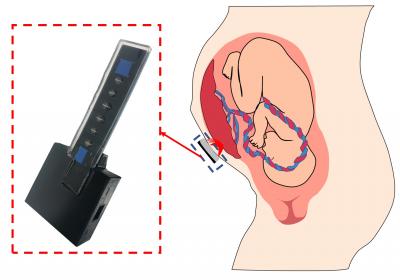
Researchers at the National Institutes of Health have developed a prototype device that could potentially diagnose pregnancy complications by monitoring the oxygen level of the placenta. The device sends near-infrared light through the pregnant person’s abdomen to measure oxygen levels in the arterial and venous network in the placenta. The method was used to study anterior placenta, which is attached to the front wall of the uterus. The researchers described their results as promising but added that further study is needed before the device could be used routinely.

The small study was conducted by Amir Gandjbakhche, Ph.D., of the Section on Translational Biophotonics at NIH’s Eunice Kennedy Shriver National Institute of Child Health and Human Development (NICHD), and colleagues. It appears in Biomedical Optics Express.

The researchers devised mathematical methods to study the passage of light through the skin, abdominal wall and uterine tissue to reach the placenta and calculate its oxygen levels. Currently, the device cannot monitor oxygen in women with a posterior placenta, which is attached to the back wall of the uterus, because the distance is too far for the light to travel. However, anterior placenta is associated with a higher rate of complications than posterior placenta, such as postpartum hemorrhage and an increased need for labor induction or cesarean delivery.

The researchers enrolled 12 pregnant women with an anterior placenta in the study. Of these, five had a pregnancy complication, including hypertension, a short cervix and polyhydramnios (excess amniotic fluid). On average, the women with complications had a placental oxygen level of 69.6%, a difference statistically significant from the 75.3% seen in the healthy pregnancies in the study. The authors see their results as a first step in continuously monitoring placental oxygen levels to assess maternal and fetal health.

###

Media Contact
Robert Bock or Linda Huynh
[email protected]

Related Journal Article

http://dx.doi.org/10.1364/BOE.424969

Tags: Diagnosticsmaternal-fetal healthMedicine/Healthnear-infrared diagnosticsNIH researchplacental oxygen monitoringpregnancy complications
Share12Tweet8Share2ShareShareShare2

Related Posts

Austria’s Post-Pandemic Deaths Point to Overcounted COVID-19 Mortality

September 23, 2026

Protein Maps of Colorectal Cancer Reveal New Biomarkers of Tumor Spread

September 23, 2026

Six Experts Map the Future of Rare Metabolic Disease Research

September 23, 2026

Prenatal Mercury at Real-World Levels Rewires Development Differently in Male and Female Rats

September 23, 2026
Please login to join discussion

POPULAR NEWS

  • Programmable Spinning Weaves Entire Integrated Circuits Into a Single Fibre

    29 shares
    Share 12 Tweet 7
  • Austria’s Post-Pandemic Deaths Point to Overcounted COVID-19 Mortality

    29 shares
    Share 12 Tweet 7
  • X-rays Reveal the Interlayer Glue Behind Superconductivity in Bilayer Nickelates

    29 shares
    Share 12 Tweet 7
  • Microfluidic Encoding Turns Ordinary Fibres into Working Electronic Circuits

    29 shares
    Share 12 Tweet 7

About

We bring you the latest biotechnology news from best research centers and universities around the world. Check our website.

Follow us

Recent News

Programmable Spinning Weaves Entire Integrated Circuits Into a Single Fibre

Austria’s Post-Pandemic Deaths Point to Overcounted COVID-19 Mortality

X-rays Reveal the Interlayer Glue Behind Superconductivity in Bilayer Nickelates

Subscribe to Blog via Email

Enter your email address to subscribe to this blog and receive notifications of new posts by email.

Join 85 other subscribers
  • Contact Us

Bioengineer.org © Copyright 2023 All Rights Reserved.

Welcome Back!

Login to your account below

Forgotten Password?

Retrieve your password

Please enter your username or email address to reset your password.

Log In
No Result
View All Result
  • Homepages
    • Home Page 1
    • Home Page 2
  • News
  • National
  • Business
  • Health
  • Lifestyle
  • Science

Bioengineer.org © Copyright 2023 All Rights Reserved.