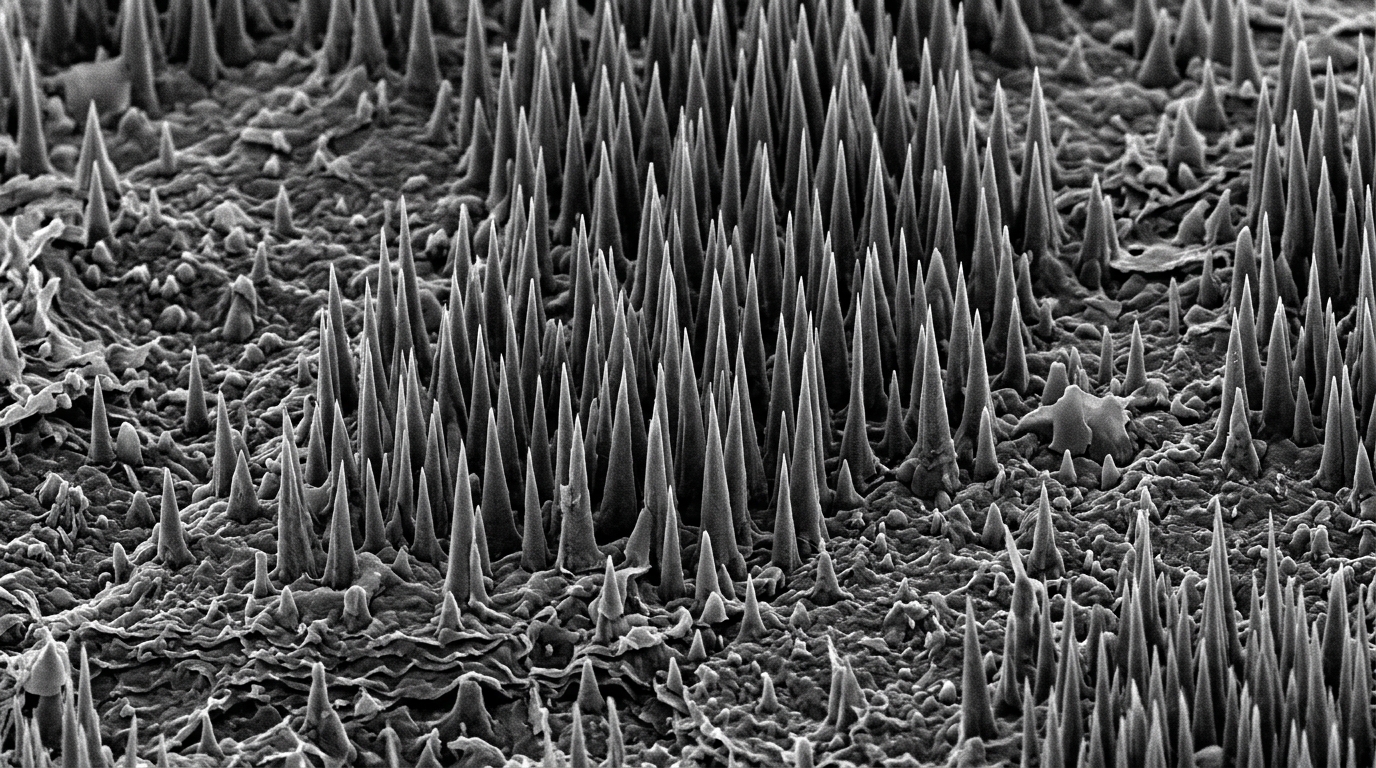
Graphene oxide can survive a barrage of high-energy protons and, in some forms, transform itself into entirely new shapes. Researchers report that 3 MeV proton irradiation triggers morphological transformations and defect formation in two types of graphene oxide layers deposited on silicon substrates: Hummers’ graphene oxide, known as HGO, and Eigler’s oxo-graphene, known as oxoG. The fluences ranged from 5 × 10^12 to 5 × 10^15 protons per square centimeter, and the team tracked changes in surface chemical composition, layer spacing and structural defects before and after irradiation.
The most striking result came from high-resolution transmission electron microscopy of the HGO layers. The images revealed irradiation-induced structural transformations and pointed to a mechanism behind the formation of a needle-like structure. According to the model proposed in the study, proton irradiation stimulates the formation of carbonyl groups, C=O, at defect sites. These chemical changes deform the carbon skeleton, and the graphene flakes bend because of built-in differential stress. The bent flakes then self-assemble into a new tubular, needle-like structure, a shape that emerges from the interplay between radiation-induced chemistry and mechanical strain within the material.
The oxo-graphene layers told a different story. Statistical Raman spectroscopy showed that the full width at half maximum of the 2D band, Γ(2D), of the oxoG monolayers stays between 100 and 125 cm−1 across the entire fluence range. The researchers interpret this as a sign of a high degree of stability and radiation hardness of the carbon framework under high-energy proton irradiation. In other words, while the Hummers-derived material visibly reorganizes into needle-like forms, the oxo-graphene framework holds its structural signature even at the highest proton doses tested.
The study also explored what happens when irradiation is combined with a chemical reduction step. The authors propose a combined treatment in which proton irradiation is followed by reduction with HI/TFA vapor. This sequence yields a reduced graphene oxide with a sheet resistance of 5.56 kΩ per square, a value reported for the material produced by this two-step process.
The HRTEM evidence tied the needle-like structures specifically to the HGO layers, and the proposed mechanism links carbonyl formation at defect sites to skeleton deformation, flake bending under differential stress and eventual self-assembly into tubular shapes.
Raman spectroscopy served as the quantitative probe for the oxoG monolayers. The finding that Γ(2D) remains within the 100 to 125 cm−1 band over the whole fluence range suggests that the carbon framework of oxo-graphene tolerates proton impacts without losing its essential order, which the authors describe as radiation hardness.
Proton irradiation followed by HI/TFA vapor reduction produced a reduced graphene oxide with a measured sheet resistance of 5.56 kΩ sq−1.
The work, published in the Journal of Materials Science in 2026, was carried out by researchers including Bangun Satrio Nugroho, Franck Nadji Adjim, Herry Wijayanto, Triyono Basuki, Vladimir Tuboltsev, Kenichiro Mizohata, Christian E. Halbig and Satoru Nakashima. It classifies under electronic materials and demonstrates that the response of graphene oxide to proton irradiation depends strongly on which oxide variant you start with: one bends and self-assembles into needles, while the other keeps its carbon framework stable across the full dose range.
Subject of Research: Morphological transformations and defect formation in Hummers' graphene oxide and oxo-graphene under high-energy proton irradiation
Article Title: Effect of proton irradiation on morphology of Hummers’ graphene oxide and oxo-graphene
Article References: Nugroho, B. S., Adjim, F. N., Wijayanto, H., Basuki, T., Tuboltsev, V., Mizohata, K., Halbig, C. E., & Nakashima, S. (2026). Effect of proton irradiation on morphology of Hummers’ graphene oxide and oxo-graphene. Journal of Materials Science. https://doi.org/10.1007/s10853-026-14032-9
Image Credits: AI Generated
DOI: 10.1007/s10853-026-14032-9
Keywords: graphene oxide, proton irradiation, oxo-graphene, HRTEM, Raman spectroscopy, carbonyl groups, radiation hardness, reduced graphene oxide, sheet resistance, electronic materials, defect formation, needle-like structure
News Source: Neil Sanderson. (November 7, 2026). Proton irradiation reshapes graphene oxide into needle-like structures. Scienmag.