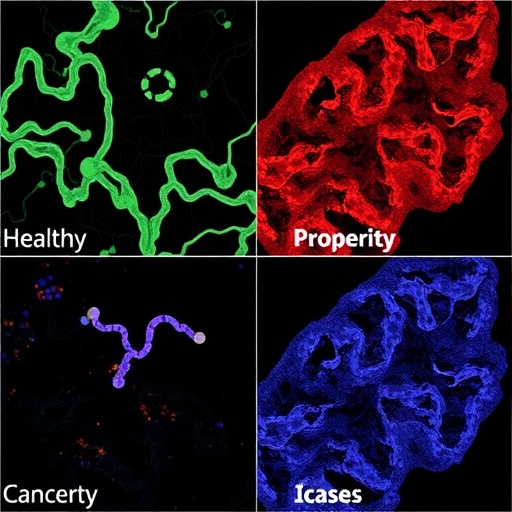

In a groundbreaking proteogenomic study, researchers have unveiled the profound impact of missense mutations on protein abundance within prostate cancer tissues, employing a sophisticated Stable Isotope Labeling by/with Amino acids in Cell culture (SILAC)-based quantitative proteomics approach. This meticulous analysis juxtaposed malignant prostate samples against adjacent healthy tissues, revealing a complex landscape where genetic alterations directly reshape the tumor proteome, offering new vistas in understanding tumor biology and potential clinical applications.
Prostate cancer remains one of the leading causes of cancer-related mortality among men globally, therefore comprehending the molecular mechanisms driving its progression is paramount. Traditional genomic sequencing studies have cataloged numerous mutations, yet their direct impact on protein expression and functional consequences often remain speculative. This study bridges that gap by directly quantifying protein abundance linked to missense mutations, thus providing compelling evidence that these genetic variations profoundly influence the tumor’s proteomic profile.
Employing SILAC-based mass spectrometry, the research team quantified protein levels across paired tumor and healthy prostate tissue samples. This approach enabled differentiation between RefSeq Abundant proteins—those commonly expressed in normal physiology—and Variant Abundant proteins, which exhibit altered expression in cancerous states. By integrating mutation data from comprehensive databases such as RefSeq and dbPepVar, researchers successfully mapped missense variants and correlated these with protein abundance changes.
.adsslot_mWF5TpG1PV{width:728px !important;height:90px !important;}
@media(max-width:1199px){ .adsslot_mWF5TpG1PV{width:468px !important;height:60px !important;}
}
@media(max-width:767px){ .adsslot_mWF5TpG1PV{width:320px !important;height:50px !important;}
}
ADVERTISEMENT
Statistical analysis unveiled a significant negative correlation between protein intensity difference and protein intensity ratio (p < 0.05), underscoring the notion that missense mutations are not merely passengers but active drivers reshaping protein expression patterns within prostate tumors. This insight denotes a nuanced regulation where mutated proteins are often downregulated or altered in abundance, reflecting a complex adaptation of cancer cells to their mutational landscape.
Further mutation hotspot analysis spotlighted specific genes with recurrent alterations, notably ACTB and PPIF. Mutations in ACTB are implicated in disrupted cell adhesion processes, potentially enhancing metastatic potential, while PPIF variants may influence mitophagy—a critical mitochondrial quality control mechanism—thereby promoting tumor cell survival under metabolic stress. These findings pinpoint essential nodes in cancer biology that could serve as therapeutic targets.
In addition to hotspot mutations, the research employed PROVEAN, a computational tool designed to predict the deleterious effects of protein variants on structure and function. Notably, mutations in PGK1, HSPA9, and MDH2 were classified as damaging, hinting at compromised metabolic enzyme functionality within tumor cells. These disruptions may fuel the metabolic reprogramming often observed in cancers, facilitating unchecked proliferation and survival.
Unlike standard genomic analyses inferring mutation impacts indirectly, this proteogenomic approach validates the functional repercussions at the protein expression level, fortifying the biological and clinical relevance of these mutations. Importantly, the method led to the discovery of novel missense mutations in genes such as PNP, CSRP1, and GEMIN6. These genes are implicated in immune modulation, cytoskeletal organization, and metabolic adaptation, suggesting multifaceted roles in tumor progression and immune evasion.
Intriguingly, the study highlights possible crosstalk between neutrophil-associated proteins and the tumor’s immune microenvironment, shedding light on mechanisms of immune escape. This revelation opens avenues for therapeutic exploration, as targeting these interactions may enhance immunotherapy efficacy in prostate cancer, a malignancy traditionally considered less responsive to such treatments.
While this integrative proteogenomic study offers substantial advancements, it acknowledges limitations. Reliance on existing mutation databases may introduce biases, and the functional effects of identified mutations require further experimental validation through rigorous in vitro and in vivo studies. Establishing mechanistic links between these mutations and tumor behavior remains a critical next step to translate findings into therapeutic strategies.
Future research must focus on deploying functional assays to confirm the roles of these mutations in tumor aggression, metastasis, and resistance to therapy. Moreover, expanding proteogenomic profiling to broader patient cohorts could reveal mutation-driven proteomic signatures predictive of clinical outcomes, steering precision oncology efforts in prostate cancer management.
Collectively, this study exemplifies how integrating high-resolution proteomics with genomic data transforms our understanding of cancer biology. By directly assessing how missense mutations alter protein landscapes within tumors, researchers lay foundations for identifying novel biomarkers and pinpointing actionable targets, ultimately advancing personalized cancer diagnostics and treatments.
This transformative work, recently published in the peer-reviewed journal Oncology Advances, sets a new standard for dissecting the proteomic consequences of genomic aberrations in cancer. It underscores the necessity of synergistic analytical approaches to capture the complex interplay between genotype and phenotype, charting pathways to innovative interventions against one of the most formidable men’s cancers worldwide.
Subject of Research: Proteogenomic analysis of missense mutations affecting protein abundance in prostate cancer
Article Title: Proteogenomic Analysis of Healthy and Cancerous Prostate Tissues Using SILAC and Mutation Databases
News Publication Date: 30-Mar-2025
Web References: https://www.xiahepublishing.com/journal/oncoladv
References: DOI: 10.14218/OnA.2024.00032
Image Credits: Lucas Marques da Cunha
Keywords: Prostate cancer, Protein abundance, Protein coding genes
Tags: cancer-related mortality among menclinical applications of proteogenomicsgenetic alterations in prostate cancerhealthy vs. cancerous prostate comparisonmass spectrometry in cancer researchmissense mutations in tumorsmolecular mechanisms of prostate cancerprotein abundance in cancer tissuesproteogenomic study of prostate cancerRefSeq and dbPepVar integrationSILAC quantitative proteomicstumor proteome analysis