• HOME
  • NEWS
  • EXPLORE
    • CAREER
      • Companies
      • Jobs
    • EVENTS
    • iGEM
      • News
      • Team
    • PHOTOS
    • VIDEO
    • WIKI
  • BLOG
  • COMMUNITY
    • FACEBOOK
    • INSTAGRAM
    • TWITTER
Thursday, April 16, 2026
BIOENGINEER.ORG
No Result
View All Result
  • Login
  • HOME
  • NEWS
  • EXPLORE
    • CAREER
      • Companies
      • Jobs
        • Lecturer
        • PhD Studentship
        • Postdoc
        • Research Assistant
    • EVENTS
    • iGEM
      • News
      • Team
    • PHOTOS
    • VIDEO
    • WIKI
  • BLOG
  • COMMUNITY
    • FACEBOOK
    • INSTAGRAM
    • TWITTER
  • HOME
  • NEWS
  • EXPLORE
    • CAREER
      • Companies
      • Jobs
        • Lecturer
        • PhD Studentship
        • Postdoc
        • Research Assistant
    • EVENTS
    • iGEM
      • News
      • Team
    • PHOTOS
    • VIDEO
    • WIKI
  • BLOG
  • COMMUNITY
    • FACEBOOK
    • INSTAGRAM
    • TWITTER
No Result
View All Result
Bioengineer.org
No Result
View All Result
Home NEWS Science News Chemistry

Proteins guide electrons to the right place

Bioengineer by Bioengineer
February 15, 2024
in Chemistry
Reading Time: 2 mins read
0
Illustration of charge transfer in cells
Share on FacebookShare on TwitterShare on LinkedinShare on RedditShare on Telegram

Cells need energy to function. Researchers at the University of Gothenburg can now explain how energy is guided in the cell by small atomic movements to reach its destination in the protein. Imitating these structural changes of the proteins could lead to more efficient solar cells in the future.
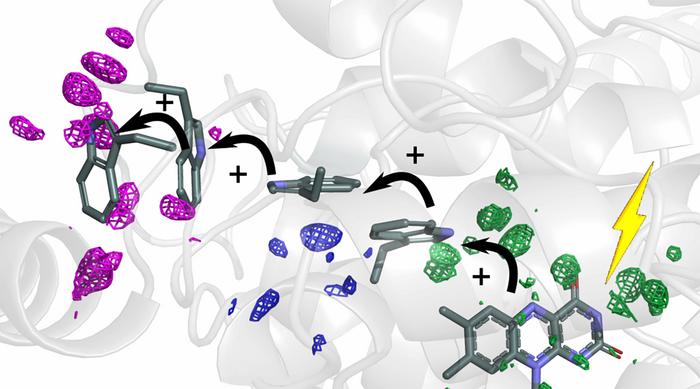
Illustration of charge transfer in cells

Credit: Sebastian Westenhoff

Cells need energy to function. Researchers at the University of Gothenburg can now explain how energy is guided in the cell by small atomic movements to reach its destination in the protein. Imitating these structural changes of the proteins could lead to more efficient solar cells in the future.

The sun’s rays are the basis for all the energy that creates life on Earth. Photosynthesis in plants is a prime example, where solar energy is needed for the plant to grow. Special proteins absorb the sun’s rays, and the energy is transported as electrons inside the protein, in a process called charge transfer. In a new study, researchers show how proteins deform to create efficient transport routes for the charges.

Guided electrons

“We studied a protein, photolyase, in the fruit fly, whose function is to repair damaged DNA. The DNA repair is powered by solar energy, which is transported in the form of electrons along a chain of four tryptophans (amino acids). The interesting discovery is that the surrounding protein structure was reshaped in a very specific way to guide the electrons along the chain,” explains Sebastian Westenhoff, Professor of Biophysical Chemistry.

The researchers noted how the changes in the structure followed precise timings in line with the transfer of the charge – important knowledge that could be used to design better solar panels, batteries or other applications that require energy transport.

Better able to imitate nature

“Evolution is nature’s material development and it is always the best. What we have done is basic research. The more we understand about what happens when proteins absorb sunlight, the better we can imitate this conversion of solar energy into electricity,” says Sebastian Westenhoff.

The study, published in Nature Chemistry, is a clear step forward in the research on charge transfer in proteins. Studying the process in the fruit fly, using the Serial Femtosecond Crystallography (SFX) technique, can give researchers an insight into the dynamic interaction of the protein as the electrons move.

“This is going to open up new chapters in our understanding of life’s mysteries at the molecular level,” concludes Sebastian Westenhoff.


Journal

Nature Chemistry

DOI

10.1038/s41557-023-01413-9

Method of Research

Observational study

Subject of Research

Cells

Article Title

Directed ultrafast conformational changes accompany electron transfer in a photolyase as resolved by serial crystallography

Article Publication Date

15-Jan-2024

Share12Tweet8Share2ShareShareShare2

Related Posts

Breakthrough Laser Technique Unveils Secrets of Radioactive Atomic Nuclei

Breakthrough Laser Technique Unveils Secrets of Radioactive Atomic Nuclei

April 16, 2026
Ultra-Stretchable, Anti-Freezing Hydrogel Electrolytes Cross-Linked with Liquid Metal Particle Initiators for Advanced Soft Energy Storage Devices

Ultra-Stretchable, Anti-Freezing Hydrogel Electrolytes Cross-Linked with Liquid Metal Particle Initiators for Advanced Soft Energy Storage Devices

April 16, 2026

Scientists Develop Multiscale Electrode Design to Boost Hydrogen Production Efficiency

April 16, 2026

“Entangled, Staple-Like Particles Mimic Liquid Metal to Inspire Next-Gen Materials”

April 16, 2026

POPULAR NEWS

  • Scientists Investigate Possible Connection Between COVID-19 and Increased Lung Cancer Risk

    61 shares
    Share 24 Tweet 15
  • Boosting Breast Cancer Risk Prediction with Genetics

    47 shares
    Share 19 Tweet 12
  • Popular Anti-Aging Compound Linked to Damage in Corpus Callosum, Study Finds

    45 shares
    Share 18 Tweet 11
  • NSF funds machine-learning research at UNO and UNL to study energy requirements of walking in older adults

    94 shares
    Share 38 Tweet 24

About

We bring you the latest biotechnology news from best research centers and universities around the world. Check our website.

Follow us

Recent News

Foxes and Birds as Early Indicators for Tracking Antibiotic Resistance Spread in Ecosystems

Breakthrough Laser Technique Unveils Secrets of Radioactive Atomic Nuclei

Linear RAG Scanning Edits Igκ Variable Regions

Subscribe to Blog via Email

Enter your email address to subscribe to this blog and receive notifications of new posts by email.

Join 79 other subscribers
  • Contact Us

Bioengineer.org © Copyright 2023 All Rights Reserved.

Welcome Back!

Login to your account below

Forgotten Password?

Retrieve your password

Please enter your username or email address to reset your password.

Log In
No Result
View All Result
  • Homepages
    • Home Page 1
    • Home Page 2
  • News
  • National
  • Business
  • Health
  • Lifestyle
  • Science

Bioengineer.org © Copyright 2023 All Rights Reserved.