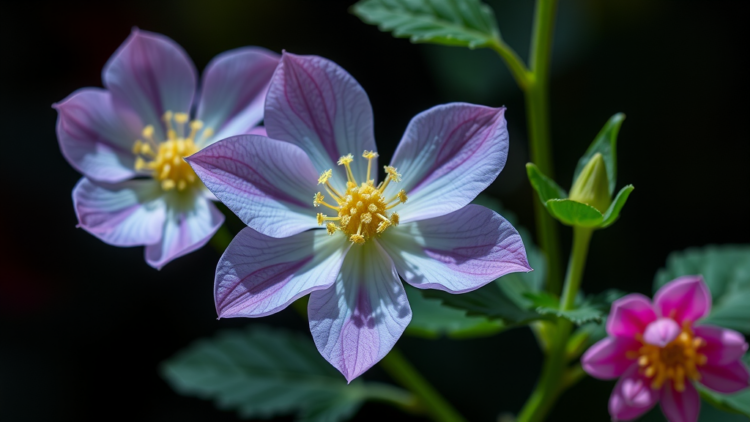
Timing is everything in the life of a plant. Flower too early and a late frost can destroy the reproductive effort; flower too late and the season’s warmth may already be gone. For decades, biologists have mapped the genetic circuitry that decides when the transition from leaf to bloom occurs, focusing largely on transcription factors, chromatin modifiers, and hormone signals. Now a team at Fujian Agriculture and Forestry University in China has added an unexpected player to that map: the protein-destruction machinery of the cell itself. In a study published in Plant Cell Reports, Jia Liu, Li-Yu Chen and colleagues demonstrate that a core component of the 26S proteasome, the cellular shredder that degrades damaged or unwanted proteins, directly governs flowering time in Arabidopsis thaliana by controlling the stability of a pivotal epigenetic regulator.
The protein at the center of the story is WD40-REPEAT 5a, or WDR5a, a structural backbone component of the Arabidopsis COMPASS-like complex. This complex is the plant equivalent of a histone methyltransferase assembly first characterized in yeast and animals, and its job is to deposit trimethylation marks on lysine 4 of histone H3, a modification universally associated with active gene transcription. When WDR5a is present and functional, the COMPASS-like complex maintains proper H3K4me3 levels across the genome, keeping thousands of genes in a transcriptionally permissive state. When WDR5a is lost, those marks erode, and genes that depend on them fall silent. Previous work had shown that WDR5a is constantly turned over by the ubiquitin-proteasome system, but the identity of the proteasome subunit responsible for its degradation, and the developmental consequences of that degradation, remained unknown.
To find the missing link, the researchers turned to a classic tool of molecular biology: the yeast two-hybrid screen. By baiting the screen with WDR5a, they pulled out an unexpected partner, REGULATORY PARTICLE AAA-ATPASE 2a, or RPT2a. RPT2a is no ordinary protein; it is one of six AAA-ATPases that form a ring at the entrance of the 26S proteasome’s regulatory particle, unfolding ubiquitinated substrates and threading them into the proteolytic core for destruction. Earlier studies had established that RPT2a is essential for meristem maintenance in Arabidopsis, and that mutations in the gene cause pleiotropic developmental defects, including a characteristic halted-root phenotype. The new finding suggested that at least part of RPT2a’s developmental influence might flow through a specific substrate: WDR5a itself.
The interaction was not a fleeting artifact of the screen. The team confirmed the physical association between RPT2a and WDR5a in plant cells, and then asked what the interaction means functionally. Their experiments showed that RPT2a promotes the degradation of WDR5a through the 26S proteasome pathway. When proteasomal activity is compromised, or when RPT2a function is reduced, WDR5a accumulates. Conversely, the degradation of WDR5a depends on its prior tagging with ubiquitin, the small protein flag that directs substrates to the proteasome. The researchers traced that tagging to a Cullin4-based ubiquitin ligase complex. CUL4, a scaffold protein, partners with the adaptor DNA Damage Binding protein 1A, or DDB1A, to recognize WDR5a and recruit the enzymatic machinery that attaches ubiquitin chains. This CUL4-DDB1A complex, they found, is what targets WDR5a for ubiquitination in vivo.
Perhaps the most technically satisfying part of the study is the mapping of the ubiquitination sites themselves. By analyzing which lysine residues on WDR5a receive ubiquitin marks, the team identified lysine 31 and lysine 211 as the principal targets. These residues sit on exposed surfaces of the WD40 beta-propeller structure, consistent with their accessibility to the CUL4-DDB1A ligase. Mutating these lysines stabilizes the protein, providing direct genetic evidence that they are the functional degradation signals. The finding echoes a striking parallel from human biology: the X-linked mental retardation gene CUL4B was previously shown to target the mammalian WDR5 ortholog for ubiquitylation, regulating neuronal gene expression. The Arabidopsis work suggests that the strategy of controlling H3K4 methylation by destroying a COMPASS scaffold protein is an evolutionarily conserved theme, deployed independently in plants and animals.
With the degradation pathway established, the researchers connected it to the phenotype that matters most to a plant: when it flowers. WDR5a’s influence on H3K4me3 extends to FLOWERING LOCUS C, or FLC, the master floral repressor of Arabidopsis. FLC encodes a transcription factor that binds directly to the chromatin of FLOWERING LOCUS T (FT) and SUPPRESSOR OF OVEREXPRESSION OF CO 1 (SOC1), the two genes whose activation is required for the floral transition. As long as FLC is expressed, FT and SOC1 stay off and the plant remains vegetative. The new study shows that RPT2a-mediated degradation of WDR5a modulates H3K4me3 at FLC and thereby its expression level, establishing an inverse relationship: when WDR5a is degraded and FLC transcription falls, FT and SOC1 rise, and flowering is promoted. When WDR5a is stabilized, FLC stays high, FT and SOC1 stay low, and flowering is delayed.
The genetic evidence supports this model at every node. Plants with reduced RPT2a function accumulate WDR5a, show altered H3K4me3 patterns, misexpress FLC, and display measurable shifts in flowering time under both long-day and short-day conditions. Manipulating WDR5a levels phenocopies the effects, and the expression changes in FT and SOC1 track faithfully with the FLC changes, exactly as expected from the well-characterized FLC-FT/SOC1 regulatory module. In other words, a proteasome subunit once viewed simply as a generic component of the cell’s waste-disposal system turns out to act as a specific, substrate-selective regulator of a developmental switch, funneling protein-turnover information into the epigenetic control of a single decisive gene.
The broader significance of the work lies in what it reveals about how plants integrate proteostasis with chromatin regulation. The 26S proteasome has long been known to shape plant development, with subunit mutants showing defects in meristem maintenance, hormone signaling, and stress responses. But most of those effects were attributed to the wholesale turnover of signaling proteins such as transcription factors and repressors. The new study adds a subtler layer: by degrading a chromatin scaffold, the proteasome can reconfigure the histone modification landscape itself, changing not just the abundance of individual regulators but the accessibility of entire genomic regions. A recent companion study from another group showed that the RPT2a-MET1 axis controls TERMINAL FLOWER1 and inflorescence meristem determinacy, suggesting that RPT2a may act as a hub connecting protein degradation to multiple chromatin systems, from DNA methylation to histone methylation, across diverse developmental contexts.
There are also practical implications. Flowering time is a major determinant of yield in crops, and the COMPASS-like complex has already been implicated in panicle branching and flowering in rice. If the RPT2a-WDR5a-CUL4/DDB1A pathway identified in Arabidopsis is conserved in crop species, it could offer breeders a new set of targets for tuning flowering schedules, whether to escape seasonal stresses, synchronize flowering for hybrid seed production, or adapt varieties to shifting climates. The identification of specific ubiquitination sites on WDR5a is particularly appealing from this perspective, since those residues define a molecular interface that could in principle be modified to alter protein stability without abolishing function.
Many questions remain. What signals trigger the CUL4-DDB1A ligase to attack WDR5a at a given moment? Is the degradation pathway responsive to environmental cues such as photoperiod or temperature, which are the dominant natural inputs to flowering time? And does RPT2a recognize WDR5a directly, or does it simply provide the proteasomal gate through which the ubiquitinated protein passes? Answering these questions will require connecting the biochemical pathway to the circadian and vernalization circuits that plants use to sense the seasons. What is already clear, however, is that the decision to flower is not made solely at the level of gene transcription. It is also made, moment by moment, at the mouth of the proteasome, where a molecular gatekeeper decides how long a chromatin scaffold survives, and with it, how much longer a plant will wait to bloom.
Subject of Research: Proteasome-mediated degradation of the histone H3K4 methyltransferase component WDR5a and its role in regulating flowering time in Arabidopsis
Article Title: RPT2a-mediated degradation of WDR5a regulates flowering time in Arabidopsis
Article References: Liu, J., Liu, Y.-Y., Wu, J., Zhang, Y.-T., Yang, F., Du, Q., & Chen, L.-Y. (2026). RPT2a-mediated degradation of WDR5a regulates flowering time in Arabidopsis. Plant Cell Reports, 45(10), Article 296. https://doi.org/10.1007/s00299-026-03966-8
Image Credits: AI Generated
DOI: 10.1007/s00299-026-03966-8
Keywords: RPT2a, WDR5a, 26S proteasome, COMPASS-like complex, H3K4me3, flowering time, Arabidopsis, FLC, CUL4-DDB1A, ubiquitination, epigenetics, plant development
Cite Scienmag News
APA MLA Chicago
Juliet Wilcox. (September 21, 2026). Proteasome Gatekeeper RPT2a Controls When Plants Flower by Destroying a Key Histone Protein. Scienmag. https://scienmag.com/proteasome-gatekeeper-rpt2a-controls-when-plants-flower-by-destroying-a-key-histone-protein/
Juliet Wilcox. “Proteasome Gatekeeper RPT2a Controls When Plants Flower by Destroying a Key Histone Protein.” Scienmag, 21 September 2026, https://scienmag.com/proteasome-gatekeeper-rpt2a-controls-when-plants-flower-by-destroying-a-key-histone-protein/. Accessed 21 September 2026.
Juliet Wilcox. “Proteasome Gatekeeper RPT2a Controls When Plants Flower by Destroying a Key Histone Protein.” Scienmag. September 21, 2026. https://scienmag.com/proteasome-gatekeeper-rpt2a-controls-when-plants-flower-by-destroying-a-key-histone-protein/
Copy citation Download RIS
Tags: 26S proteasome26S proteasome function in ArabidopsisArabidopsischromatin remodeling in plant developmentCOMPASS-like complexCUL4-DDB1Aepigenetic regulators in plant reproductive timingepigeneticsFLCflowering timeH3K4me3histone modification and gene activation in plantsplant cell protein destruction machineryplant developmentplant epigenetic regulation of flowering timeplant proteasProteasome-mediated protein degradation in plant flowering regulationregulation of flowering genes by proteasomerole of WD40-REPEAT 5a in flowering controlRPT2aRPT2a role in histone protein stabilityubiquitinationWDR5a