• HOME
  • NEWS
  • EXPLORE
    • CAREER
      • Companies
      • Jobs
    • EVENTS
    • iGEM
      • News
      • Team
    • PHOTOS
    • VIDEO
    • WIKI
  • BLOG
  • COMMUNITY
    • FACEBOOK
    • INSTAGRAM
    • TWITTER
Monday, June 29, 2026
BIOENGINEER.ORG
No Result
View All Result
  • Login
  • HOME
  • NEWS
  • EXPLORE
    • CAREER
      • Companies
      • Jobs
        • Lecturer
        • PhD Studentship
        • Postdoc
        • Research Assistant
    • EVENTS
    • iGEM
      • News
      • Team
    • PHOTOS
    • VIDEO
    • WIKI
  • BLOG
  • COMMUNITY
    • FACEBOOK
    • INSTAGRAM
    • TWITTER
  • HOME
  • NEWS
  • EXPLORE
    • CAREER
      • Companies
      • Jobs
        • Lecturer
        • PhD Studentship
        • Postdoc
        • Research Assistant
    • EVENTS
    • iGEM
      • News
      • Team
    • PHOTOS
    • VIDEO
    • WIKI
  • BLOG
  • COMMUNITY
    • FACEBOOK
    • INSTAGRAM
    • TWITTER
No Result
View All Result
Bioengineer.org
No Result
View All Result
Home NEWS Science News Health

Promising results from first-in-humans study of a novel PET radiopharmaceutical

Bioengineer by Bioengineer
April 16, 2021
in Health
Reading Time: 2 mins read
0
IMAGE
Share on FacebookShare on TwitterShare on LinkedinShare on RedditShare on Telegram

Study continues with rheumatoid arthritis patients
IMAGE

Credit: Anne Roivainen

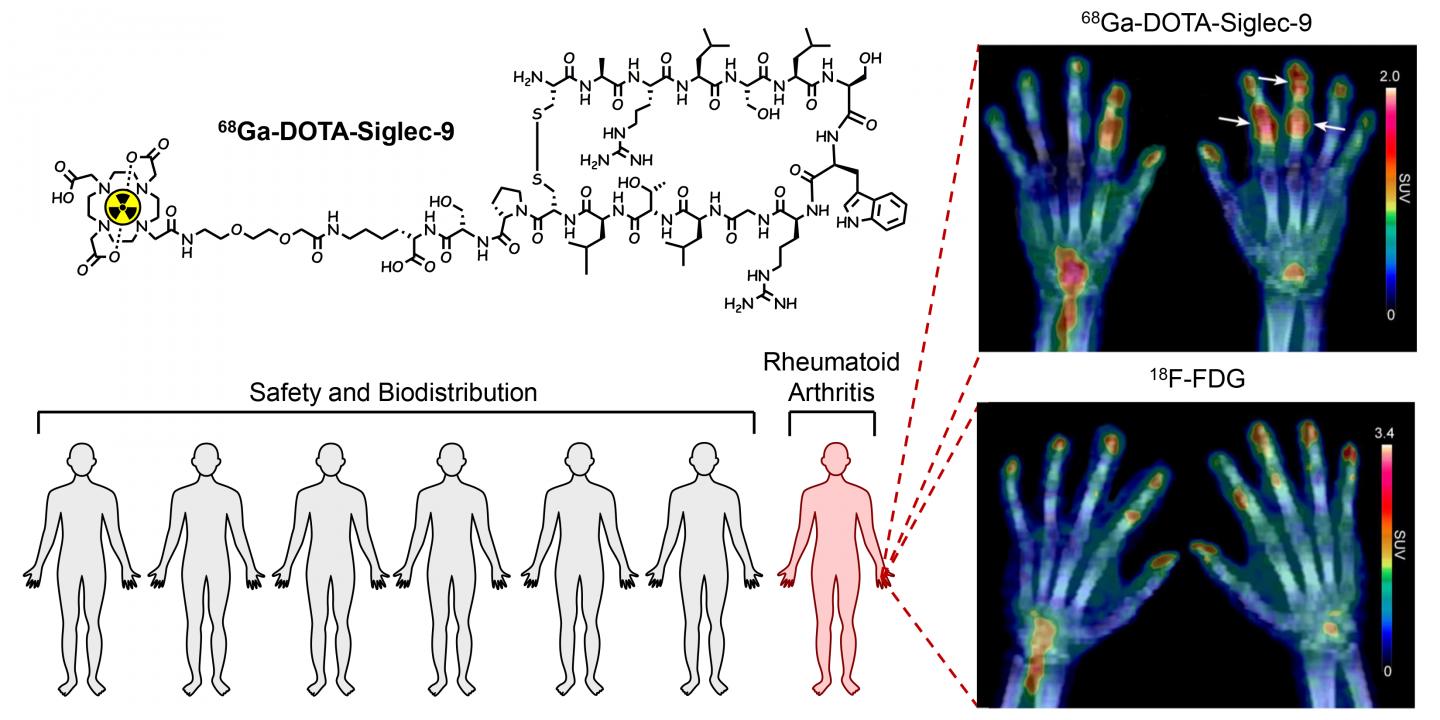
The preliminary trial results of a novel radiopharmaceutical for PET imaging of inflammation developed at the University of Turku, Finland, have been published. The compound, which targets the vascular adhesion protein 1 (VAP-1) that regulates inflammatory cell traffic, is the first radiopharmaceutical that has been developed completely in Finland and has advanced to clinical trials. In the study that started with healthy volunteers, the radiopharmaceutical was found to be well tolerated and safe.

The radiopharmaceutical is 68Ga-labelled Siglec-9 peptide.

“The dose of the radiopharmaceutical used in PET imaging is thousands of times lower when compared with the regular drugs. Studies with new radiopharmaceuticals are therefore safer than the usual drug research studies,” explain Researchers Riikka Viitanen and Olli Moisio from the Turku PET Centre.

The study also included the imaging of a patient with early rheumatoid arthritis. The inflamed joints were clearly visible in the PET images, and the radiopharmaceutical seems to effectively target inflamed tissue.

“Our radiopharmaceutical is a product of long-term preclinical research work, and it is rewarding to see results that match our expectations. The research results are promising, but all novel radiopharmaceuticals must fulfil strict medical and statistical criteria before they can be considered for general research use. Therefore, we will continue the study with voluntary rheumatoid arthritis patients,” says the leader of the research group, Professor Anne Roivainen from the University of Turku.

“This study is unique and has long, innovative history in the University of Turku. Now, it has been proven that the new radiopharmaceutical works in humans, rejoices Academician of Science,” Professor Sirpa Jalkanen.

The purpose of the new radiopharmaceutical is to advance both the diagnostics of inflammatory diseases and drug development with molecular imaging. The research field is rapidly developing, and the Turku PET Centre, research institute of the University of Turku, Åbo Akademi University, and Turku University Hospital is one of the field’s leading research centres in Europe.

###

The study was funded by the Academy of Finland, Hospital District of Southwest Finland (ERVA funding), Jane and Aatos Erkko Foundation, Sigrid Jusélius Foundation, Business Finland, Finnish Cultural Foundation, and Finnish Foundation for Cardiovascular Research.

The study was published in the Journal of Nuclear Medicine in April 2021.

Media Contact
Anne Roivainen
[email protected]

Original Source

https://www.utu.fi/en/news/press-release/promising-results-from-first-in-humans-study-of-a-novel-pet-radiopharmaceutical

Related Journal Article

http://dx.doi.org/10.2967/jnumed.120.250696

Tags: Clinical TrialsDiagnosticsMedicine/Health
Share12Tweet8Share2ShareShareShare2

Related Posts

Tracking Lanthanide-Labeled Microplastics in Plants

June 25, 2026

Neural Design Enables Zero-Shot Drug-Binding Proteins

June 25, 2026

Genomic Insights into Human Skin Fungi Diversity

June 25, 2026

Chiral Laser Gyroscopes Surpass Lock-In Limit

June 25, 2026
Please login to join discussion

POPULAR NEWS

  • Saying Goodbye to PGY-6: Pediatric Fellowship Realities

    103 shares
    Share 41 Tweet 26
  • Multi-Hospital Study Reveals Long Covid Burden Is Twice as High as Current Estimates

    92 shares
    Share 36 Tweet 23
  • Detection of EDCs in Breast Milk and Infant Urine Up to Six Months Highlights Early Exposure Risks

    77 shares
    Share 31 Tweet 19
  • New Drug Candidate Developed at McMaster Shows Potential for Treating Brain Cancer

    58 shares
    Share 23 Tweet 15

About

We bring you the latest biotechnology news from best research centers and universities around the world. Check our website.

Follow us

Recent News

Tracking Lanthanide-Labeled Microplastics in Plants

POSTECH Researchers Slash Cost of Reconstituted Cell-Free Systems by 95%

AI and Physics Collaborate to Design Advanced Hydrogen Storage Materials

Subscribe to Blog via Email

Success! An email was just sent to confirm your subscription. Please find the email now and click 'Confirm' to start subscribing.

Join 82 other subscribers
  • Contact Us

Bioengineer.org © Copyright 2023 All Rights Reserved.

Welcome Back!

Login to your account below

Forgotten Password?

Retrieve your password

Please enter your username or email address to reset your password.

Log In
No Result
View All Result
  • Homepages
    • Home Page 1
    • Home Page 2
  • News
  • National
  • Business
  • Health
  • Lifestyle
  • Science

Bioengineer.org © Copyright 2023 All Rights Reserved.