Mechanical engineering professor focuses on mechanical stresses on female reproductive system during pregnancy, specifically pre-term birth
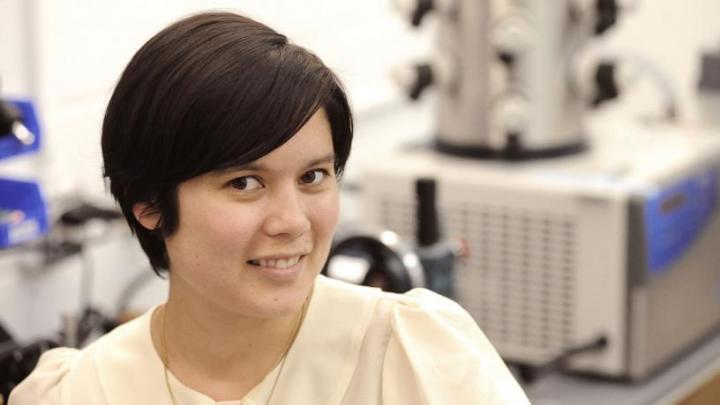
Credit: Eileen Barroso/Columbia Engineering
Kristin Myers, associate professor of mechanical engineering at Columbia Engineering, has won the Presidential Early Career Award (PECASE), the highest honor the U.S. government gives to outstanding young scientists and engineers. Myers, who studies the material behavior of biological soft tissues with a focus on the female reproductive system and pregnancy and specifically pre-term birth, joins a select group of researchers noted for their exceptional promise to advance the frontiers of scientific knowledge and for their leadership in science and technology.
“This national award is a great recognition of the work we’re doing in exploring the mechanics of the cervix and determining the biomechanical mechanisms that may cause preterm birth,” says Myers, who was nominated for the PECASE by the National Science Foundation (NSF). “I’m honored to join such a distinguished group of researchers. This is an award you shoot for early in your career and it is such a thrill to receive one. I am especially honored to be nominated by the NSF, who has supported my academic career since the graduate research fellowship.”
A leading cause of death in children under five in the United States and around the world, pre-term birth (PTB, birth before 37 weeks of gestation) rates are high in both the United States and around the world. Its causes are still not well understood, and Myers’ research focuses on determining exactly what causes premature cervical remodeling, softening, and dilating, and the mechanical dysfunction of the cervix.
“What really motivates us,” she says, “is figuring out the structural antecedents of preterm birth, a major long-lasting public health problem with heavy emotional and financial consequences.”
Myers won an NSF Faculty Early Career Development (CAREER) award in 2015 for her project, “Growth and Remodeling of the Uterine Cervix during Pregnancy,” which was cited by the NSF in its nomination. As part of this project, her team is measuring the mechanical and biochemical property changes of the cervix under various hormonal cues in order to develop a set of equations that can predict the mechanical function of the cervix during pregnancy.
Using the experimental and modeling results from her CAREER award, the Myers group is collaborating with clinical colleagues in the department of obstetrics and gynecology at the Columbia University Irving Medical Center on building a fast and flexible computational mechanics framework to clinically diagnose and treat mechanical failure in pregnancy. They are using experimental, theoretical, and computational mechanics to calculate and study the loading environment of pregnancy and postpartum recovery.
“If we can predict pregnancy outcomes through non-invasive, patient-specific metrics that we assess early in gestation, and make an early and precise diagnosis, then we should be able to develop methods to truly restore the mechanical integrity of the pregnant abdomen,” notes Myers, who began her career studying the mechanical stresses and failure properties of over-heated automobile tires at the University of Michigan before switching to biomechanics while earning her MS and PhD degrees at MIT. Inspired by a new project exploring the mechanical properties of the cervix in the lab of Simona Socrate at MIT, Myers was eager to apply non-linear mechanics to such an understudied topic of pregnancy biomechanics.
“Applying large-deformation mechanics just makes sense when considering the female body during pregnancy and delivery,” Myers adds.
Myers will receive the PECASE award with 314 other honorees, including three Columbia University colleagues–Luis Campos, associate professor of chemistry, Cory Dean, professor of condensed matter physics, and Timothy Berkelbach, assistant professor of chemistry–on July 25 at a ceremony in Washington, DC. The PECASE was established in 1996 to acknowledge the contributions scientists and engineers have made to the advancement of science, technology, education, and mathematics (STEM) education and to community service as demonstrated through scientific leadership, public education, and community outreach. The awards foster innovative and far-reaching developments in science and technology, increase awareness of careers in science and engineering, give recognition to the scientific missions of participating agencies, enhance connections between fundamental research and national goals, and highlight the importance of science and technology for the nation’s future.
###
Media Contact
Holly Evarts
[email protected]
Original Source
https:/