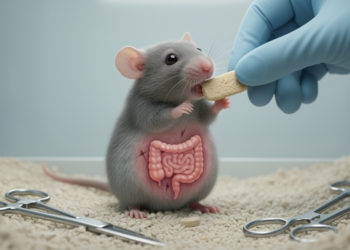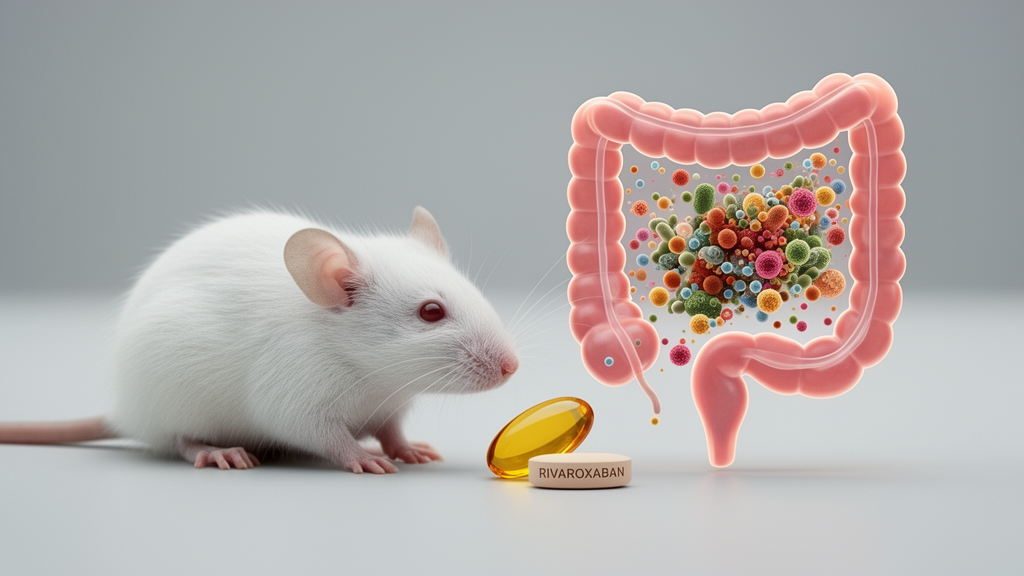
A four-strain probiotic blend reduced fecal occult blood, inflammation and colonic tissue damage in mice previously exposed to rivaroxaban, according to a controlled animal study. The preparation, called live combined Bifidobacterium, or LCB, contains Bifidobacterium longum subsp. infantis, Lactobacillus acidophilus, Enterococcus faecalis and Bacillus cereus. Researchers began the probiotic intervention only after rivaroxaban had produced detectable fecal bleeding and then followed the animals for another seven days.
The results support a substantial microbiota-dependent component to the treatment’s overall effect, but they do not establish that the probiotic prevents bleeding in people taking the anticoagulant. The researchers used 30 seven-week-old male C57BL/6J mice in two main experiments, with six animals assigned to each group. In the first experiment, mice received rivaroxaban at 9 mg/kg by oral gavage for seven days or served as normal controls.
The rivaroxaban-exposed animals then received either LCB or phosphate-buffered saline for seven days. The preparation was delivered once daily by oral gavage at a body-weight-adjusted dose, described in the study as a minimum nominal total of approximately 5.81 × 10^3 colony-forming units per mouse per day. Fecal occult blood became detectable after anticoagulant exposure and rose progressively during the initial treatment period.
Once LCB was introduced, occult-blood scores were generally lower than in mice receiving placebo, with a statistically significant difference on day 9 after adjustment for the experiment’s 14 daily comparisons. Blinded examination of colon tissue showed that rivaroxaban caused capillary congestion and inflammatory-cell infiltration, abnormalities that were substantially less pronounced in mice given LCB. A prespecified scoring system combined four components of injury: inflammatory-cell infiltration, damage to crypts and epithelium, vascular congestion and edema, and bleeding within the tissue.
Each component was assigned a score from zero to three, producing a total injury score ranging from zero to 12. Mice receiving rivaroxaban alone had significantly worse scores than normal controls. LCB lowered the score relative to rivaroxaban alone to a level that did not differ significantly from the control group.
Serum concentrations of tumor necrosis factor-alpha and chemokine ligand 5, also called CXCL5, were elevated after rivaroxaban and markedly attenuated by LCB. The intervention therefore ameliorated an existing bleeding and injury pattern in mice rather than testing prevention, because rivaroxaban was stopped before probiotic treatment began. To examine how the blend was associated with these changes, the team analyzed fecal bacterial communities by 16S rRNA gene sequencing.
Four randomly selected mice from each group were analyzed, with the selection made before the researchers acquired the sequencing data. Overall alpha diversity, summarized by the Shannon and Simpson indices, differed among the normal-control, rivaroxaban and LCB groups after correction for multiple testing. Principal coordinate analysis based on Bray–Curtis dissimilarities and an analysis of similarities also indicated distinct community structures among the groups.
Rivaroxaban was associated with increased relative abundance of Bacteroidota and reduced Bacillota and Campylobacterota. LCB shifted these patterns toward those observed in control animals. At the genus level, rivaroxaban-treated mice had more Muribaculaceae, Prevotellaceae and Rikenellaceae RC9 gut group bacteria and fewer Lachnospiraceae NK4A136 group and Helicobacter than controls.
LCB generally reversed these changes. Taxa enriched in controls included members of Clostridia, Lachnospirales and Lachnospiraceae, whereas the rivaroxaban group was enriched in Bacteroidota, Bacteroidia, Bacteroidales, Muribaculaceae and Prevotellaceae. The LCB group was distinguished by enrichment of an unclassified Anaerovoracaceae genus.
These compositional observations are consistent with the idea that the treatment acts through the gut microbial community, although sequencing of relative abundance alone cannot establish which organisms caused the tissue changes. Untargeted liquid chromatography–mass spectrometry was used to compare fecal metabolite profiles, again in four randomly selected mice per group. Principal component analysis separated the normal-control, rivaroxaban and LCB groups.
The supervised orthogonal partial least-squares discriminant analysis models were evaluated with sevenfold cross-validation and 200 label permutations, but their performance was not uniform, and the small sample size limited the stability of feature prioritization. Using exploratory criteria of a variable importance in projection score above 1 and a nominal P value below 0.05, 212 metabolite features were higher and 123 were lower with rivaroxaban than in controls. Relative to rivaroxaban alone, LCB was associated with 424 higher and 339 lower features.
No candidate in the control-versus-rivaroxaban comparison survived false-discovery-rate correction, while 85 in the rivaroxaban-versus-LCB comparison did. One feature putatively annotated as anandamide attracted attention because it was nominally lower after rivaroxaban and nominally higher after LCB. Its differences did not survive correction for multiple testing: the false-discovery-rate-adjusted P values were 0.4154 for rivaroxaban versus control and 0.1904 for LCB versus rivaroxaban alone.
The researchers therefore treated it as a hypothesis-generating signal rather than a confirmed mediator. In a second experiment involving antibiotic-treated mice, the putative anandamide feature was also nominally higher with LCB despite the absence of a statistically significant improvement in occult blood. That dissociation indicates that an increase in this signal alone is insufficient to explain the broader ameliorative phenotype.
The feature’s identity, absolute concentration and functional contribution require targeted quantitative measurement and causal experiments. A separate preliminary cohort confirmed that the seven-day regimen of vancomycin, neomycin and metronidazole, supplemented with ampicillin in drinking water, substantially disrupted the community: estimated richness and Shannon diversity fell, and overall community structure changed. In the main antibiotic experiment, 12 additional mice underwent antibiotic pretreatment, received rivaroxaban for seven days and then received LCB or placebo for seven days.
During probiotic treatment, occult-blood scores were numerically lower with LCB, but no daily comparison remained significant after Bonferroni adjustment. Serum TNF-alpha also did not differ significantly between the groups. CXCL5 was lower with LCB, and blinded colon injury scores showed partial improvement, but these residual responses were weaker than the broad effects observed in conventional mice.
LCB continued to alter bacterial and metabolic features after antibiotic pretreatment, but those changes alone did not establish how much microbial disruption remained in the main experimental animals. Sequencing showed differences in community structure between the antibiotic-treated groups, while LCB was associated with increased relative abundance of Escherichia-Shigella and several Muribaculaceae and Erysipelotrichaceae groups. Fecal metabolic profiles also differed, and 71 candidate features survived false-discovery-rate correction.
The putative anandamide feature was nominally higher with LCB in the antibiotic-treated comparison, with a nominal P value of 0.0109 and a false-discovery-rate-adjusted P value of 0.1465. These results show that selected LCB-associated responses remained detectable after antibiotic pretreatment, while also indicating that the overall ameliorative response was reduced. Because absolute bacterial load was not quantified, the findings cannot be described as complete depletion or as evidence that particular persistent microbial populations caused the residual effects.
Pooled exploratory correlation analysis across all five experimental groups linked the putative anandamide feature nominally to three Lachnospiraceae-associated taxa, but none of the eight explored correlations remained significant after Benjamini–Hochberg correction. Because the pooled data combined different treatment groups, these correlations may partly reflect treatment effects rather than biological links within individual animals. Several limitations constrain the findings.
The work involved only male mice, the main experiments included six animals per group, and metabolomic analyses used four. Antibiotic disruption was verified in an independent preliminary cohort rather than measured longitudinally in every experimental animal, and absolute bacterial load was not quantified, so complete depletion could not be assumed. The normal-control group also received phosphate-buffered saline without the minimal dimethyl sulfoxide used to dissolve rivaroxaban, potentially contributing to comparisons with controls.
Most importantly, the probiotic was administered after rivaroxaban exposure ended. The design therefore did not test whether LCB is safe or effective during ongoing anticoagulant treatment, and it did not measure whether the preparation could prevent bleeding before injury developed. The mouse model also cannot establish clinical benefit, safety or an appropriate dose in patients.
The study consequently provides initial preclinical evidence that the gut microbiota contributes substantially to the full ameliorative response of LCB in this mouse model. It does not support a clinical recommendation, a claim about prevention, or a conclusion that anandamide mediates the observed protection. Targeted measurements with authentic and isotope-labelled standards, functional tests of candidate metabolites and bacterial functions, and validation in independent human cohorts would be required before the biological mechanism or therapeutic relevance could be established.
Subject of Research: Mouse-model study of probiotic modulation of rivaroxaban-associated colonic bleeding and the gut microbiota
Article Title: Live combined bifidobacterium attenuates rivaroxaban-associated colonic bleeding in mice: evidence for a substantial gut microbiota-dependent component
Article References: Chen, X., Lin, Y., Huang, Y., Zeng, L., Lin, J., & Chen, M. (2026). Live combined bifidobacterium attenuates rivaroxaban-associated colonic bleeding in mice: evidence for a substantial gut microbiota-dependent component. Frontiers in Pharmacology, 17, 1846463. https://doi.org/10.3389/fphar.2026.1846463
Image Credits: AI Generated
DOI: 10.3389/fphar.2026.1846463
Keywords: rivaroxaban, colonic bleeding, gut microbiota, live combined Bifidobacterium, probiotics, mouse model, gut inflammation, 16S rRNA sequencing, untargeted metabolomics, antibiotic disruption, Live, combined
News Source: Ophelia Keating. (October 21, 2026). Probiotic blend reduces rivaroxaban-associated colonic bleeding in mice. Scienmag.