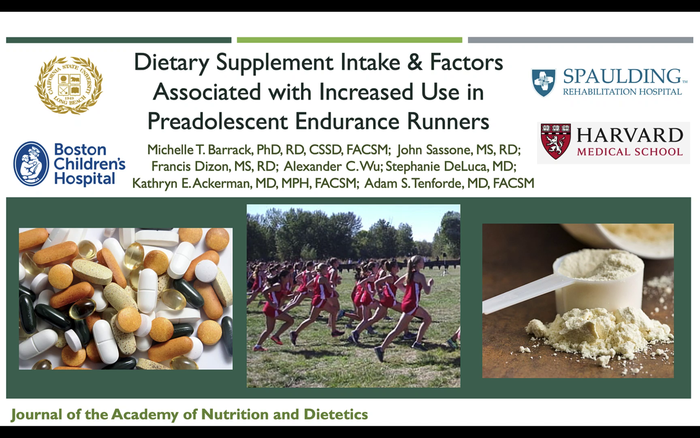
Philadelphia, November 17, 2021 – The first investigation into the prevalence of dietary supplement and sport food use in male and female middle school-aged runners has found that almost half the study participants used these products on two or more days a week during the prior year. Characteristics associated with supplement use included a prior bone stress injury, following a vegetarian diet and behaviors suggesting dietary restrictions such as losing weight and skipping meals, researchers report in the Journal of the Academy of Nutrition and Dietetics.
Credit: Journal of the Academy of Nutrition and Dietetics
Philadelphia, November 17, 2021 – The first investigation into the prevalence of dietary supplement and sport food use in male and female middle school-aged runners has found that almost half the study participants used these products on two or more days a week during the prior year. Characteristics associated with supplement use included a prior bone stress injury, following a vegetarian diet and behaviors suggesting dietary restrictions such as losing weight and skipping meals, researchers report in the Journal of the Academy of Nutrition and Dietetics.
“The preadolescent years represent a crucial period of growth. While previous studies have examined the use of dietary supplements in high school and college athletes, intake among preadolescent athletes was unknown,” explained lead author Michelle Barrack, PhD, RD, CSSD, FACSM, Department of Family and Consumer Sciences, California State University, Long Beach, CA, USA. “It is important to evaluate this population due to the recognition of an elevated risk of low bone mineral density, bone stress injury, and inadequate intake of energy. Additionally, in some cases, dietary supplements have been associated with the development of adverse events in children and adolescents.”
Data were gathered from 2,113 middle school-aged cross-country runners who completed a survey on dietary supplement use and related factors. Dietary supplements included vitamin/mineral and non-vitamin/mineral products; sport foods included energy bars, carbohydrate-electrolyte drinks, and protein bars or drinks. The survey covered demographic information, weight, height, sports participation history, weekly exercise training, running performance times, dietary patterns, menstrual function, history of a clinical eating disorder, and injury history. Respondents were asked to indicate the type and frequency of supplements and sports food consumption over the last year.
Among the middle school runners surveyed, 42.7% used either a dietary supplement or sport food on two or more days per week. Overall, 26.1% of runners reported using one or more dietary supplement, and 32.6% reported use of a sports food. Girls reported higher use of multivitamins/minerals, vitamin D, calcium, iron, probiotics, and diet pills. Boys reported higher use of creatine and sports food.
A higher proportion of runners with supplement use, compared to preadolescents with no supplement use, followed a vegetarian diet, were underweight, had one or more running-related injuries, met criteria for elevated dietary restraint, had a diagnosed eating disorder, or reported currently attempting to gain weight. Supplement use was reported by 51% of runners who skipped meals and 77% of runners with weight loss in the past year. The findings support associations between higher supplement use and factors consistent with lower food intake or energy deficiency.
“To our knowledge, this is the first study to observe these associations in youth runners,” said Dr. Barrack. “Findings from the study draw attention to the need for teaching middle school runners following an omnivorous or vegetarian diet about the importance of eating adequate energy, while avoiding calorie restriction or skipping meals.”
While supplements can aid in addressing nutrient inadequacies, limited regulation means that some products may contain harmful ingredients or promote adverse health effects. “Preadolescent endurance runners should maximize energy and nutrient intake from foods and consume a level of energy that supports their exercise energy expenditure,” added principal investigator Adam S. Tenforde, MD, FACSM, Spaulding Rehabilitation Hospital, Charlestown, MA, and Harvard Medical School, Boston, MA, USA. “Dietary supplementation should, ideally, be considered after a nutrition assessment and with consultation from a registered dietitian nutritionist.”
###
Journal
Journal of the Academy of Nutrition and Dietetics
DOI
10.1016/j.jand.2021.07.013
Method of Research
Data/statistical analysis
Subject of Research
People
Article Title
Dietary Supplement Intake and Factors Associated with Increased Use in Preadolescent Endurance Runners