• HOME
  • NEWS
  • EXPLORE
    • CAREER
      • Companies
      • Jobs
    • EVENTS
    • iGEM
      • News
      • Team
    • PHOTOS
    • VIDEO
    • WIKI
  • BLOG
  • COMMUNITY
    • FACEBOOK
    • INSTAGRAM
    • TWITTER
Monday, December 29, 2025
BIOENGINEER.ORG
No Result
View All Result
  • Login
  • HOME
  • NEWS
  • EXPLORE
    • CAREER
      • Companies
      • Jobs
        • Lecturer
        • PhD Studentship
        • Postdoc
        • Research Assistant
    • EVENTS
    • iGEM
      • News
      • Team
    • PHOTOS
    • VIDEO
    • WIKI
  • BLOG
  • COMMUNITY
    • FACEBOOK
    • INSTAGRAM
    • TWITTER
  • HOME
  • NEWS
  • EXPLORE
    • CAREER
      • Companies
      • Jobs
        • Lecturer
        • PhD Studentship
        • Postdoc
        • Research Assistant
    • EVENTS
    • iGEM
      • News
      • Team
    • PHOTOS
    • VIDEO
    • WIKI
  • BLOG
  • COMMUNITY
    • FACEBOOK
    • INSTAGRAM
    • TWITTER
No Result
View All Result
Bioengineer.org
No Result
View All Result
Home NEWS Science News Biology

Print me an organ — Why are we not there yet?

Bioengineer by Bioengineer
December 11, 2019
in Biology
Reading Time: 2 mins read
0
IMAGE
Share on FacebookShare on TwitterShare on LinkedinShare on RedditShare on Telegram

SUTD leads in-depth review on the impending reality of 3D printed organs and analyses recent accomplishments, limitations and opportunities for future research.
IMAGE

Credit: SUTD


3D bioprinting is a highly-advanced manufacturing platform that allows for the printing of tissue, and eventually vital organs, from cells. This could open a new world of possibilities for the medical field, while directly benefiting patients who need replacement organs.

Instead of waiting for a suitable donor or having the risk of their body rejecting a transplanted organ, 3D printed organs allow patients to have a customised organ fabricated specifically to replace their faulty ones. However, even with headway that 3D bioprinting has made in the last two decades, it is still lacking significant strides in order to produce complex 3D biomimetic tissue constructs.

According to researchers from the Singapore University of Technology and Design (SUTD), Nanyang Technological University (NTU) and Asia University, tissue culture techniques in particular require accelerated progress to address the bottleneck of maturing bioprinted multi-cellular 3D tissue constructs into functional tissues. Their research paper entitled “Print me an organ! Why are we not there yet?” has been published in the Progress in Polymer Science.

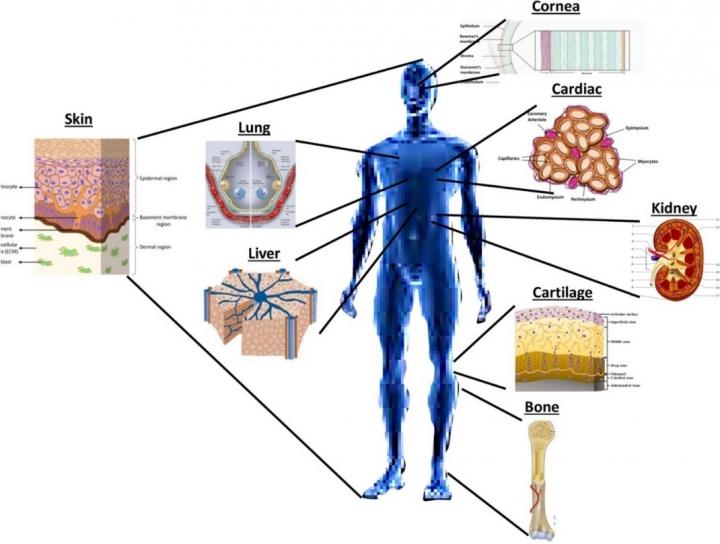
In the paper, researchers also provided in-depth review of recent improvements and analysed the bioprinting techniques, progress in bio-ink development, implementation of new bioprinting and tissue maturation strategies. Special attention was also given to the role of polymer science and how it complemented 3D bioprinting to overcome some of the major impediments such as achieving biomimicry, vascularization and 3D anatomically-relevant biological structures, in the field of organ printing (refer to image).

The use of complementary strategies such as dynamic co-culture perfusion system was seen as critical towards ensuring maturation and assembly of bioprinted tissue constructs. Even though it is now possible to fabricate human-scale tissues or organs that can potentially mature into vascularized and partially-functional tissues, the industry is still lagging behind in the bioprinting of human-specific tissues or organs due to the complexities in tissue-specific extracellular matrices (ECM) and tissue maturation process – the lack of suitable co-culture medium to support multiple types of cells and the need for further tissue conditioning prior to implantation.

“While 3D bioprinting is still in its early stages, the remarkable leap it has made in recent years points to the eventual reality of lab-grown, functional organs. However, to push the frontiers of medicine we must overcome the technical challenges in creating tissue-specific bio-inks and optimizing the tissue maturation process. This will ultimately have a huge impact on patients’ lives, many of whom may be reliant on the future of 3D bioprinting,” said Professor Chua Chee Kai, lead author of the paper from SUTD.

###

Media Contact
Jessica Sasayiah
[email protected]
656-499-4823

Original Source

https://www.sciencedirect.com/science/article/pii/S007967001930156X

Related Journal Article

http://dx.doi.org/10.1016/j.progpolymsci.2019.101145

Tags: BiologyBiomedical/Environmental/Chemical EngineeringBiotechnologyMedicine/HealthResearch/DevelopmentTechnology/Engineering/Computer Science
Share12Tweet8Share2ShareShareShare2

Related Posts

Future of Algeria’s Endemic Oak Under Climate Change

Future of Algeria’s Endemic Oak Under Climate Change

December 29, 2025
blank

New Nuclei Isolation Unveils Litopenaeus vannamei Cell Atlas

December 28, 2025

Unlocking Rice Quality: GWAS Sheds Light on Traits

December 28, 2025

Chloroplast Genome of Ecklonia maxima: A Comparative Study

December 27, 2025
Please login to join discussion

POPULAR NEWS

  • Robotic Waist Tether for Research Into Metabolic Cost of Walking

    NSF funds machine-learning research at UNO and UNL to study energy requirements of walking in older adults

    71 shares
    Share 28 Tweet 18
  • Exploring Audiology Accessibility in Johannesburg, South Africa

    51 shares
    Share 20 Tweet 13
  • Nurses’ Views on Online Learning: Effects on Performance

    70 shares
    Share 28 Tweet 18
  • SARS-CoV-2 Subvariants Affect Outcomes in Elderly Hip Fractures

    44 shares
    Share 18 Tweet 11

About

We bring you the latest biotechnology news from best research centers and universities around the world. Check our website.

Follow us

Recent News

Maternal Low Sodium, Postnatal Diuretics Harm Metabolism, Breathing

Quick Vessel Healing via Progenitor-Endothelial Cell Interaction

Future of Algeria’s Endemic Oak Under Climate Change

Subscribe to Blog via Email

Enter your email address to subscribe to this blog and receive notifications of new posts by email.

Join 71 other subscribers
  • Contact Us

Bioengineer.org © Copyright 2023 All Rights Reserved.

Welcome Back!

Login to your account below

Forgotten Password?

Retrieve your password

Please enter your username or email address to reset your password.

Log In
No Result
View All Result
  • Homepages
    • Home Page 1
    • Home Page 2
  • News
  • National
  • Business
  • Health
  • Lifestyle
  • Science

Bioengineer.org © Copyright 2023 All Rights Reserved.