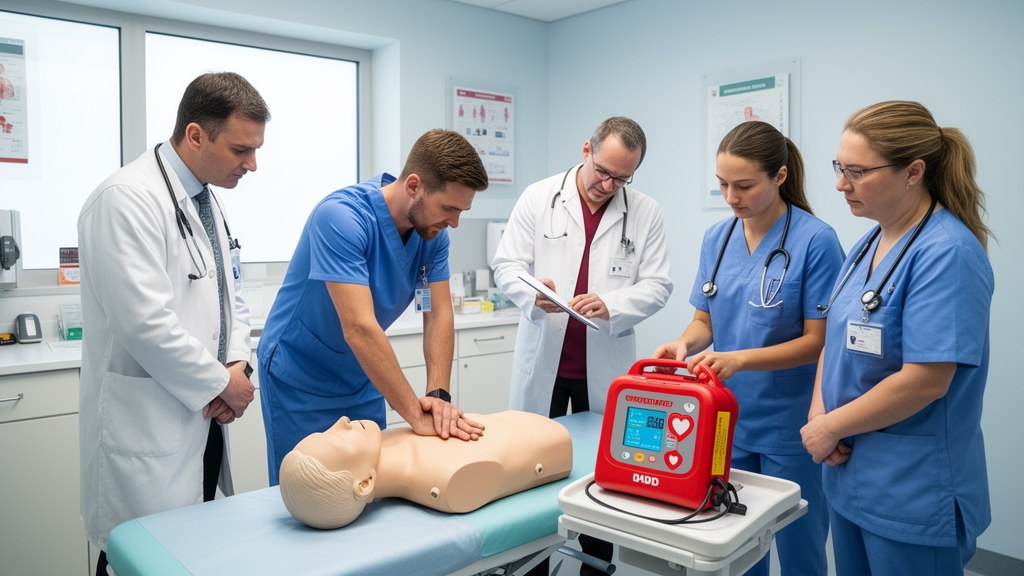
Most primary health care practices in and around the Polish city of Poznań are poorly prepared to manage out-of-hospital cardiac arrest, according to a cross-sectional survey published in BMC Health Services Research. The study, led by Tomasz Kłosiewicz and colleagues including Mateusz Puślecki, surveyed all 217 primary health care practices in Poznań and Poznań County between May and July 2025 and received 177 complete responses, a response rate of 81.6 percent. Out-of-hospital cardiac arrest is a leading resuscitation emergency, and primary care teams may be the closest trained personnel when a collapse occurs near their premises, making their readiness a direct determinant of whether guideline-concordant basic life support begins in time.
The survey assessed three domains: exposure to cardiac arrest events, basic life support training, and availability of resuscitation equipment. Data were collected through structured interviews using a standardized questionnaire, and in 104 practices the team carried out partial visual verification of the equipment reported. Events in the previous ten years were reported by 40.0 percent of county practices and 28.9 percent of urban practices, confirming that cardiac arrest is not a rare occurrence in the primary care setting. Yet formal basic life support training had been conducted in only 26.3 percent of county practices and 14.4 percent of urban practices, and within the last two years in just 10.0 percent and 5.2 percent respectively.
Equipment availability was similarly limited. Automated external defibrillators, which analyze the heart rhythm and deliver a shock for shockable arrhythmias such as ventricular fibrillation, were present in 43.8 percent of county practices and 32.0 percent of urban practices. Airway management capacity was scarcer still: supraglottic airway devices, which allow ventilation without the skill requirements of endotracheal intubation, were available in 12.5 percent of county practices and only 2.1 percent of urban practices. Suction devices were reported in 17.5 to 18.8 percent of practices, and oxygen sources in 11.3 to 17.5 percent. In multivariable logistic regression, practices that had conducted basic life support training showed greater availability of automated external defibrillators, but the authors note that because training and equipment were measured concurrently, the temporal sequence and direction of this association could not be established.
The authors conclude that the preparedness of primary health care practices for out-of-hospital cardiac arrest is insufficient, and that updating minimum equipment standards and implementing regular training programs are warranted. The study’s strengths include a near-complete census of practices in a defined geographic area and a high response rate, while its limitations include self-reported equipment data for most practices and the cross-sectional design, which precludes causal inference. The findings describe one Polish metropolitan region and do not establish how preparedness has changed over time or how it compares with other regions.
Subject of Research: Preparedness of primary health care practices for out-of-hospital cardiac arrest in Poznań, Poland
Article Title: Preparedness of primary health care practices for out-of-hospital cardiac arrest: a cross-sectional study of training, equipment, and cardiac arrest experience in a large Polish metropolitan area
Article References: Wójcik, R., Kłosiewicz, T., & Puślecki, M. (2026). Preparedness of primary health care practices for out-of-hospital cardiac arrest: a cross-sectional study of training, equipment, and cardiac arrest experience in a large Polish metropolitan area. BMC Health Services Research. https://doi.org/10.1186/s12913-026-15490-2
Image Credits: AI Generated
DOI: 10.1186/s12913-026-15490-2
Keywords: out-of-hospital cardiac arrest, primary health care, basic life support, automated external defibrillator, resuscitation equipment, cross-sectional survey, Poznań, Poland, emergency preparedness, airway management, chain of survival, health services research
News Source: Ophelia Keating. (October 26, 2026). Primary care practices fall short on cardiac arrest readiness, Polish survey finds. Scienmag.