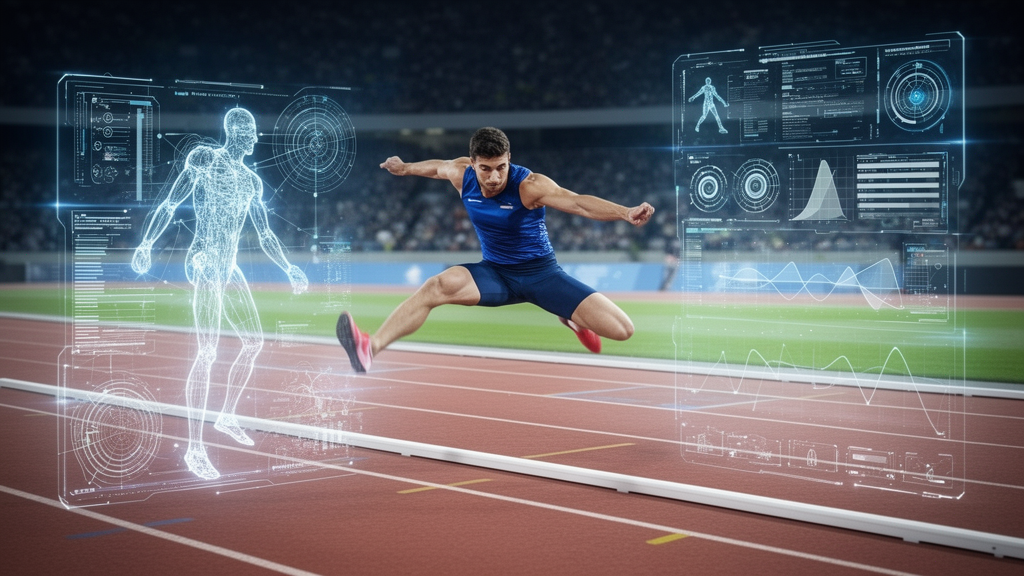
A new artificial intelligence framework for physical education can watch a student sprint down the runway, take off, fly through the air and land, then convert what it sees into precise numerical scores and targeted coaching feedback. The system, described in the journal Discover Artificial Intelligence, chains together several deep learning technologies — YOLOv5 for object detection, DeepSORT for multi-object tracking, OpenPose for skeletal keypoint extraction, a bidirectional long short-term memory network for temporal modeling, and the Dynamic Time Warping algorithm for comparing a student’s motion against a standard template. In experiments at a university athletics track, the intelligent estimation module reached an evaluation accuracy of 90.50 percent for the take-off movement, and students who trained with the system for eight weeks improved their take-off scores by 9.33 points, their flight-phase scores by 10.34 points and their landing scores by 7.34 points, with an overall long jump score gain of 15.63 points.
The motivation behind the work lies in a persistent weakness of conventional long jump instruction. The event demands explosive strength, coordination and precise timing across four rapidly transitioning phases — approach, take-off, flight and landing — and teachers traditionally assess it through direct observation and subjective judgment. That approach struggles with the temporal dynamics of continuous motion and the high-dimensional correlations between body segments, producing low efficiency and high subjectivity. Earlier AI-driven studies have applied decision trees, deep neural networks, attention-based recurrent models, graph convolutional networks and pose estimation frameworks to sports movement analysis, improving capture accuracy and evaluation precision, but the authors note that most existing models still struggle with continuous action segmentation, long-range temporal dependency modeling and scalable evaluation efficiency. Prior systems also tend to rely on high-performance computing equipment and professional camera environments, making them difficult to adapt to ordinary physical education classes.
The first technical pillar of the new model is run-up speed measurement. Because approach speed directly affects take-off performance and the final result, the system must track students moving rapidly across the runway. YOLOv5, a single-stage object detector, handles dynamic position detection through a backbone network, a neck structure and a head network: convolutional operations extract image features, a spatial pyramid pooling module captures multi-scale features, and the head network predicts bounding boxes using a Complete Intersection over Union loss function that adds comparisons of box width, height and center distance for greater stability. Because multiple students often train simultaneously and occlude one another, the detector alone cannot reliably follow a single target, so DeepSORT is layered on top. It combines a Kalman filter that predicts each target’s next position with cascade matching and the Hungarian algorithm, using a Mahalanobis distance threshold of 9.4877 for motion matching and cosine similarity between 128-dimensional appearance descriptors for visual matching.
Speed itself is measured with a virtual line calibration algorithm. The start and end lines of the approach are defined as virtual lines in the camera view, and the system records the frame numbers at which the midpoint of the bottom of a student’s bounding box crosses each line. Dividing the real-world distance between the lines by the elapsed frames, scaled by the video’s frame rate, yields the run-up speed. In validation experiments, the maximum relative error between the module’s speed measurements and actual values was 0.37 meters per second at 120 frames per second, 0.51 meters per second at 60 frames per second and 0.75 meters per second at 30 frames per second. Under different lighting, the maximum error was 0.29 meters per second in front lighting, 0.48 meters per second in side lighting and 0.67 meters per second in backlighting, which the authors attribute to the stability of the YOLOv5 and DeepSORT tracking pipeline.
The second pillar analyzes body posture during take-off, flight and landing. OpenPose, a real-time multi-person two-dimensional pose estimation framework, constructs Part Confidence Maps and Part Affinity Fields through parallel branches of convolutions, iteratively predicting skeletal confidence maps and limb affinity fields that are matched to assemble complete skeletons, detecting body, hand, face and foot keypoints simultaneously. Because each phase transition in a long jump sequence shows strong temporal dependence, OpenPose alone cannot segment the motion phases accurately, so the framework is combined with a bidirectional long short-term memory network. The BiLSTM’s hidden layer — built from input, output and forget gates plus memory cells — models temporal features to capture the inertia and adjustment characteristics of each phase, while an attention mechanism assigns weights to different features and segments the motion accordingly.
Evaluation then rests on Dynamic Time Warping, a dynamic-programming similarity method that aligns time series of different lengths. The detected motion sequence is stretched or translated to align with a standard sequence, Euclidean distances between corresponding points are computed, and those distances are converted into scores on a zero-to-one scale and multiplied by 100. The complete path distance, accumulated through a minimum-distance principle, is divided by the sequence length to produce the final posture score. The intelligent estimation module runs its motion capture layer and speed measurement layer in parallel, then combines posture and speed results into an overall assessment. In testing, the median normalized error across nine critical joint angles — including the hip-knee-ankle angle and the knee-hip-horizontal line angle — reached at most 0.150, with medians of 0.103 for angle V1 and 0.110 for angle V2, and the module achieved its highest accuracy of 90.50 percent on the take-off action, a highest F1 score of 92.75 percent on the arching action and 91.10 percent accuracy on the tucking action.
The experimental evidence base was carefully constructed. Videos of 30 students and 5 athletes were collected at a university athletics track, with each student performing three attempts in the morning, at noon and in the evening to simulate full light, backlight and side light conditions; combined footage simulated occlusion and noise. Key frames in 35 videos were manually annotated and expert-reviewed, achieving 98.2 percent annotation consistency with a Kappa coefficient of 0.82. After three severely distorted or blurred samples were excluded, 32 valid videos remained for validation. Three experts scored the students’ postures with a Krippendorff’s Alpha of 0.86 and a Cohen’s Kappa of 0.82, providing a reliable reference standard. Training used the Adam optimizer with an initial learning rate of 1e-4 decaying by a factor of 0.9 every ten rounds, 100 training rounds, a batch size of 32 and early stopping, with data split 8:1:1 into training, validation and test sets so that no athlete appeared in more than one subset.
To test teaching effectiveness, the team ran a controlled eight-week experiment with five teachers and 50 students of similar fitness, comparing the proposed model against SA-YOLOv8n-pose, Lite-HRNet-FDM and EAQA-DSPVFI. The overall long jump score weights the starting speed, take-off, flight and landing stages at 0.15, 0.35, 0.30 and 0.20 respectively. The proposed model’s fitting curve against teacher ratings reached an R-squared of 0.924, beating EAQA-DSPVFI at 0.882, SA-YOLOv8n-pose at 0.843 and Lite-HRNet-FDM at 0.831. It also posted a stable inter-frame loss rate of 0.035, the lowest among the compared systems, and a processing speed of 97.78 frames per second, the highest, with 63.20 million parameters. When 50 students rated each model’s training usefulness on a zero-to-four scale, the proposed model accumulated 53.52 percent of responses at the three-point level and 44.31 percent at the four-point level, both higher than any comparison model. By the fourth week, the experimental group’s average long jump score had risen by 12.33 points, and by the eighth week the overall gain reached 15.63 points.
Robustness checks reinforced the picture. On the external Jump-Broadcast Dataset of 127 long jump competition videos from different broadcasting platforms, the method achieved an action recognition accuracy of 92.4 percent, a stage-division F1 score of 0.87, and a key frame positioning error of plus or minus 2.3 frames, with an average cross-dataset improvement of 18.6 percent over normal training, compared with no more than 10 percent for the other methods tested. Ablation experiments confirmed that every component contributes: the complete model reached an accuracy of 0.942 and a mean average precision of 0.957, while removing YOLOv5 caused the steepest decline, to 0.887 accuracy and 0.879 mAP, with smaller but consistent drops from removing DeepSORT, OpenPose, BiLSTM or DTW. On an embedded NVIDIA Jetson Xavier NX platform processing 1920-by-1080 video at 30 frames per second, the full model averaged 45.2 milliseconds of inference per frame with about 1.8 gigabytes of memory, sustaining roughly 22 frames per second, with YOLOv5 consuming about 55 percent of inference time and OpenPose about 30 percent. Against lightweight 2024–2025 pose models, the system achieved a keypoint detection average precision of 0.912, roughly 3.2 percentage points above the second-best RTMPose, while YOLOv8n-Pose and MediaPipe Pose reached 0.874 and 0.861.
The authors frame the system as a multi-level architecture comprising an intelligent estimation layer, an interactive instruction layer and a teaching feedback layer, in which uploaded videos are split into approach and posture segments, scored, and translated through a teaching semantic feedback mechanism into intuitive reports, training plans and motion correction suggestions. They acknowledge limitations: adaptability to different populations and environmental conditions has not been fully validated, and future work should introduce learners of different ages, genders and exercise backgrounds, integrate multimodal data such as inertial sensors alongside video, and develop hybrid artificial intelligence models to improve robustness and generalization. Within the scope of the reported experiments, however, the study demonstrates that a pipeline of detection, tracking, pose estimation, temporal modeling and sequence alignment can turn ordinary classroom video into objective, phase-by-phase long jump assessment — and that students trained with that feedback improved measurably across every stage of the jump.
Subject of Research: An AI-based teaching and evaluation system for track and field long jump using deep learning motion assessment
Article Title: Teaching and evaluation methods for track and field long jump based on intelligent assessment technology
Article References: Chen, X., & Yang, C. (2026). Teaching and evaluation methods for track and field long jump based on intelligent assessment technology. Discover Artificial Intelligence, 6(1), Article 1598. https://doi.org/10.1007/s44163-026-02594-1
Image Credits: AI Generated
DOI: 10.1007/s44163-026-02594-1
Keywords: long jump, deep learning, YOLOv5, DeepSORT, OpenPose, BiLSTM, dynamic time warping, pose estimation, physical education, motion assessment, sports technology, intelligent teaching
News Source: Blake Davidson. (October 26, 2026). Deep learning system scores long jump technique and lifts student performance. Scienmag.