Solar cells are quickly becoming one of the main ways to produce clean electricity in many countries in the world. Over the past few decades, a tremendous amount of effort has been dedicated to making solar power more prominent. However, the technology currently faces several challenges that limit their widespread application.
Credit: Tomohiko Inomata from NITech, Japan
Solar cells are quickly becoming one of the main ways to produce clean electricity in many countries in the world. Over the past few decades, a tremendous amount of effort has been dedicated to making solar power more prominent. However, the technology currently faces several challenges that limit their widespread application.
In the case of dye-sensitized solar cells (DSSCs)—a highly promising photovoltaic technology—one of the main problems is dye aggregation. By design, DSSCs are electrochemical systems that mimic photosynthesis in plants; they rely on special photosensitive dyes to convert sunlight into electricity. Ideally, the dye should be applied evenly over the surface of an oxide electrode behind a transparent layer so that energy from absorbed sunlight can be transferred easily to the dye’s electrons. This process generates free electrons that power an external circuit. However, most dyes tend to aggregate over the electrode surface in a way that hinders the desired flow of both light and electric charges. This takes a toll on the performance of DSSCs that has proven difficult to overcome.
Fortunately, a team of scientists led by Associate Professor Tomohiko Inomata of Nagoya Institute of Technology, Japan, may have just found a solution to this problem. In their recent study published in RSC Advances, they showed that certain ionic liquids (molten salts that are in liquid state at relatively low temperatures) can suppress dye aggregation to an impressive degree. Other members of this research team included Ms. Ayaka Matsunaga and Prof. Tomohiro Ozawa from Nagoya Institute of Technology, and Prof. Hideki Masuda from Aichi Institute of Technology, Japan.
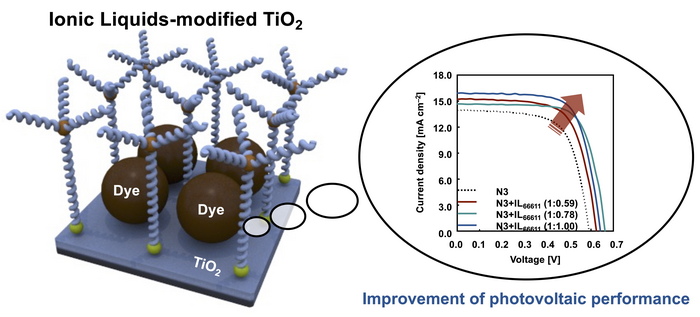
But, how do ionic liquids achieve this feat? To shed light on the exact mechanism at play, the researchers focused on two ionic liquids with markedly different molecular sizes and two types of dyes. Both the ionic liquids had a similar molecular structure comprising an anchor that binds well to the electrode (titanium dioxide, TiO2), a main polymer chain linking this anchor to a phosphor atom, and three additional short polymer chains protruding from the phosphor atom and away from the main “vertical” chain.
The researchers submerged the TiO2 electrodes in solutions with different dye-to-ionic-liquid proportions and carefully analyzed how the different molecules adhered to them. After optimizing the synthesis procedure, they found that DSSCs made using the ionic liquid with a longer molecular structure had a remarkably better performance than their counterparts with non-modified oxide electrodes. “The spatially bulky molecular structure of ionic liquids acts as an effective anti-aggregation agent without significantly impacting the amount of dye adsorbed into the electrode,” explains Dr. Inomata. “Most importantly, the introduction of the larger ionic liquid improves all the photovoltaic parameters of the DSSCs.”
Needless to say, improving solar cell technology could give us an edge in the fight against the ongoing energy and climate crisis. Although ionic liquids are typically expensive, the way it is used by the team is, in fact, cost-effective. “Put simply, the idea is to apply ionic liquids only at the required part of the device—in this case, the electrode’s surface,” states Dr. Inomata.
The team believes that the widespread use of electrodes modified with ionic liquids could pave the way for highly functional yet affordable materials for solar cells and catalytic systems. Since the structure of ionic liquids can be tuned during their synthesis, they offer a much-needed versatility as anti-aggregation agents.
Let us hope these findings lead to a brighter future for DSSCs and, eventually, for the planet.
About Nagoya Institute of Technology, Japan
Nagoya Institute of Technology (NITech) is a respected engineering institute located in Nagoya, Japan. Established in 1949, the university aims to create a better society by providing global education and conducting cutting-edge research in various fields of science and technology. To this end, NITech provides a nurturing environment for students, teachers, and academicians to help them convert scientific skills into practical applications. Having recently established new departments and the “Creative Engineering Program,” a 6-year integrated undergraduate and graduate course, NITech strives to continually grow as a university. With a mission to “conduct education and research with pride and sincerity, in order to contribute to society,” NITech actively undertakes a wide range of research from basic to applied science.
Website: https://www.nitech.ac.jp/eng/index.html
Journal
RSC Advances
DOI
10.1039/d2ra03230a
Method of Research
Experimental study
Subject of Research
Not applicable
Article Title
Improvements in photoelectric performance of dye-sensitised solar cells using ionic liquid-modified TiO2 electrodes
Article Publication Date
6-Jul-2022
COI Statement
There are no conflicts to declare.