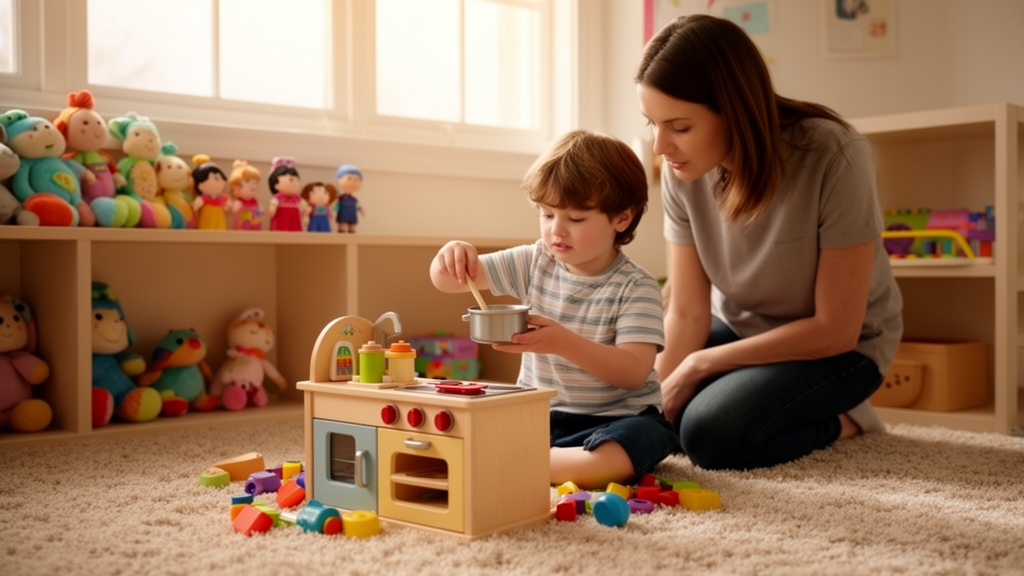
A new mixed methods study offers one of the clearest pictures yet of how pretend play differs among autistic children across the three DSM-5-TR support levels, and the results form a striking gradient. Researchers assessed 42 autistic children aged 4 to 7 years, evenly split with 14 children in each of Levels 1, 2, and 3, using the Child-Initiated Pretend Play Assessment 2, known as the ChIPPA2. Pretend play matters because it is an important indicator of child development and can reveal clinically relevant information about how a child organises, sustains, and shares play. Yet until now, little has been known about how this capacity varies across the support levels that clinicians use to describe autism severity. The study, published as an open access paper in BMC Pediatrics, found significant differences across all three levels, with children in Level 1 showing the most complex pretend play performance, children in Level 3 the least complex, and Level 2 an intermediate profile.
The quantitative component of the study relied on raw scores that capture distinct dimensions of pretend play. These included the Percentage of Elaborate Play Actions, or PEPA, which reflects how elaborate and sustained a child’s symbolic play actions are; the Number of Object Substitutions, or NOS, which measures the child’s ability to treat one object as if it were another, the hallmark of symbolic thinking; and the Number of Imitated Actions, or NIA. The researchers also scored supportive and non-supportive indicators of play and used the Enjoyment in Play Scale. Group differences were examined with Kruskal-Wallis tests, and Quade’s rank analysis of covariance was used to control for age and sex, ensuring that the observed gradients were not simply artifacts of who was older or whether boys and girls were unevenly distributed. Significant differences emerged across the three support levels for PEPA scores, NOS symbolic and combined scores, NIA scores, supportive and non-supportive indicators of play, and enjoyment in play.
The qualitative strand added texture that raw scores alone cannot supply. Sessions were video-recorded, and the researchers produced narrative observational records that were analysed using qualitative content analysis. This process identified four thematic categories: symbolic elaboration of play, social engagement during play, reduced play engagement and discontinuity, and concrete, repetitive, and sensory-perceptual engagement with materials. Symbolic play, the researchers found, was more sustained and elaborated in children at Level 1, less integrated at Level 2, and brief and circumscribed at Level 3. In contrast, concrete, repetitive, and sensory-perceptual engagement with materials was especially evident in children with higher support needs, suggesting that these children related to play materials in ways that were organised around the physical and sensory properties of objects rather than their symbolic possibilities.
When the quantitative and qualitative strands were integrated during interpretation, the findings converged in a striking way. Lower quantitative performance corresponded with play that was less sustained, less socially shared, and less symbolically organised. This convergence is what gives the study its clinical punch: the numbers and the narratives describe the same underlying phenomenon from two directions. A child whose PEPA score indicates few elaborate play actions is also the child whose video-recorded session shows play that breaks off, that is not offered to or shared with the examiner, and that remains anchored in what the materials literally are rather than what they could imaginatively become. The Enjoyment in Play Scale differences add another layer, indicating that the pleasure children take in pretend play itself varies across support levels, not merely the technical skill they display.
The authors conclude that pretend play performance varied across the three support levels in autistic children, and that the ChIPPA2 provided clinically meaningful information about the organisation, continuity, enjoyment, and social sharing of play. Because the assessment captures how play is initiated, elaborated, imitated, and enjoyed, the researchers suggest it may support more individualised assessment and intervention planning, matching support to each child’s actual play profile rather than to a support level alone. The study’s design, with equal group sizes and statistical controls for age and sex, strengthens the gradient interpretation, while the video-based observational records ground the scores in observable play behaviour. For clinicians, the message is that pretend play assessment can yield information that goes beyond a checklist of play skills, illuminating how an autistic child organises, sustains, and shares imaginative play, and where intervention might most usefully begin.
Subject of Research: Pretend play performance across support levels in autistic children: a mixed methods study
Article Title: Pretend play performance across support levels in autistic children: a mixed methods study
Article References: Caran, F. H. S., Stagnitti, K., Lucisano, R. V., Pfeifer, L. I., & Sposito, A. M. P. (2026). Pretend play performance across support levels in autistic children: a mixed methods study. BMC Pediatrics. https://doi.org/10.1186/s12887-026-07721-6
Image Credits: AI Generated
DOI: 10.1186/s12887-026-07721-6
Keywords: Pretend, play, performance, across, support, levels, autistic, children, mixed, methods, scientific research
News Source: Ophelia Keating. (October 24, 2026). Pretend play performance across support levels in autistic children: a mixed methods study. Scienmag.