Credit: Xiaojun Wang
DURHAM, N.C. — Extreme droughts, intensified by a warming climate, are increasingly causing ecosystem collapse in many regions worldwide. But models used by scientists to predict the tipping points at which drought stress leads to ecosystem collapse have proven unreliable and too optimistic.
A new study by scientists at Duke University and Beijing Normal University may hold the answer why.
The researchers found that these tipping points can happen much sooner than current models predict because of the added pressures placed on drought-weakened plants by grazing animals and fungal pathogens.
"Our work provides the first real-world experimental evidence that these natural enemies of plants can play a dramatic role in lowering ecosystems' tipping point by killing drought-weakened vegetation and preventing plants from recovering," said Brian R. Silliman, Rachel Carson Associate Professor of Marine Conservation Biology at Duke's Nicholas School of the Environment.
Ecologists have long known that drought can stimulate this type of attack on plants, he said, but they mostly discounted it as a secondary stress and not a main cause of ecosystem collapse.
"What we found is the opposite," Silliman said. "Grazers have a strong compounding effect. This means these ecosystems are far more vulnerable to drought than the current models predict. With grazers present, they can handle much less drought stress."
The team published its findings Jan. 6 in the peer-reviewed journal Ecology Letters.
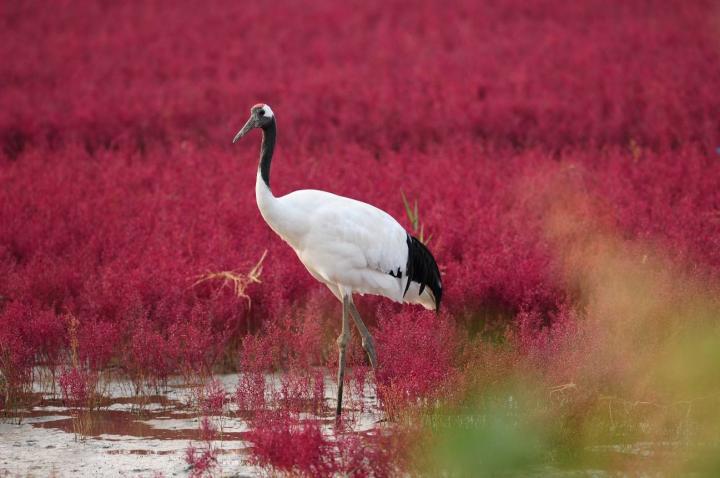
The scientists conducted their field work between 2009 and 2015 in salt marshes in China's Yellow and Liao river deltas. The marshes, which are famed for their year-round purplish-red color, are among the last protected native coastal wetlands in China.
The marshes experienced widespread vegetation die-off following an extreme drought in 2011. The researchers performed a series of experiments before, during and after the drought to test how pressures from heavy grazing by crabs — the main natural enemy of plants in the protected marshes — affected resilience to and recovery from the drought.
"In test plots where crabs were excluded, we found that vegetation loss was significantly lower and many plants could survive the drought," said Qiang He, a postdoctoral researcher in Silliman's lab. "They died back temporarily but recovered quickly after the drought ended."
"But in control plots, grazing by crabs decimated the drought-stressed plants, resulting in nearly complete vegetation loss," said He, who has studied the Chinese marshes for more than 10 years since he was a student at Beijing Normal University.
In areas open to crabs, vegetation recovery lagged for at least four years after the 2011 drought ended, Qiang He added.
Silliman said the findings are probably relevant to many other ecosystems. "Plants in forests and grasslands can also be decimated by natural enemies, such as insects and fungal pathogens, during droughts."
Based on the team's preliminary review of drought-associated plant die-offs in other ecosystems worldwide, more than half of all such reported events could have been exacerbated by some type of natural enemy. The relative importance of natural enemies versus drought in these cases, however, is still unclear and will require further study.
Severe droughts are on the rise in many regions worldwide and are increasingly affecting a wide range of ecosystems — including marshes, mangroves, temperate and tropical forests, grasslands and coral reefs — that provide essential services to humans and the environment alike, Silliman said.
"Being able to predict how and when these extreme events will affect ecosystems, and identify management practices that can help reduce the impacts, has become a high priority," Silliman said.
"The problem is that most of the plant-tolerance models we currently use to predict these outcomes are based on laboratory studies or plant physiological studies, so they often don't factor in the compounding effects of simultaneous stressors like drought and pressure from natural enemies. The result has been that ecosystems are dying well before our models predict they will.
"Hopefully," he said, "the findings from this study will help us develop better models and management practices."
###
Funding for the study, which was co-authored by Zezheng Liu and Baoshan Cui of Beijing Normal University, came from the National Key Basic Research Program of China. Qiang He was also partly supported by the Edward Stolarz Foundation, and through funding from the National Science Foundation and Duke University.
CITATION: "Natural Enemies Govern Ecosystem Resilience in the Face of Extreme Droughts," Qiang He, Brian R. Silliman, Zezheng Liu and Baoshan Cui. Ecology Letters, Jan. 6, 2017. DOI: 10.1111/ele.12721
Media Contact
Tim Lucas
[email protected]
919-613-8084
@DukeU
http://www.duke.edu