Some of North America’s most enigmatic mammals have finally begun to give up their secrets, and the evidence came from an unlikely archive: a cave floor in northern Arizona, museum drawers packed with century-old specimens, and mist nets strung across desert canyons. In a study published October 7, 2026, in the open-access journal PLOS One, Faith M. Walker of Northern Arizona University and colleagues assembled a genetic time machine for the spotted bat (Euderma maculatum), stitching together DNA from ancient, historical, and modern samples to reconstruct how this elusive species has fared across western North America over more than two thousand years. The work arrives at a moment when bat conservation has never been more urgent, with habitat loss, climate change, and the fungal disease white-nose syndrome reshaping chiropteran communities across the continent.
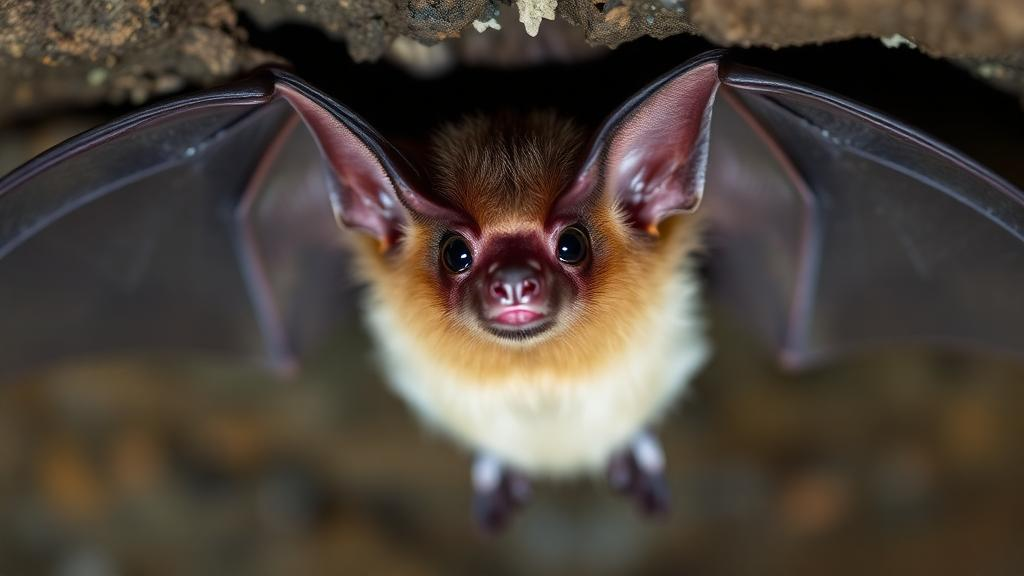
Bats represent roughly one-fifth of all mammalian diversity on Earth, yet they remain among the least understood of mammals, and the spotted bat may be the most mysterious of the lot. With its striking black fur, oversized pink ears, and bold white spots, Euderma maculatum is unmistakable when seen, but seeing one is a rare privilege. The species is nocturnal and an agile, high-flying hunter, and unlike many of its relatives it roosts solitarily, often in cliff crevices far from human observation. That combination of solitary habits and remote roosts means conventional ecological monitoring, such as colony counts or roost surveys, yields frustratingly little data. Population trends that would be obvious in a colonial species like the little brown bat remain essentially invisible for the spotted bat, which is precisely why the research team turned to genetics as an alternative lens.
The design of the study was ambitious in its temporal reach. The researchers obtained samples from 121 individual bats spanning three separate timeframes across the species’ range in western North America. The modern component came from live bats captured in the field, while contemporary specimens collected between 1994 and 2025 supplemented the picture. Historical material was drawn from museum collections, with specimens gathered between 1904 and 1991, providing a bridge to the early twentieth century. Most remarkably, the team recovered ancient remains from a cave in northern Arizona, radiocarbon dated to between 120 and 2,100 years before present. By sequencing genetic material across this continuum, the researchers could compare past and present populations directly, testing whether the genetic architecture of the species has shifted as the American West was transformed by settlement, land use change, and a warming climate.
The analytical framework behind such temporal comparisons is grounded in conservation genetics, a discipline that treats variation in DNA as a record of a population’s demographic history. When a population is large and well connected, individuals carry many different variants at the genetic markers being surveyed, and those variants are distributed relatively evenly across the landscape. When a population shrinks or becomes fragmented, two signatures typically appear: genetic diversity declines because rare variants are lost in each generation, and genetic structure increases because populations that no longer exchange migrants begin to drift apart. Relatedness among individuals also rises in isolated groups, as mates become increasingly likely to share recent ancestors. By measuring these quantities in samples from different eras, researchers can distinguish long-standing patterns from recent deterioration, something a snapshot of modern samples alone cannot achieve.
Applying this framework to the spotted bat, Walker and colleagues were able to describe the species’ genetic structure, genetic variation, and patterns of relatedness in unprecedented detail, and to identify clear genetic differences between northern and southern populations. One of the most consequential findings concerns geography: spotted bats in the southwestern United States harbor the greatest genetic diversity found anywhere across the species’ range. As Walker explains, this makes the Southwest a critical reservoir of evolutionary potential for the species, the region where the raw material for adaptation to future environmental change is most abundant. In contrast, the northern populations appear to carry lower genetic diversity, a pattern that may reflect postglacial colonization history, smaller effective population sizes, or reduced connectivity, and that could leave these animals more vulnerable as conditions shift.
The temporal dimension of the data adds a layer of interpretation that purely contemporary studies lack. Ancient remains spanning two millennia establish a baseline from before industrial-scale land transformation, allowing the researchers to ask whether the diversity observed today is a recent casualty of human activity or a persistent feature of the species’ biology. The authors report that their integrative approach across temporal scales highlights the conservation importance of preserving genetically diverse core populations, vulnerable leading-edge populations, and isolated relict lineages. In practical terms, this means the Southwest’s diverse populations deserve protection not merely because they are numerous but because they anchor the species’ adaptive capacity, while northern edge populations and any relict lineages may represent unique evolutionary histories that, once lost, cannot be recovered from elsewhere in the range.
Walker emphasizes the broader methodological lesson for conservation science. Rare and elusive species, she notes, can be extremely difficult to study using conventional methods, and genetics allows researchers to see patterns of connectivity, isolation, and long-term persistence that would otherwise remain hidden, providing information that can directly inform conservation planning. The spotted bat study demonstrates the point vividly: from 121 individuals, most of them represented only by a small tissue sample or a fragment of bone, the team reconstructed population structure across an entire continental range and across more than two thousand years of history. For species where every field sighting is a small event, genetic sampling effectively multiplies the value of each encounter.
The project also illustrates the underappreciated scientific value of natural history collections. Walker describes one of the most rewarding aspects of the work as bringing together samples collected over more than a century, from museum specimens and ancient cave remains to bats captured in the field today, with each sample representing a small piece of the species’ history that, combined with the others, allowed a much broader picture of population change through time. Museum specimens collected by collectors who could not have imagined DNA sequencing have become an irreplaceable genomic archive, and ancient subfossil material extends that archive deep into the pre-industrial past. As sequencing technology improves and costs fall, the marginal value of well-curated collections only grows, a strong argument for their continued funding and protection.
The authors are candid about the study’s limitations, which matter for how the results should be applied. Many of the modern specimens originated from a single cave, introducing a sampling bias that could skew estimates of contemporary diversity and structure if that cave’s residents are not representative of the wider region. The team notes that future studies are needed to better understand the impacts of specific anthropogenic disturbances, such as habitat alteration, climate shifts, and disease, on population dispersal and dynamics. Refining the geographic coverage of modern sampling, and extending the ancient record to additional caves and time periods, would sharpen the inferences and help attribute observed changes to particular causes rather than to general environmental change.
For now, the study offers both a warning and a roadmap. By combining DNA from ancient, historical, and modern specimens, the researchers traced the spotted bat’s evolutionary history across space and time and identified the populations that may be most important to conserve for the future, as Walker puts it. Further knowledge of population structure and genetic diversity across the species’ range, the authors write, will promote conservation and management actions for spotted bats. As emerging threats intensify across North America, the ability to read a species’ demographic past directly from its DNA may prove to be one of conservation biology’s most powerful tools, and the spotted bat, long a ghost of the desert night, has now contributed one of the clearest demonstrations of that power.
Subject of Research: Conservation genetics of the spotted bat using ancient, historical, and modern DNA samples
Article Title: Ancient spotted bat samples help researchers understand present-day population dynamics
Article References: Ancient spotted bat samples help researchers understand present-day population dynamics. (n.d.). Original publication
Image Credits: AI Generated
DOI: Not provided
Keywords: spotted bat, Euderma maculatum, ancient DNA, conservation genetics, population structure, genetic diversity, museum specimens, PLOS One, white-nose syndrome, North America, wildlife conservation, temporal genomics
News Source: Margaret Porter. (October 8, 2026). Ancient DNA From Cave-Dwelling Spotted Bats Reveals a Century of Population Change. Scienmag.