• HOME
  • NEWS
  • EXPLORE
    • CAREER
      • Companies
      • Jobs
    • EVENTS
    • iGEM
      • News
      • Team
    • PHOTOS
    • VIDEO
    • WIKI
  • BLOG
  • COMMUNITY
    • FACEBOOK
    • INSTAGRAM
    • TWITTER
Tuesday, June 30, 2026
BIOENGINEER.ORG
No Result
View All Result
  • Login
  • HOME
  • NEWS
  • EXPLORE
    • CAREER
      • Companies
      • Jobs
        • Lecturer
        • PhD Studentship
        • Postdoc
        • Research Assistant
    • EVENTS
    • iGEM
      • News
      • Team
    • PHOTOS
    • VIDEO
    • WIKI
  • BLOG
  • COMMUNITY
    • FACEBOOK
    • INSTAGRAM
    • TWITTER
  • HOME
  • NEWS
  • EXPLORE
    • CAREER
      • Companies
      • Jobs
        • Lecturer
        • PhD Studentship
        • Postdoc
        • Research Assistant
    • EVENTS
    • iGEM
      • News
      • Team
    • PHOTOS
    • VIDEO
    • WIKI
  • BLOG
  • COMMUNITY
    • FACEBOOK
    • INSTAGRAM
    • TWITTER
No Result
View All Result
Bioengineer.org
No Result
View All Result
Home NEWS Science News

Pressing ‘pause’ on nature’s crystal symmetry

Bioengineer by Bioengineer
May 1, 2020
in Science News
Reading Time: 3 mins read
0
IMAGE
Share on FacebookShare on TwitterShare on LinkedinShare on RedditShare on Telegram

Discovery by Drexel researchers could improve targeted medicine delivery
IMAGE

Credit: Drexel University

The new development, recently reported in the scientific journal Nature Communications, was led by Christopher Li, PhD, a professor in Drexel’s College of Engineering whose research has centered around engineering polymer structures for special applications, in collaboration with Bin Zhao, PhD, a professor in the Chemistry Department at the University of Tennessee, Knoxville. Their work shows how these structures, like polymer crystal spheres, can be formed simply by mixing chemicals in a solution – rather than physically manipulating their growth.

“Most crystals grow in a regular pattern, if you think about snowflakes, there is a translational symmetry that guides the unit cell repeating throughout the crystalline flake. What we’ve discovered is a way to chemically manipulate the macromolecular structure so that this translational symmetry is broken when the molecule crystallizes,” Li said. “This means we can control the overall shape of the crystal as it forms – which is a very exciting development, both for its scientific significance and the implications it could have for mass production of targeted therapies.”

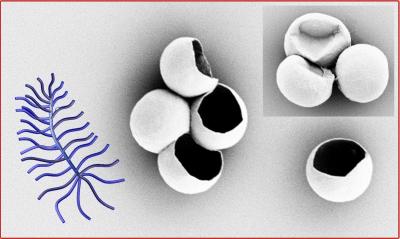
The technique Li uses to compel what would normally be a flake-like crystal to draw itself up into a sphere builds on his previous work with polymers that look like brushes and polymer crystals formed from emulsion droplets. Incorporating these pliable “bottle-brush” polymers as the structural system of the crystal, allows Li to shape its growth by adjusting the “bristles” of the brush.

“A bottle-brush polymer has lining bristles surrounding a spine, what we discovered is that we can make that spine bend upon crystallization by packing bristles on to one side of it,” Li said. “This sets the pattern that is repeated as the crystal grows – so instead of growing flat it curves three-dimensionally to form a sphere.”

This means the amount of bristle polymers in the solution will determine how much the bottle-brush spine bends and thus the shape and size of the crystal ball.

Li’s team also reports on how to pause the formation of the crystal, leaving holes in the sphere that could be useful for inserting a medicinal payload during the manufacturing process. Once filled, it can be closed with polymers tailored to help direct it to its target in the body.

“We have been working toward this achievement for some time,” Li said. “This spherical crystallography manifest itself in robust structures that we see in nature from egg shells to virus capsids, so we believe it is the ideal form to survive the rigors of delivering medication in the body. Being able to control the properties of the crystal as it forms is an important step toward realizing this application.”

###

In addition to Li and Zhao, Hao Qi, PhD; Xiting Liu from Drexel, and Daniel M. Henn, PhD, from the University of Tennessee, are co-first authors of this work. Shan Mei, PhD; and Mark C. Staub, from Drexel, also participated in this research.

Media Contact
Britt Faulstick
[email protected]

Original Source

https://drexel.edu/now/archive/2020/May/pausing-crystal-symmetry/

Related Journal Article

http://dx.doi.org/10.1038/s41467-020-15477-5

Tags: Chemistry/Physics/Materials SciencesMaterialsNanotechnology/MicromachinesPharmaceutical SciencesPolymer Chemistry
Share12Tweet8Share2ShareShareShare2

Related Posts

Tracking Lanthanide-Labeled Microplastics in Plants

June 25, 2026

POSTECH Researchers Slash Cost of Reconstituted Cell-Free Systems by 95%

June 25, 2026

AI and Physics Collaborate to Design Advanced Hydrogen Storage Materials

June 25, 2026

Natural Hallucinogens: Evolution’s Ecological Tools, Not Mere Chemical Byproducts

June 25, 2026
Please login to join discussion

POPULAR NEWS

  • Saying Goodbye to PGY-6: Pediatric Fellowship Realities

    103 shares
    Share 41 Tweet 26
  • Multi-Hospital Study Reveals Long Covid Burden Is Twice as High as Current Estimates

    92 shares
    Share 36 Tweet 23
  • Detection of EDCs in Breast Milk and Infant Urine Up to Six Months Highlights Early Exposure Risks

    77 shares
    Share 31 Tweet 19
  • New Drug Candidate Developed at McMaster Shows Potential for Treating Brain Cancer

    58 shares
    Share 23 Tweet 15

About

We bring you the latest biotechnology news from best research centers and universities around the world. Check our website.

Follow us

Recent News

Tracking Lanthanide-Labeled Microplastics in Plants

POSTECH Researchers Slash Cost of Reconstituted Cell-Free Systems by 95%

AI and Physics Collaborate to Design Advanced Hydrogen Storage Materials

Subscribe to Blog via Email

Success! An email was just sent to confirm your subscription. Please find the email now and click 'Confirm' to start subscribing.

Join 82 other subscribers
  • Contact Us

Bioengineer.org © Copyright 2023 All Rights Reserved.

Welcome Back!

Login to your account below

Forgotten Password?

Retrieve your password

Please enter your username or email address to reset your password.

Log In
No Result
View All Result
  • Homepages
    • Home Page 1
    • Home Page 2
  • News
  • National
  • Business
  • Health
  • Lifestyle
  • Science

Bioengineer.org © Copyright 2023 All Rights Reserved.