• HOME
  • NEWS
  • EXPLORE
    • CAREER
      • Companies
      • Jobs
    • EVENTS
    • iGEM
      • News
      • Team
    • PHOTOS
    • VIDEO
    • WIKI
  • BLOG
  • COMMUNITY
    • FACEBOOK
    • INSTAGRAM
    • TWITTER
Wednesday, January 14, 2026
BIOENGINEER.ORG
No Result
View All Result
  • Login
  • HOME
  • NEWS
  • EXPLORE
    • CAREER
      • Companies
      • Jobs
        • Lecturer
        • PhD Studentship
        • Postdoc
        • Research Assistant
    • EVENTS
    • iGEM
      • News
      • Team
    • PHOTOS
    • VIDEO
    • WIKI
  • BLOG
  • COMMUNITY
    • FACEBOOK
    • INSTAGRAM
    • TWITTER
  • HOME
  • NEWS
  • EXPLORE
    • CAREER
      • Companies
      • Jobs
        • Lecturer
        • PhD Studentship
        • Postdoc
        • Research Assistant
    • EVENTS
    • iGEM
      • News
      • Team
    • PHOTOS
    • VIDEO
    • WIKI
  • BLOG
  • COMMUNITY
    • FACEBOOK
    • INSTAGRAM
    • TWITTER
No Result
View All Result
Bioengineer.org
No Result
View All Result
Home NEWS Science News Biology

Preserving workers’ hearing health by improving earplug efficiency

Bioengineer by Bioengineer
January 8, 2021
in Biology
Reading Time: 2 mins read
0
IMAGE
Share on FacebookShare on TwitterShare on LinkedinShare on RedditShare on Telegram

Work carried out by researchers from ÉTS and the IRSST
IMAGE

Credit: ÉTS

Noise exposure accounts for 22% of worldwide work-related health problems. Excessive noise not only causes hearing loss and tinnitus, but also increases the risk of cardiovascular diseases. To provide protection, workers normally wear earplugs. However, commonly available earplugs are often uncomfortable, since they don’t fit everyone’s ears equally well.

How could we improve the comfort and effectiveness of these earplugs? What aspects of the ear canal must be taken into account? To answer these questions, researchers from the École de technologie supérieure (ÉTS University) and the Institut de recherche en santé et sécurité du travail (IRSST) analyzed the varying structure of ear canals to find a correlation between their shapes and the effectiveness of three commonly-used models of earplugs.

Each one is unique

Just like fingerprints, ear canals are unique. So, to find the best compromise between comfort and efficiency, you need to understand the relationship between the shapes of ear canals and of earplugs.

Earplugs must not only fit properly inside the ear canal, but must also exert pressure against the walls of the canal in order to make a tight seal. However, if the plugs put too much pressure on the ear canal walls, they will cause the wearer pain.

The methodology

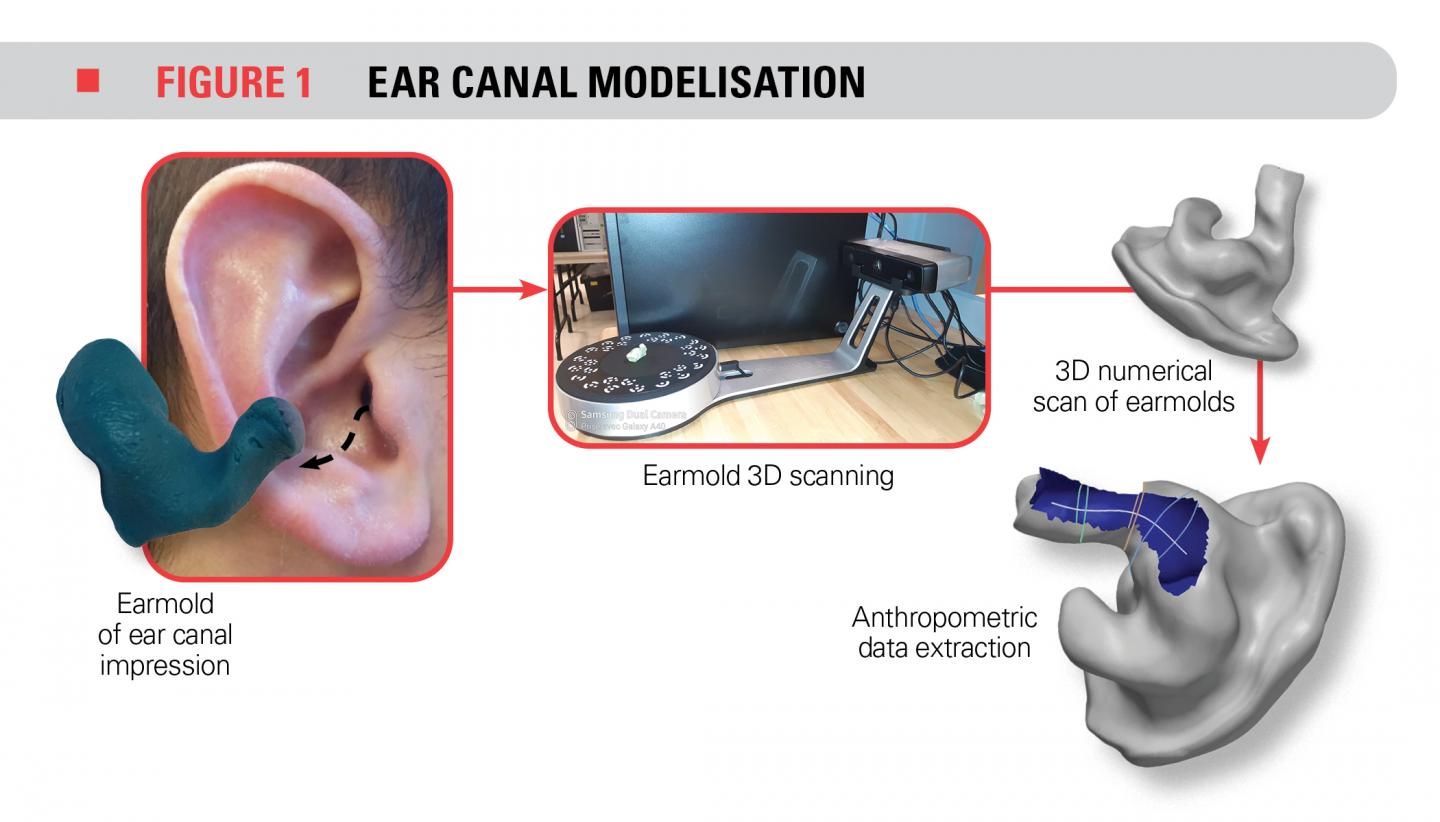
To study these aspects, 3D models of volunteer workers’ ear canals were created. These people wore three different types of earplugs. To obtain the geometry of their ear canals, a moulding material was injected to create canal moulds. These moulds were then scanned by measurement software to establish the geometric characteristics of the ear canal, such as the width at various locations and the overall length.

The noise attenuation of the three models of earplugs was then measured for each volunteer. Two miniature microphones were installed in and around the plugs to measure the noise outside and inside the ear plug.
A statistical analysis as well as algorithms based on artificial intelligence helped categorize the morphology of ear canals as a function of the degree of noise mitigation of each earplug.

Concrete applications

The results of the study show that the area of the ear canal called the “first elbow” is closely linked to noise attenuation by earplugs. Groups of similar structures created using artificial intelligence will allow researchers to develop a multitude of tools for manufacturers, who will then be able to produce a range of more comfortable ear plugs. This will allow prevention professionals to suggest models suited to each worker’s ear canals.

###

Media Contact
Chantal Crevier
[email protected]

Tags: Biomedical/Environmental/Chemical EngineeringHearing/SpeechTechnology/Engineering/Computer Science
Share12Tweet8Share2ShareShareShare2

Related Posts

blank

Selective Tryptophan Detection in Milk via Enzyme Sensor

January 14, 2026
Structural and Functional Differences in Citrus PRR and R Genes

Structural and Functional Differences in Citrus PRR and R Genes

January 14, 2026

Gut Microbiota l-Theanine Boosts Amino Acid Breakdown

January 14, 2026

Accelerated Donkey Breed Classification via SNP Insights

January 14, 2026
Please login to join discussion

POPULAR NEWS

  • Enhancing Spiritual Care Education in Nursing Programs

    155 shares
    Share 62 Tweet 39
  • PTSD, Depression, Anxiety in Childhood Cancer Survivors, Parents

    147 shares
    Share 59 Tweet 37
  • Robotic Ureteral Reconstruction: A Novel Approach

    74 shares
    Share 30 Tweet 19
  • Study Reveals Lipid Accumulation in ME/CFS Cells

    53 shares
    Share 21 Tweet 13

About

We bring you the latest biotechnology news from best research centers and universities around the world. Check our website.

Follow us

Recent News

Exploring Gut Microbiota’s Role in Prostate Health

Ghostwriting’s Lasting Effects on Alcohol Withdrawal Research

Smartphone Distractions Link to Surgical Errors in Nurses

Subscribe to Blog via Email

Enter your email address to subscribe to this blog and receive notifications of new posts by email.

Join 71 other subscribers
  • Contact Us

Bioengineer.org © Copyright 2023 All Rights Reserved.

Welcome Back!

Login to your account below

Forgotten Password?

Retrieve your password

Please enter your username or email address to reset your password.

Log In
No Result
View All Result
  • Homepages
    • Home Page 1
    • Home Page 2
  • News
  • National
  • Business
  • Health
  • Lifestyle
  • Science

Bioengineer.org © Copyright 2023 All Rights Reserved.