• HOME
  • NEWS
  • EXPLORE
    • CAREER
      • Companies
      • Jobs
    • EVENTS
    • iGEM
      • News
      • Team
    • PHOTOS
    • VIDEO
    • WIKI
  • BLOG
  • COMMUNITY
    • FACEBOOK
    • INSTAGRAM
    • TWITTER
Saturday, April 18, 2026
BIOENGINEER.ORG
No Result
View All Result
  • Login
  • HOME
  • NEWS
  • EXPLORE
    • CAREER
      • Companies
      • Jobs
        • Lecturer
        • PhD Studentship
        • Postdoc
        • Research Assistant
    • EVENTS
    • iGEM
      • News
      • Team
    • PHOTOS
    • VIDEO
    • WIKI
  • BLOG
  • COMMUNITY
    • FACEBOOK
    • INSTAGRAM
    • TWITTER
  • HOME
  • NEWS
  • EXPLORE
    • CAREER
      • Companies
      • Jobs
        • Lecturer
        • PhD Studentship
        • Postdoc
        • Research Assistant
    • EVENTS
    • iGEM
      • News
      • Team
    • PHOTOS
    • VIDEO
    • WIKI
  • BLOG
  • COMMUNITY
    • FACEBOOK
    • INSTAGRAM
    • TWITTER
No Result
View All Result
Bioengineer.org
No Result
View All Result
Home NEWS Science News Chemistry

Prehistoric predator? Artificial intelligence says no

Bioengineer by Bioengineer
November 15, 2022
in Chemistry
Reading Time: 2 mins read
0
Digital dino
Share on FacebookShare on TwitterShare on LinkedinShare on RedditShare on Telegram

Artificial intelligence has revealed that prehistoric footprints thought to be made by a vicious dinosaur predator were in fact from a timid herbivore.
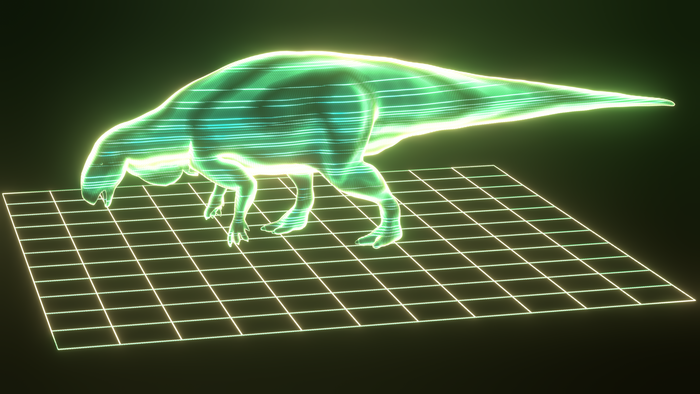
Digital dino

Credit: Dr Anthony Romilio

Artificial intelligence has revealed that prehistoric footprints thought to be made by a vicious dinosaur predator were in fact from a timid herbivore.

In an international collaboration, University of Queensland palaeontologist Dr Anthony Romilio used AI pattern recognition to re-analyse footprints from the Dinosaur Stampede National Monument, south-west of Winton in Central Queensland.

“Large dinosaur footprints were first discovered back in the 1970s at a track site called the Dinosaur Stampede National Monument, and for many years they were believed to be left by a predatory dinosaur, like Australovenator, with legs nearly two metres long,” said Dr Romilio.

“The mysterious tracks were thought to be left during the mid-Cretaceous Period, around 93 million years ago.

“But working out what dino species made the footprints exactly – especially from tens of millions of years ago – can be a pretty difficult and confusing business.

“Particularly since these big tracks are surrounded by thousands of tiny dinosaur footprints, leading many to think that this predatory beast could have sparked a stampede of smaller dinosaurs.

“So, to crack the case, we decided to employ an AI program called Deep Convolutional Neural Networks.”

It was trained with 1,500 dinosaur footprints, all of which were theropod or ornithopod in origin – the groups of dinosaurs relevant to the Dinosaur Stampede National Monument prints.

The results were clear: the tracks had been made by a herbivorous ornithopod dinosaur.

Dr Jens Lallensack, lead author from Liverpool John Moores University in the UK, said that the computer assistance was vital, as the team was originally at an impasse.

“We were pretty stuck, so thank god for modern technology,” Dr Lallensack said.

“In our research team of three, one person was pro-meat-eater, one person was undecided, and one was pro-plant-eater.

“So – to really check our science – we decided to go to five experts for clarification, plus use AI.

“The AI was the clear winner, outperforming all of the experts by a wide margin, with a margin of error of around 11 per cent.

“When we used the AI on the large tracks from the Dinosaur Stampede National Monument, all but one of these tracks was confidently classified as left by an ornithopod dinosaur – our prehistoric ‘predator’.”

The team hopes to continue to add to the fossil dinosaur tracks database and conduct further AI investigations. 

The research is published in the Journal of the Royal Society Interface and includes collaborations between Australian, German, and UK researchers. 

A replica of the dinosaur trackway is on display at the Queensland Museum, Brisbane, and the track site can be visited near south-west of Winton, Queensland.


DOI

10.1098/rsif.2022.0588

Article Publication Date

9-Nov-2022

Share12Tweet8Share2ShareShareShare2

Related Posts

Transforming Microalgae into Premium Fuels: Biochar Catalyst Enables Cleaner Aromatic Synthesis

Transforming Microalgae into Premium Fuels: Biochar Catalyst Enables Cleaner Aromatic Synthesis

April 17, 2026
New Study Unveils Pathway to Harness Majorana States for Quantum Computing

New Study Unveils Pathway to Harness Majorana States for Quantum Computing

April 17, 2026

Concordia Study Explores Using Mining Waste to Store Carbon Emissions

April 17, 2026

Breaking Boundaries: Soft Materials Pave the Way for Transparent, Broadband Ultrasound

April 17, 2026

POPULAR NEWS

  • Scientists Investigate Possible Connection Between COVID-19 and Increased Lung Cancer Risk

    62 shares
    Share 25 Tweet 16
  • NSF funds machine-learning research at UNO and UNL to study energy requirements of walking in older adults

    101 shares
    Share 40 Tweet 25
  • Boosting Breast Cancer Risk Prediction with Genetics

    47 shares
    Share 19 Tweet 12
  • Popular Anti-Aging Compound Linked to Damage in Corpus Callosum, Study Finds

    46 shares
    Share 18 Tweet 12

About

We bring you the latest biotechnology news from best research centers and universities around the world. Check our website.

Follow us

Recent News

Swedish Study: Person-Centred Communication Training for Caregivers

Membrane Protein Amuc_1098 Eases Pancreatitis via TLR2

Cadmium Exposure Boosts Metallothionein, Oxidative Damage Markers

Subscribe to Blog via Email

Enter your email address to subscribe to this blog and receive notifications of new posts by email.

Join 79 other subscribers
  • Contact Us

Bioengineer.org © Copyright 2023 All Rights Reserved.

Welcome Back!

Login to your account below

Forgotten Password?

Retrieve your password

Please enter your username or email address to reset your password.

Log In
No Result
View All Result
  • Homepages
    • Home Page 1
    • Home Page 2
  • News
  • National
  • Business
  • Health
  • Lifestyle
  • Science

Bioengineer.org © Copyright 2023 All Rights Reserved.