• HOME
  • NEWS
  • EXPLORE
    • CAREER
      • Companies
      • Jobs
    • EVENTS
    • iGEM
      • News
      • Team
    • PHOTOS
    • VIDEO
    • WIKI
  • BLOG
  • COMMUNITY
    • FACEBOOK
    • INSTAGRAM
    • TWITTER
Friday, May 15, 2026
BIOENGINEER.ORG
No Result
View All Result
  • Login
  • HOME
  • NEWS
  • EXPLORE
    • CAREER
      • Companies
      • Jobs
        • Lecturer
        • PhD Studentship
        • Postdoc
        • Research Assistant
    • EVENTS
    • iGEM
      • News
      • Team
    • PHOTOS
    • VIDEO
    • WIKI
  • BLOG
  • COMMUNITY
    • FACEBOOK
    • INSTAGRAM
    • TWITTER
  • HOME
  • NEWS
  • EXPLORE
    • CAREER
      • Companies
      • Jobs
        • Lecturer
        • PhD Studentship
        • Postdoc
        • Research Assistant
    • EVENTS
    • iGEM
      • News
      • Team
    • PHOTOS
    • VIDEO
    • WIKI
  • BLOG
  • COMMUNITY
    • FACEBOOK
    • INSTAGRAM
    • TWITTER
No Result
View All Result
Bioengineer.org
No Result
View All Result
Home NEWS Science News Chemistry

Predicting breast cancer recurrences

Bioengineer by Bioengineer
December 3, 2020
in Chemistry
Reading Time: 3 mins read
0
IMAGE
Share on FacebookShare on TwitterShare on LinkedinShare on RedditShare on Telegram

IMAGE

Credit: Dr. Howard R. Petty

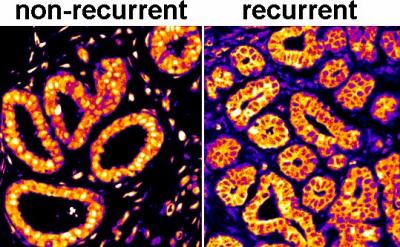
A new tool combining traditional pathology with machine learning could predict which breast cancer patients actually need surgery. The technology, reported in the November issue of American Journal of Physiology — Cell Physiology (vol. 319: C910-C921; https://doi.org/10.1152/ajpcell.00280.2020), could spare women from unnecessary treatments, reduce medical expenses, and lead to a new generation of drugs to stop breast cancer recurrences.

Ductal carcinoma in situ (DCIS) of the breast, an early form of disease also known as stage 0 breast cancer, is a diagnosis that only sometimes leads to invasive breast cancer. But only some patients need surgery, chemotherapy and/or radiotherapy, and the rest could be sent home. Predicting the outcomes of patients with early forms of cancer has been a major scientific problem for decades.

Professor Howard Petty and Ms. Alexandra Kraft, his research assistant, both of the University of Michigan, have just reported a solution to this diagnostic dilemma. The new technology was tested on DCIS patient samples donated to research over 10 years ago supplemented by their current clinical histories.

“Typically, patients with pre-invasive cancers, such as DCIS, are treated very aggressively,” says Prof. Petty. “In the case of DCIS, this means partial or total mastectomies…but we know from other work that more than half of these patients will not experience invasive disease.”

The method relies upon the newly reported discovery that, in both DCIS cases that are destined to recur and metastatic breast cancer, cells reorganize certain enzymes into “metabolic platforms” just beneath the outer membrane of these dangerous tumor cells. “This allows the enzymes to operate with high efficiencies, like an assembly line at a factory,” Prof. Petty says. That efficiency is what makes those cancers so dangerous. Petty theorizes that the enzyme products produced by these cellular factories promote tumor cell invasiveness and simultaneously deflect many forms of chemotherapy and radiotherapy.

To predict which DCIS cases lead to such assembly lines, Petty and colleagues tag biomarkers within patient samples then photograph the biomarkers with a sophisticated camera – similar to those used in astronomy. The digital images are then uploaded into a cloud computing platform for analysis.

Using this approach, the researchers correctly predicted cancer recurrences and non-recurrences 91% of the time, with only 4% false negatives. Further improvements are on the way.

The authors suggest that this tool will reduce the overdiagnosis of life-threatening DCIS. The technique may allow scientists to pharmaceutically disrupt metabolic platforms, thereby blocking tumor invasiveness, enhancing chemotherapy and radiotherapy, and stopping recurrences. “This tool may also be useful in predicting the outcomes of other pre-invasive lesions and in predicting which patients will respond to specific therapeutic interventions,” Prof. Petty says.

The researchers are presently performing the additional retrospective experiments needed to obtain FDA approval of this new diagnostic test.

###

This work has recently received the American Physiological Society’s APSselect Award.

Contact: [email protected]

Media Contact
Vanessa Denha-Garmo
[email protected]

Related Journal Article

http://dx.doi.org/10.1152/ajpcell.00280.2020

Tags: BiochemistryBiomechanics/BiophysicsBreast CancerCell BiologyMedicine/HealthRobotry/Artificial Intelligence
Share12Tweet8Share2ShareShareShare2

Related Posts

Scientists Overcome Longstanding Challenge in Measuring Semiconductor Defects — Chemistry

Scientists Overcome Longstanding Challenge in Measuring Semiconductor Defects

May 14, 2026
Wall Design Highlights Deaf and Hard-of-Hearing Experience at #ASA190 — Chemistry

Wall Design Highlights Deaf and Hard-of-Hearing Experience at #ASA190

May 14, 2026

New Method Finds More Efficient Route Between Earth and Moon Than Ever Before

May 14, 2026

Unveiling the Unseen: Exploring the Boundaries of Two-Photon Vision

May 14, 2026
Please login to join discussion

POPULAR NEWS

  • Research Indicates Potential Connection Between Prenatal Medication Exposure and Elevated Autism Risk

    843 shares
    Share 337 Tweet 211
  • New Study Reveals Plants Can Detect the Sound of Rain

    729 shares
    Share 291 Tweet 182
  • Salmonella Haem Blocks Macrophages, Boosts Infection

    62 shares
    Share 25 Tweet 16
  • Breastmilk Balances E. coli and Beneficial Bacteria in Infant Gut Microbiomes

    58 shares
    Share 23 Tweet 15

About

We bring you the latest biotechnology news from best research centers and universities around the world. Check our website.

Follow us

Recent News

Unseen Hazards: How AI Agents’ Routine Tasks Can Spiral into Digital Disasters

Could Sea Squirts’ Nano-Packaging Unlock a New Era in Sea Forest Restoration?

Comprehensive Study Finds No Clear Association Between Common Antidepressant Use During Pregnancy and Autism or ADHD in Children

Subscribe to Blog via Email

Enter your email address to subscribe to this blog and receive notifications of new posts by email.

Join 82 other subscribers
  • Contact Us

Bioengineer.org © Copyright 2023 All Rights Reserved.

Welcome Back!

Login to your account below

Forgotten Password?

Retrieve your password

Please enter your username or email address to reset your password.

Log In
No Result
View All Result
  • Homepages
    • Home Page 1
    • Home Page 2
  • News
  • National
  • Business
  • Health
  • Lifestyle
  • Science

Bioengineer.org © Copyright 2023 All Rights Reserved.