• HOME
  • NEWS
  • EXPLORE
    • CAREER
      • Companies
      • Jobs
    • EVENTS
    • iGEM
      • News
      • Team
    • PHOTOS
    • VIDEO
    • WIKI
  • BLOG
  • COMMUNITY
    • FACEBOOK
    • INSTAGRAM
    • TWITTER
Saturday, October 24, 2026
BIOENGINEER.ORG
No Result
View All Result
  • Login
  • HOME
  • NEWS
  • EXPLORE
    • CAREER
      • Companies
      • Jobs
        • Lecturer
        • PhD Studentship
        • Postdoc
        • Research Assistant
    • EVENTS
    • iGEM
      • News
      • Team
    • PHOTOS
    • VIDEO
    • WIKI
  • BLOG
  • COMMUNITY
    • FACEBOOK
    • INSTAGRAM
    • TWITTER
No Result
View All Result
Bioengineer.org
No Result
View All Result
Home NEWS Science News Technology

Pre-shrunk fibers unlock crack-free large carbon aerogel composites

by
October 24, 2026
in Technology
Reading Time: 2 mins read
0
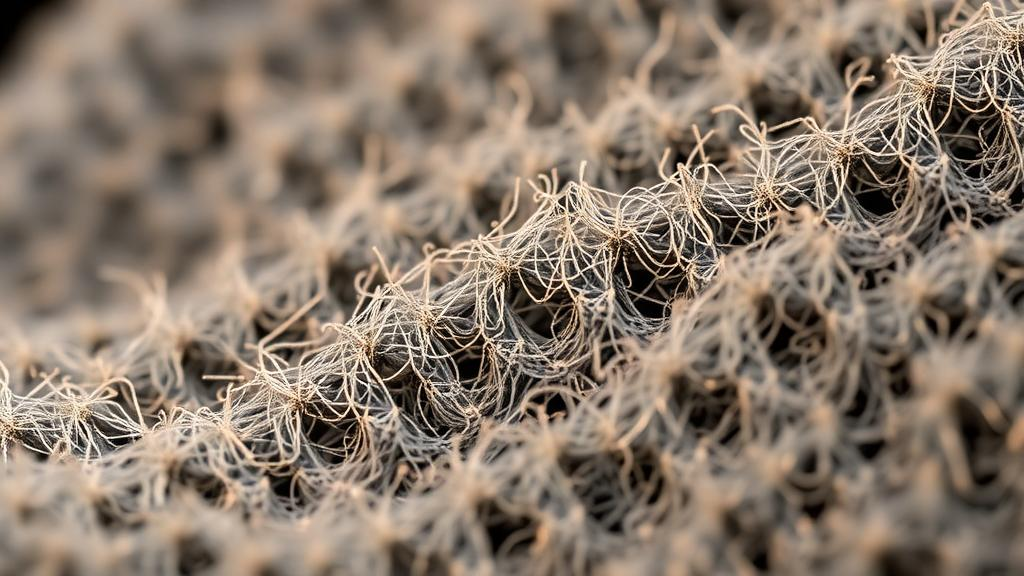
Pre-shrunk fibers unlock crack-free large carbon aerogel composites

Pre-shrunk fibers unlock crack-free large carbon aerogel composites

Share on FacebookShare on TwitterShare on LinkedinShare on RedditShare on Telegram

The strategy, described by Rui Luo and colleagues, centers on rationally matching the carbonization shrinkage of viscose fiber felts with that of a phenolic resin aerogel matrix. When the two components shrink by different amounts during high-temperature carbonization, residual stress builds up at their interface, and composites with such mismatches significantly underperform. By pretreating the felts in advance, the team ensured that both reinforcement and matrix contracted by nearly the same amount, leaving a continuous, gradient interface free of cracks and voids.

The fabrication route combined several steps. The researchers first pretreated the viscose fiber felts at elevated temperatures to induce controlled pre-shrinkage. They then carried out an in situ sol-gel transition of the phenolic resin precursor within the felt, followed by ambient-pressure drying, to produce large monolithic organic aerogels.

The critical variable was the pretreatment temperature. At 265 degrees Celsius, the pretreated fibers and the subsequently carbonized matrix showed nearly identical shrinkages of 26.2 percent and 25.0 percent respectively, a close match that drastically reduced the residual stress generated during carbonization. The consequences of that matching were substantial.

Composites built from fibers pretreated at the optimal temperature contained only 2 percent defects. Compared with conventional counterparts made without pre-shrinking, the optimized design achieved a 91 percent reduction in residual stress and a 94 percent decrease in structural defects. Those gains translated directly into mechanical performance: specific compressive strength improved 3.0-fold and specific flexural strength 2.5-fold, reaching 106.9 and 29.1 MPa·g⁻¹·cm³ respectively, while fracture toughness rose 2.3-fold to 0.54 MPa·m1/2.

Beyond fixing the shrinkage mismatch, the team exploited the same design principle to tune the microstructure and density of the aerogel matrix itself, indicating that the approach offers more than one lever for engineering the final material. The most demanding test came at extreme temperature. The authors position the strategy as a versatile route toward high-performance, large-sized carbon aerogel composites for demanding structural and thermal applications.

Because the process relies on a simple thermal pretreatment, an in situ sol-gel transition and ambient-pressure drying, it can be applied to produce large monolithic components rather than small specimens.

Subject of Research: Fabrication of large-sized robust carbon aerogel composites via pre-shrinkage-induced interfacial engineering

Article Title: Fabrication of large-sized robust carbon aerogel composites via pre-shrinkage-induced interfacial engineering

Article References: Luo, R., Li, J., Bao, K., Hu, C., Yan, M., Zhang, W., Zhao, R., Pang, S., & Tang, S. (2026). Fabrication of large-sized robust carbon aerogel composites via pre-shrinkage-induced interfacial engineering. Advanced Composites and Hybrid Materials. https://doi.org/10.1007/s42114-026-02142-6

Image Credits: AI Generated

DOI: 10.1007/s42114-026-02142-6

Keywords: Fabrication, large-sized, robust, carbon, aerogel, composites, pre-shrinkage-induced, interfacial, engineering, scientific research

News Source: Denise Maddox. (October 24, 2026). Pre-shrunk fibers unlock crack-free large carbon aerogel composites. Scienmag.


Tags: aerogelcarboncompositesengineeringfabricationinterfaciallarge-sizedpre-shrinkage-inducedRobustscientific research
Share12Tweet7Share2ShareShareShare1

Related Posts

Lightweight CNN-LSTM framework spots malicious traffic in encrypted networks

Lightweight CNN-LSTM framework spots malicious traffic in encrypted networks

October 24, 2026
Volcanic cement blends face their toughest test in Algeria's salt flats

Volcanic cement blends face their toughest test in Algeria’s salt flats

October 24, 2026

Experts Rank Pavement Resistance as the Leading Factor in Road Quality

October 24, 2026

New AI Tool Searches a Billion Aurora Images in Milliseconds

October 24, 2026

POPULAR NEWS

  • Osteopontin Fingerprints in Tissue Scans Predict Pancreatic Cancer Survival

    Osteopontin Fingerprints in Tissue Scans Predict Pancreatic Cancer Survival

    29 shares
    Share 12 Tweet 7
  • Efficiency scoring method picks winning ETFs and sizes each bet

    29 shares
    Share 12 Tweet 7
  • Willingness Outpaces Action: Parental HPV Vaccine Beliefs Across the Middle East

    29 shares
    Share 12 Tweet 7
  • Mobility patterns dominate explainable machine learning forecasts of COVID-19 cases in India

    29 shares
    Share 12 Tweet 7

About

We bring you the latest biotechnology news from best research centers and universities around the world. Check our website.

Follow us

Recent News

Osteopontin Fingerprints in Tissue Scans Predict Pancreatic Cancer Survival

Efficiency scoring method picks winning ETFs and sizes each bet

Willingness Outpaces Action: Parental HPV Vaccine Beliefs Across the Middle East

Subscribe to Blog via Email

Enter your email address to subscribe to this blog and receive notifications of new posts by email.

Join 85 other subscribers
  • Contact Us

Bioengineer.org © Copyright 2023 All Rights Reserved.

Welcome Back!

Login to your account below

Forgotten Password?

Retrieve your password

Please enter your username or email address to reset your password.

Log In
No Result
View All Result
  • Homepages
    • Home Page 1
    • Home Page 2
  • News
  • National
  • Business
  • Health
  • Lifestyle
  • Science

Bioengineer.org © Copyright 2023 All Rights Reserved.