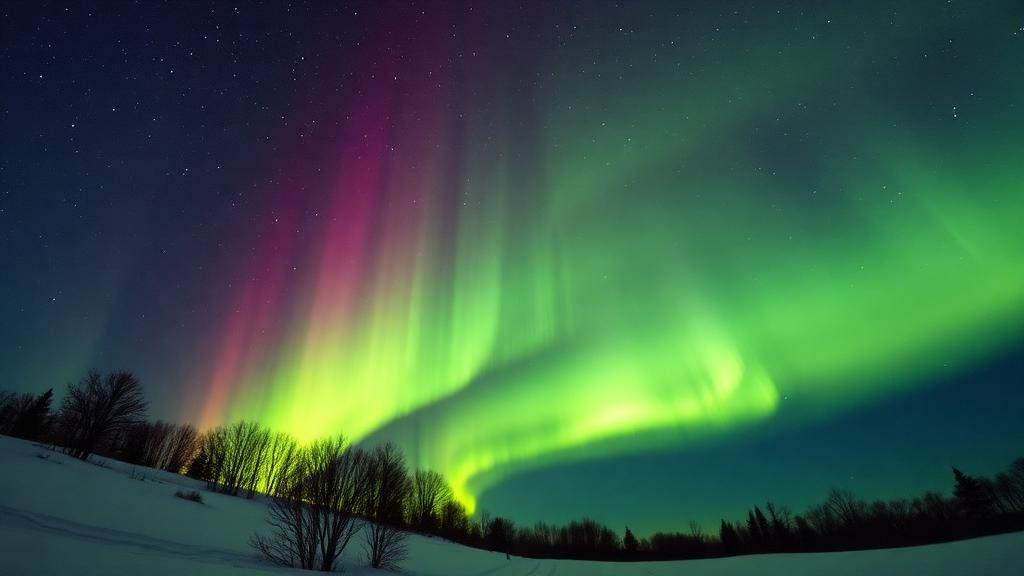
Since 2006, a network of cameras scattered across North America has quietly photographed the night sky every three seconds, amassing more than a billion images of the aurora. The archive, assembled by the Time History of Events and Macroscale Interactions during Substorms project, known as THEMIS, is the largest collection of auroral imagery in existence. Twenty-four all-sky imaging stations have recorded the glowing curtains, arcs, and beads that trace how Earth’s magnetosphere couples to its upper atmosphere. Yet the sheer scale of the database has become its own obstacle. Image quality varies dramatically from frame to frame, and manually combing through a billion photographs to find a specific auroral shape is tedious, time-consuming, and error-prone. A new open-source software tool called THEMISim now promises to change that, letting researchers search the entire archive for visually similar images in a fraction of a second.
THEMISim, developed by Jeremiah W. Johnson and Dogacan Su Ozturk at the University of New Hampshire, is built on the idea of similarity search: instead of matching pixels, the software represents each image as a compact mathematical fingerprint. Every photograph is embedded as a 512-dimensional vector in a latent space where proximity corresponds to visual and morphological similarity rather than pixel-level identity. These representations are obtained through an adaptation of the Simple Framework for Contrastive Learning of Visual Representations, or SimCLR, a self-supervised algorithm that learns what makes images alike without requiring human labels. The quality of these latent representations is critical, the developers note, because the entire search pipeline depends on them to return morphologically meaningful results.
Turning those vectors into a searchable index over a billion entries is the job of FAISS, an open-source library for large-scale vector search. THEMISim constructs a FAISS index using a factory specification that combines several state-of-the-art techniques: an optimized product quantization matrix, an inverted file structure dividing the space into roughly 65,536 cells, a hierarchical navigable small world graph for fast cell location, and product quantization compressing each 512-dimensional vector to 64 bytes. This approximate search strategy is what makes the system fast, while an exact corrective reranking step is what keeps it honest. The combination allows the software to scan a billion images without ever loading most of them into memory.
The software is organized around three paths. The Build path downloads the all-sky image data and a pretrained model checkpoint, verifies the checkpoint against a pinned SHA-256 digest, preprocesses the images, and passes them through the neural network to construct the latent embedding database. This embedding stage can take GPU-days of computation and is implemented to be resumable at the level of a site-hour if interrupted, so a crashed run does not force researchers to start over. The resulting database is stored as a 16-bit memory-mapped file with global IDs assigned in station-major and then chronological order, allowing sequential reads of contiguous ID ranges. Once these artifacts are in place, the Query path lets a user specify a query image and receive a CSV of results containing the site, datetime, source file, and similarity score for each match. A Validate path allows benchmarking of the software without running the full build.
A query proceeds in four steps. First, the user supplies a query image. Second, the FAISS index identifies approximate candidate images for similarity. Third, the uncompressed vectors corresponding to those prefilter candidates are extracted from the vector database and their exact cosine similarities are computed, providing an exact reranking. Fourth, the highest-scoring images are returned. Several tunable parameters shape this process. The nprobe parameter controls how many cells the search visits, with a default of 64; lower values are faster while higher values ensure higher recall. The prefilter parameter sets how many approximately ranked candidates are exactly reranked. A diversify interval, defaulting to 30 seconds, ignores images from the same station captured within seconds of an already-kept result, because the rapid three-second cadence produces many temporally close frames that are morphologically near-identical. In most use cases, researchers want distinct events rather than dozens of copies of the same aurora.
The performance numbers reveal how well the system walks the accuracy-speed tradeoff. At the library default operating point of 64 cells scanned and 500 prefilter candidates, the pipeline retains a recall@10 of 0.937 against an exhaustive search, meaning nearly 94 percent of the ten best true matches are found. Scanning more cells pushes recall to 0.961 or 0.973 at higher prefilter settings. Latency measurements on an Intel Core i9-9920X CPU with 12 OpenMP threads show a warm median query time of about 118 milliseconds at the defaults, rising to roughly 650 milliseconds at a higher-recall setting of 256 cells and 1,000 prefilter candidates. The benchmark is a demanding one: the compressed index file, at 72.7 gigabytes, resides on an SSD, while the full-precision vector database, at over 1,033 gigabytes, sits on a hard drive and is far larger than the machine’s memory.
The comparison against brute force search is striking. A single sequential pass computing cosine similarity against every indexed vector requires scanning 1,009,488,343 vectors and reading 1.034 terabytes at an effective rate of 114 megabytes per second, taking 150.5 minutes for a full pass. A brute force single query takes 9,032 seconds, or roughly two and a half hours. THEMISim completes the same query in about 118 milliseconds when warm, a speedup of approximately 21,854 times. Even when batching amortizes one pass over 500 queries, brute force still needs 18.1 seconds per query, while the indexed pipeline retains a roughly 163-fold throughput advantage, all while holding 93.7 percent of its recall. Memory management is equally careful: the full index, vector database, and metadata occupy 1.048 terabytes on disk, but pages are loaded only as they are touched, and the software holds about 19 gigabytes in resident memory during use, letting the operating system evict cold pages under pressure.
Filtered searches work differently. When a researcher restricts a query to a particular site, date range, or combination, the approximations used in the general pipeline can become unreliable, so for filtered searches of up to 4 million rows the software performs an exact brute force search instead, falling back to the indexed path only when the filtered set exceeds that threshold. Users can also control how many results are returned, either as a fixed number, defaulting to 24, or based on a minimum similarity threshold. A bundled visualization tool displays a query image alongside its most similar matches, and the developers report that the tool already produces coherent results with the default parameters.
The scientific payoff centers on rare auroral morphologies. The developers’ primary motivation is the comprehensive identification of images capturing auroral beads and omega bands, two rare but important auroral shapes whose occurrence rates and relationship to underlying magnetospheric processes are not fully understood. Their group is now using the software to catalog occurrences of these phenomena across the last 20 years of THEMIS observations, enabling more rigorous statistical study. More broadly, THEMISim allows researchers to improve on existing classification results: prior work assigned labels to over 700 million THEMIS all-sky images, but those labels are coarse, and the new tool lets scientists fine-tune the labeling to capture notable phenomena more accurately and correct mislabelings when they occur. The software also opens the door to multi-instrument conjugacy studies linking magnetospheric and ionospheric measurements, facilitating cross-instrument comparison and validation of corresponding auroral morphologies.
THEMISim is released under the MIT License, written in Python with CUDA C++ components, and requires torch, FAISS, and standard scientific libraries, with full documentation available online. The developers argue that its availability contributes to reproducibility and transparency in ground-based auroral research, and that it enables researchers for the first time to efficiently and effectively search the THEMIS archive for rare and important auroral morphologies. That capability, in turn, is expected to unlock rigorous large-scale statistical and machine learning studies of auroral phenomena that were previously impractical, giving scientists a practical way to interrogate an observational record that has grown far faster than anyone could look at it by hand.
Subject of Research: Machine learning-based similarity search software for the THEMIS all-sky auroral image database
Article Title: THEMISim: Efficient all-sky image similarity search
Article References: Johnson, J. W., & Ozturk, D. S. (2026). THEMISim: Efficient all-sky image similarity search. SoftwareX, 36, Article 103167. https://doi.org/10.1016/j.softx.2026.103167
Image Credits: AI Generated
DOI: 10.1016/j.softx.2026.103167
Keywords: THEMISim, aurora, all-sky imaging, similarity search, machine learning, FAISS, THEMIS mission, magnetosphere, space weather, contrastive learning, open-source software, ionosphere
News Source: Russell Cooper. (October 24, 2026). New AI Tool Searches a Billion Aurora Images in Milliseconds. Scienmag.