


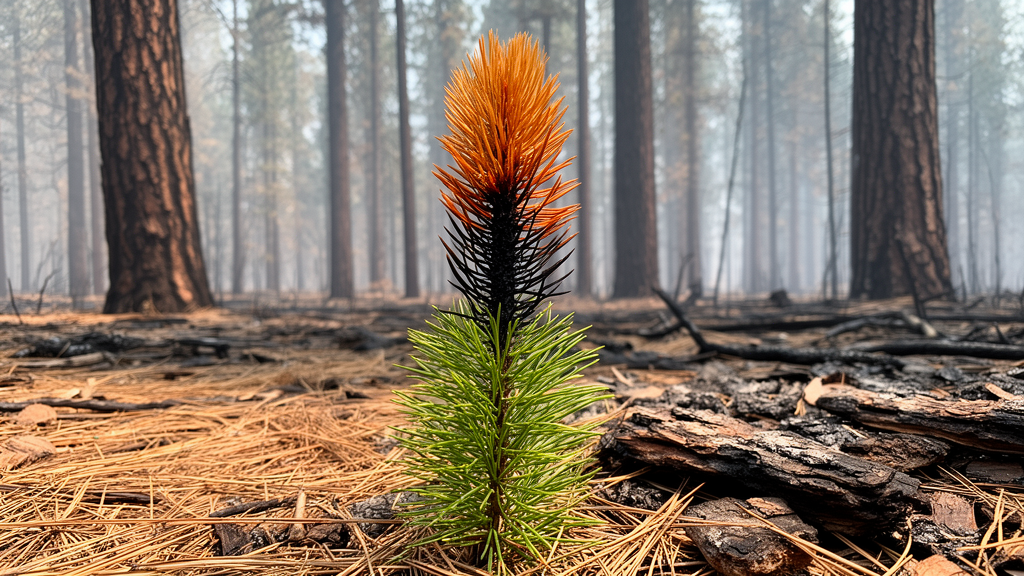
Fertilizing young ponderosa pines before a fire does nothing to protect them from dying, according to a controlled laboratory study published in Fire Ecology. Across all treatments, fires delivering 0.8 megajoules per square meter of fire radiative energy killed every sapling, fertilized or not. At the moderate 0.6 megajoule dose, the unfertilized group lost 50.0 percent of its saplings, the seven-week group 66.7 percent, and the one-week group 83.3 percent, but a Tukey’s honest significant difference test found none of these differences statistically significant at the 0.05 level. The study, led by Scott W. Rainsford of the University of Idaho and colleagues, set out to test whether pre-fire fertilization could increase sapling resistance to fire-induced mortality, and the answer was no.
The experiment grew from the structural overshoot hypothesis, an idea drawn from drought and heat-stress research but never before tested in wildland fire studies. Structural overshoot describes what happens when plants, flush with abundant water and nutrients, pour resources into overbuilding tissue. Large-scale climate and modeling work has shown that such resource-driven growth, whether from carbon dioxide enrichment or fertilization, creates anomalous overgrowth that raises tissue maintenance costs and water transpiration demands. Those overbuilt components become structurally unsustainable when resources tighten, increasing mortality risk through hydraulic failure during subsequent stress or disturbance. The research team reasoned that if fertilized saplings had already spent their resource pools on new structural growth before a fire, the combined water and nutrient demands of post-fire recovery could compound physiological strain and push the plant past its hydraulic breaking point. They also noted that the presence of nutrients does not guarantee usability, because severe heat stress reduces a plant’s ability to take them up.
To run the test, the researchers purchased 125 two-to-three-year-old ponderosa pine saplings from a commercial nursery in Tekoa, Washington, and potted them in a uniform, fast-draining growth medium at Washington State University’s greenhouse facility. After roughly seventeen months of growth, they randomly selected 90 healthy saplings and divided them into three treatment groups: no fertilizer, slow-release nitrogen fertilizer applied seven weeks before fire, and the same fertilizer applied one week before fire. The fertilizer was an NPK 23-0-0 formulation delivered at 5 grams per pot, chosen to represent 150 to 200 percent of typical baseline nitrogen. Only nitrogen was added, so any other nutrient changes observed would be stoichiometric or fire-stress related. Nitrogen was the focus because conifers cannot fix atmospheric nitrogen themselves and depend on soil-microbial processes to acquire it. Before the fires, the saplings averaged 1.49 centimeters in diameter at root collar and 0.55 meters in height.
The fires themselves took place at the indoor combustion facility of the Idaho Fire Initiative for Research and Education in Moscow, Idaho, between July 30 and August 1, 2024. Researchers burned pure fuel beds of oven-dried western white pine needles to achieve two fire intensity levels, defined by fire radiative energy: 0.6 and 0.8 megajoules per square meter, alongside unburned controls. These dose levels were selected because prior pyro-ecophysiology experiments had established that ponderosa saplings of similar size do not respond to fire in a binary burned-or-unburned fashion but instead show graded responses to increasing energy doses. Previous work had recorded 100 percent mortality at 0.8 megajoules per square meter, roughly 40 percent mortality at 0.7, and 35 percent at 0.6. Each sapling was burned individually to avoid pseudoreplication, with roughly 2 grams of ethanol igniting the fuel bed edge and all fires allowed to extinguish naturally.
Mortality was assessed eight weeks after fire using a stem cambium scratch test, where living cambium appears green and dead cambium brown. The dose-response relationship held across every fertilization treatment, with the 0.8 megajoule dose proving uniformly lethal. The researchers attributed the lack of statistical separation among treatment groups at the moderate dose to the binary nature of the mortality data combined with low sample size, a consequence of destructive sampling for nutrient analysis that left high variance in the 0.6 megajoule group. The unfertilized dose-response curve agreed with prior work by Steady and colleagues, who observed a mean of 35 percent mortality at the same moderate dose in similarly sized saplings, compared with 50.0 percent in the current study.
Morphological measurements told a similar story of fertilization providing no advantage. Diameter at root collar generally declined after fire regardless of dose, and fertilization had no effect on that change over the measurement period. Sapling height showed no significant difference across fertilization treatments except at 14 days post-fire in the unfertilized group, a result the researchers attributed to most shoot elongation following bud break having already occurred. Percent crown green showed a clear binary response between burned and unburned saplings across all fertilization treatments, with no significant difference observed across fertilizer levels when dose levels were considered separately. The one transient effect appeared in the seven-week fertilization treatment at the moderate dose, where post-fire diameter at root collar showed significantly different groups at 14 and 28 days, though this did not persist to the final measurement.
Physiological data revealed more nuanced differences. Chlorophyll fluorescence, measured as the maximum quantum yield of photosystem II, declined significantly across all post-fire timepoints, and fertilization produced a clear and significant impact on the post-fire change in that metric at the highest dose. The researchers interpreted this as fertilized saplings experiencing a greater decline, presumably from investing more in growth over defense or recovery capacity, which they said may provide some support for the structural overshoot hypothesis. Light-saturated net photosynthesis collapsed in burned saplings immediately after fire at both dose levels regardless of fertilizer timing, dropping to between 0.28 and 1.53 micromoles per square meter per second at the moderate dose and between negative 0.29 and 0.24 at the high dose, with limited recovery by week eight. Unburned saplings remained stable or increased throughout the recovery period. Leaf area data collected the day before the fires showed that both fertilization treatments produced a decrease in leaf area, significant for the one-week group and marginally significant for the seven-week group, a pattern the researchers suggested could reflect accelerated needle senescence, supra-optimal or toxic nitrogen doses, or nutrient imbalance involving potassium and the base cations magnesium and calcium.
Spectral measurements added an unexpected dimension. Using a field spectroradiometer, the team collected reflectance data converted to Landsat 8 band equivalents and calculated differenced spectral indices comparing pre-fire and post-fire states. The seven-week fertilization treatment showed reasonable spectral separability, with M-statistic values above the 1.5 benchmark, for three of four indices at the moderate dose and all four at the high dose, suggesting cellular changes occurred over that longer pre-fire window. A two-way analysis of variance confirmed a significant main effect of fertilizer treatment across all nine differenced indices. When the researchers fitted logistic regression models to predict mortality from spectral change across 54 trees with confirmed mortality records, the char soil index performed strongest with an area under the curve of 0.831, followed closely by the normalized burn ratio and the shortwave near-infrared ratio. The team noted this raises questions about whether vegetation fire severity maps generated nationally through the Monitoring Trends in Burn Severity program could monitor fire-induced tree mortality, but also whether differential pre-fire nutrient availability could cause signals misinterpreted as severity.
Tissue nutrient analysis, conducted on 36 destructively harvested saplings two weeks after the fires, uncovered a finding the researchers did not anticipate. Root aluminum concentrations in the 0.8 megajoule treatment rose dramatically compared to unburned controls, increasing by 162 percent in the unfertilized group, 175 percent in the one-week group, and 91 percent in the seven-week group, with both comparisons surviving Bonferroni correction. The researchers noted that laboratory experiments have demonstrated temperatures exceeding 350 degrees Celsius in litter fuel and 500 degrees Celsius in soil can each drive significant post-fire aluminum increases, and that aluminum is known to inhibit cell division and elongation in roots while disrupting nutrient and water uptake. They suggested this accumulation may indicate an additional mechanism contributing to fire-induced tree mortality, though they cautioned it should be reassessed across different soil media, particularly given that pines are generally considered highly resistant to aluminum toxicity.
The researchers concluded that pre-fire fertilization does not increase resistance to fire-induced mortality in ponderosa pine saplings and recommended evaluating the approach in other species with improved ability to use supplemental nutrients, such as western larch, grand fir, and Douglas fir, which respond more readily to nutrient applications than pines. They also flagged a potential unintended consequence worth exploring: whether fertilization stimulates additional resin production, making plants more flammable, a hypothesis with existing support from loblolly pine and Scots pine fertilization trials that documented increases in resin ducts and constitutive resin flow. The persistent suppression of net photosynthesis in fertilized groups alongside the absence of a detectable fertilizer effect on foliar nitrogen led the team to conclude that the link between pre-fire nutrition and post-fire recovery is not straightforward. They called for future work examining longer pre-burn fertilization intervals, post-burn applications, paired soil chemistry measurements to test whether fire-induced acidification mobilizes aluminum into root tissue, and expanded research across tree species, size classes, and pre-fire management histories.
Subject of Research: Whether pre-fire nitrogen fertilization alters fire-induced mortality and post-fire recovery in ponderosa pine saplings exposed to controlled experimental fires
Article Title: Needing a quick fix? Exploring the potential of pre-fire fertilization to mitigate fire severity in ponderosa pine saplings
Article References: Rainsford, S. W., Bhatta, R. P., Brown, L. M., Kimsey, M. J., Wilson, D. R., Huang, L., Adams, H. D., Sparks, A. M., Whipple, B., Johnson, D. M., & Smith, A. M. S. (2026). Needing a quick fix? Exploring the potential of pre-fire fertilization to mitigate fire severity in ponderosa pine saplings. Fire Ecology, 22(1), Article 135. https://doi.org/10.1186/s42408-026-00579-0
Image Credits: AI Generated
DOI: 10.1186/s42408-026-00579-0
Keywords: ponderosa pine, pre-fire fertilization, fire radiative energy, structural overshoot, sapling mortality, chlorophyll fluorescence, root aluminum, spectral indices, pyro-ecophysiology, nitrogen, fire ecology, Needing
News Source: Drew Townsend. (October 30, 2026). Pre-fire fertilization fails to save young ponderosa pines from fire mortality. Scienmag.



