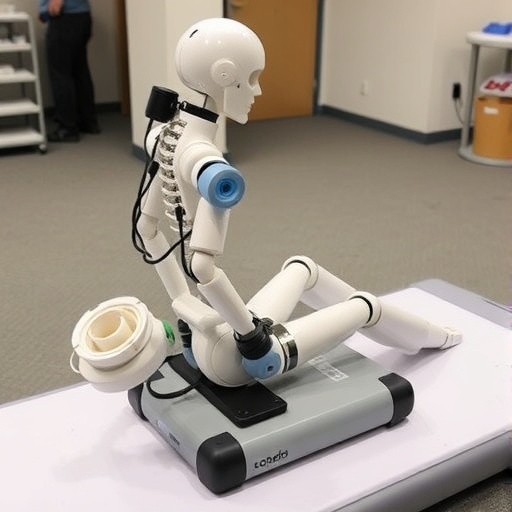
In the evolving landscape of rehabilitation robotics, a novel portable device is redefining the possibilities for neuromuscular recovery in juveniles affected by Spinal Muscular Atrophy (SMA) type II. Unlike conventional lower-extremity assistive robots that primarily focus on passive gait assistance, this newly developed robot introduces an innovative approach by integrating isokinetic resistance training—a method known to engage muscles dynamically through controlled velocity movements. The essence of this breakthrough lies in its capacity to not only assist but actively rehabilitate neuromuscular function over the long term, a facet often overlooked in existing robotic interventions.
The device’s architecture centers around a lightweight design, weighing merely 0.96 kilograms, making it highly wearable and user-friendly for the pediatric demographic it serves. Core to its functionality is a sophisticated variable stiffness mechanism, which, when coupled with a back-drivable damping motor, ushers in a finely tunable resistance training environment. This ensures the training is both safe and customizable, allowing adaptation to the individual capabilities and progress of each user. The back-drivability aspect is critical, minimizing the risk of injury while maintaining user autonomy during movement.
A pivotal clinical trial involving six juvenile participants diagnosed with SMA type II showcased the efficacy of this approach. Conducted over six weeks, the trial entailed robot-assisted isokinetic resistance training sessions designed to sustain and enhance neuromuscular capabilities. The outcomes were striking: participants demonstrated marked functional improvements in lower-extremity movement, particularly in the ability to perform sit-to-stand transitions. Before intervention, these movements required external support and exhibited compromised knee flexion angles; post-intervention, participants achieved such maneuvers independently, reflecting a notable decrement in the average seated knee flexion angle from 111° to 104°.
Beyond these functional milestones, the training regimen induced significant enhancements in bilateral knee joint parameters. Key biomechanical metrics, including peak torque, range of motion (ROM), and work output, surged—peaking at increases of over 130%, 51%, and 97%, respectively. Such improvements underscore the device’s potential to instigate profound musculoskeletal adaptations, suggesting an underlying reconditioning of muscular strength and joint mobility. This is particularly remarkable given the patient population’s typical progressive muscle weakness and motor impairment.
Crucially, these functional gains were paralleled by physiological transformations within the quadriceps muscle group. Magnetic resonance imaging revealed notable hypertrophic changes, with increases in anatomical cross-sectional area (+12%), muscle volume (+19%), and physiological cross-sectional area (+21%). These indices of muscle growth provide compelling evidence that the intervention stimulates structural muscular adaptations, likely contributing to enhanced force-generating capacity. The hypertrophy observed aligns seamlessly with the improvements in joint function, bolstering the argument for an integrated neuromotor recovery facilitated by robotic training.
Electrophysiological assessments further substantiated the intervention’s profound impact at the neuromuscular junction. Measurements of femoral nerve conduction demonstrated a 19% increase in compound muscle action potential (CMAP), indicative of improved neural signaling and muscle responsiveness. This enhancement suggests that the robot-assisted isokinetic training not only fortifies muscle tissue but also promotes neural plasticity and conduction efficacy—essential elements for sustainable motor function recovery.
Importantly, the therapeutic gains achieved were maintained even following cessation of the robotic training, with participants reverting to standard physiotherapy. This retention of neuromuscular improvements signifies that the intervention fosters durable adaptations rather than transient performance boosts. The implications for clinical practice are profound, proposing a complementary role for isokinetic robotic training within conventional rehabilitation protocols, potentially revolutionizing treatment paradigms for neuromuscular disorders.
Technically, the device’s innovation stems from its ability to modulate resistance dynamically during user movement, a departure from traditional robotic exoskeletons that primarily provide assistive torque without actively challenging the musculature. This isokinetic paradigm, involving constant-speed resistance against user effort, may provoke superior neuromuscular engagement by continuously stimulating muscle fibers and fostering neurological feedback loops essential for motor relearning. The highly adjustable mechanical and control components provide a customizable user experience, accommodating varied disease severities and progression rates.
The lightweight form factor, achieved through advanced materials and compact actuation technology, enhances patient compliance and usability, especially in a pediatric setting where bulkier devices pose practical and comfort challenges. Its portability means rehabilitation can be pursued beyond clinical environments, facilitating more frequent and contextually relevant training sessions, which are crucial for neuroplastic adaptation and functional restoration.
From a broader scientific perspective, this development underscores the growing synergy between biomechanics, robotics, and neurorehabilitation. By leveraging isokinetic resistance within wearable robotics, researchers are transcending passive assistance, fostering active rehabilitation strategies that can harness and expedite neuromuscular recovery. The device exemplifies how technological innovation, grounded in a deep understanding of human physiology and motor control, can transform therapeutic outcomes for populations with hitherto limited effective interventions.
Future directions for this research include scaling the cohort size to validate the device’s efficacy across more diverse patient populations and extending training durations to assess long-term outcomes and potential plateau effects. Moreover, integrating real-time biofeedback and machine learning algorithms could personalize training protocols further, optimizing resistance parameters and session timing to maximize individual recovery trajectories.
In conclusion, this portable isokinetic training robot marks a significant milestone in spinal neuromotor rehabilitation, especially for juvenile patients grappling with SMA type II. Its ability to promote meaningful functional, physiological, and electrophysiological improvements while being lightweight and adaptable offers new hope for sustainable neuromuscular recovery. As wearable rehabilitation robotics continue to evolve, such innovations are poised to reshape the future of therapeutic interventions for neuromuscular disorders worldwide.
Subject of Research: Neuromuscular rehabilitation using robotic isokinetic resistance training for Spinal Muscular Atrophy type II patients.
Article Title: Spinal neuromotor rehabilitation using a portable isokinetic training robot.
Article References:
Li, Y., Ren, J., Shu, T. et al. Spinal neuromotor rehabilitation using a portable isokinetic training robot. Nature (2026). https://doi.org/10.1038/s41586-026-10642-0
Image Credits: AI Generated
Tags: active spinal rehabilitation technologyback-drivable damping motor safetyclinical trials in SMA rehabilitationcustomizable resistance trainingisokinetic resistance training benefitslightweight wearable rehabilitation devicelong-term neuromuscular function improvementneuromuscular recovery in juvenilespediatric rehabilitation roboticsportable isokinetic rehabilitation robotspinal muscular atrophy type II therapyvariable stiffness mechanism in robots