

• HOME
  • NEWS
  • EXPLORE
    • CAREER
      • Companies
      • Jobs
    • EVENTS
    • iGEM
      • News
      • Team
    • PHOTOS
    • VIDEO
    • WIKI
  • BLOG
  • COMMUNITY
    • FACEBOOK
    • INSTAGRAM
    • TWITTER
Monday, January 12, 2026
BIOENGINEER.ORG
No Result
View All Result
  • Login
  • HOME
  • NEWS
  • EXPLORE
    • CAREER
      • Companies
      • Jobs
        • Lecturer
        • PhD Studentship
        • Postdoc
        • Research Assistant
    • EVENTS
    • iGEM
      • News
      • Team
    • PHOTOS
    • VIDEO
    • WIKI
  • BLOG
  • COMMUNITY
    • FACEBOOK
    • INSTAGRAM
    • TWITTER
  • HOME
  • NEWS
  • EXPLORE
    • CAREER
      • Companies
      • Jobs
        • Lecturer
        • PhD Studentship
        • Postdoc
        • Research Assistant
    • EVENTS
    • iGEM
      • News
      • Team
    • PHOTOS
    • VIDEO
    • WIKI
  • BLOG
  • COMMUNITY
    • FACEBOOK
    • INSTAGRAM
    • TWITTER
No Result
View All Result
Bioengineer.org
No Result
View All Result
Home NEWS Science News Health

Polysulfide donors strongly suppress inflammatory responses

Bioengineer by Bioengineer
April 4, 2019
in Health
Reading Time: 2 mins read
0
IMAGE
Share on FacebookShare on TwitterShare on LinkedinShare on RedditShare on Telegram

IMAGE

Credit: Prof. Tomohiro Sawa

Researchers from Japan have developed a new polysulfide donor: a chemical compound composed of chains of sulfur atoms that can artificially increase reactive sulfur species (chemically reactive molecules containing sulfur) in cells and tissues. This donor is believed to be an excellent candidate for a new anti-inflammatory therapy because it has an extremely high anti-inflammatory effect.

In the cells of many organisms, metabolites called reactive sulfur species (RSS) are made from the amino acid cysteine. Recent studies have revealed that RSS protect cells from oxidative stress and, under certain conditions, have the important function of maintaining mitochondrial respiration. Polysulfide donors are expected to be an important tool in investigating the function of RSS, and are being developed all over the world. However, their therapeutic effects remain to be discovered.

A collaboration between researchers at Kumamoto University (Kumamoto, Japan) and Tohoku University (Sendai, Japan) has succeeded in synthesizing a new polysulfide donor by linking multiple sulfur atoms to acetylcysteine, an artificial amino acid. Their experiments revealed that the new donor was able to quickly penetrate into cells and greatly increase the RSS content by transferring extra sulfur atoms to intracellular cysteine and gluthathione.

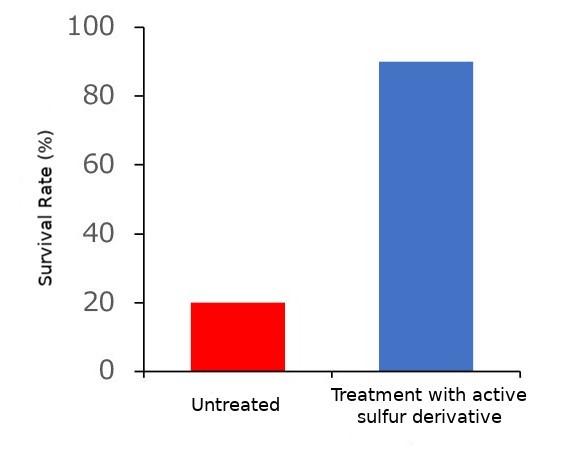
When immune cells were treated with the donor, macrophage response to stimulation by various inflammation-inducing substances (e.g., lipopolysaccharides derived from gram-negative bacteria) was greatly inhibited. In other words, the researchers found that their new polysulfide donor was very good at reducing inflammation. To confirm its anti-inflammation properties, the polysulfide donor was administered to mice suffering from endotoxin shock–a condition that often leads to death due to excessive inflammation. Compared to non-treated mice, the survival rate significantly improved.

“This is a landmark achievement that shows, for the first time, that RSS are closely involved with immune function regulation, and that inflammatory pathology can be improved by artificially increasing RSS,” said study leader, Professor Tomohiro Sawa of Kumamoto University. “Furthermore, excessive inflammatory reactions are involved in endotoxin shock, allergies, and autoimmune diseases. Steroid hormones and immunosuppressants are the typical treatments for these disorders, but they come with various side effects. In the future, we expect to target intracellular active sulfur regulation to develop new anti-inflammatory therapies.”

###

This research was posted online in Cell Chemical Biology on 7 March 2019.

[Source]

Zhang, T., Ono, K., Tsutsuki, H., Ihara, H., Islam, W., Akaike, T., & Sawa, T. (2019). Enhanced Cellular Polysulfides Negatively Regulate TLR4 Signaling and Mitigate Lethal Endotoxin Shock. Cell Chemical Biology. doi:10.1016/j.chembiol.2019.02.003

Media Contact
J. Sanderson & N. Fukuda
[email protected]

Original Source

https://www.kumamoto-u.ac.jp/daigakujouhou/kouhou/pressrelease/2018-file/release190307.pdf

Related Journal Article

http://dx.doi.org/10.1016/j.chembiol.2019.02.003

Tags: BiochemistryCell BiologyImmunology/Allergies/AsthmaMedicine/HealthPhysiology
Share12Tweet8Share2ShareShareShare2

Related Posts

Cytokine Storm: Victory in Infection, Defeat in Sepsis

January 12, 2026

Enhanced Tumor Immunotherapy via Targeted Nanoparticles

January 12, 2026

How BMI Affects Mortality in Elderly ICU Patients

January 12, 2026

Senior Nursing Students Encounter End-of-Life Experiences

January 11, 2026
Please login to join discussion

POPULAR NEWS

  • Enhancing Spiritual Care Education in Nursing Programs

    154 shares
    Share 62 Tweet 39
  • PTSD, Depression, Anxiety in Childhood Cancer Survivors, Parents

    146 shares
    Share 58 Tweet 37
  • Robotic Ureteral Reconstruction: A Novel Approach

    68 shares
    Share 27 Tweet 17
  • Impact of Vegan Diet and Resistance Exercise on Muscle Volume

    47 shares
    Share 19 Tweet 12

About

We bring you the latest biotechnology news from best research centers and universities around the world. Check our website.

Follow us

Recent News

Cytokine Storm: Victory in Infection, Defeat in Sepsis

Enhanced Tumor Immunotherapy via Targeted Nanoparticles

How BMI Affects Mortality in Elderly ICU Patients

Subscribe to Blog via Email

Enter your email address to subscribe to this blog and receive notifications of new posts by email.

Join 71 other subscribers
  • Contact Us

Bioengineer.org © Copyright 2023 All Rights Reserved.

Welcome Back!

Login to your account below

Forgotten Password?

Retrieve your password

Please enter your username or email address to reset your password.

Log In
No Result
View All Result
  • Homepages
    • Home Page 1
    • Home Page 2
  • News
  • National
  • Business
  • Health
  • Lifestyle
  • Science

Bioengineer.org © Copyright 2023 All Rights Reserved.


