


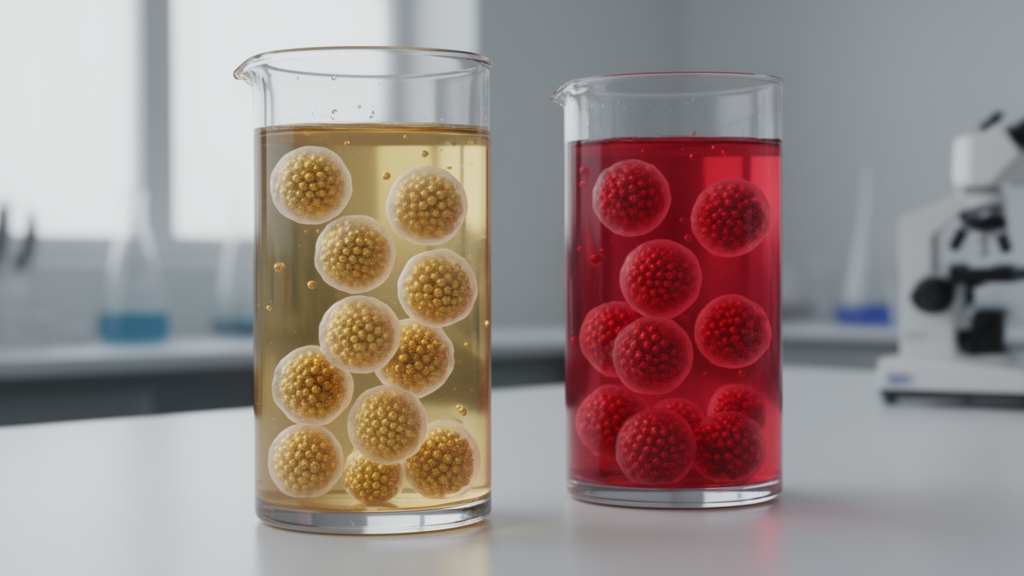
Gold nanoparticles have long been touted as a route to cheap, equipment-free diagnostics, and one of their most promising targets is hepatitis C virus, an RNA pathogen that infects an estimated 185 million people worldwide. A new study published in Gold Bulletin by Debarun Paul, Ramakrishnan Ganesan and Jayati Ray Dutta examines a practical obstacle that has received surprisingly little attention: what happens to the assay when the nanoparticles are coated with stabilizing polymers to extend their shelf life. The answer, based on a preliminary laboratory investigation with synthetic oligomers, is a trade-off. Polyvinyl alcohol (PVA) and polyethylene glycol (PEG) markedly improved the colloidal stability of gold nanoparticles, but both additives interfered with the biochemical interactions that allow the colorimetric test to tell HCV-positive samples from negative ones.
The assay at the heart of the study exploits a striking optical property of dispersed gold nanoparticles. Spherical particles roughly 5 to 50 nanometers in diameter appear ruby red because of surface plasmon resonance; when they clump together, the coupled plasmon shifts and the suspension turns purple. In the classic unmodified-probe format, negatively charged citrate-capped nanoparticles are mixed with single-stranded DNA probes designed against the highly conserved 5′ untranslated region of the HCV genome. Where a complementary target is present, hybridization creates duplexes with free overhanging ends that adsorb to the nanoparticles and stabilize them against salt-induced aggregation, so positive samples stay red while negative samples, lacking that protection, aggregate and turn purple under an optimized salt threshold.
The researchers synthesized citrate-capped nanoparticles by the well-established Turkevich method, boiling gold chloride with trisodium citrate, and prepared two polymer-modified versions by adding either PVA or PEG during synthesis. They also tested commercially available nanoparticles of about 20 nanometers, along with variants concentrated fourfold by vacuum concentration, dialyzed to reduce proprietary stabilizers, or both dialyzed and concentrated. Characterization drew on UV-visible spectroscopy, dynamic light scattering, zeta potential measurements, high-resolution transmission electron microscopy, X-ray photoelectron spectroscopy and inductively coupled plasma mass spectrometry, giving the team an unusually complete picture of how each additive changed the particles before any sensing was attempted.
The spectroscopy told a consistent story of polymer-surface interaction. Absorbance maxima sat at 520 to 525 nanometers for the as-synthesized particles and shifted gently to 527 nanometers after polymer addition, accompanied by a faint purplish hue, a red shift the authors attribute to polymer chains engaging the particle surface. Dynamic light scattering showed a bimodal distribution for the as-synthesized particles with a z-average near 20 nanometers, a larger hydrodynamic diameter around 32 nanometers and a high polydispersity index of 0.55; adding PEG lowered that index to 0.31, which the authors read as evidence of enhanced stability, while PVA left sizes largely unchanged with an index of 0.34. Electron microscopy placed citrate-capped particles at 25 plus or minus 7.6 nanometers and PEGylated ones at 27 plus or minus 6 nanometers, but revealed a drastic reduction to 9 plus or minus 3.5 nanometers under PVA, suggesting the polymer also acts as a mild reducing and co-capping agent during synthesis.
Surface charge measurements highlighted how strongly the coatings mask the particles. Citrate-capped nanoparticles carried a zeta potential of minus 52.5 millivolts, but PVA coating reduced this dramatically to minus 11.6 millivolts by shielding the charged groups, while PEG had a milder effect at minus 31.8 millivolts. The commercial particles measured minus 28.5 millivolts, dropping to minus 13.6 millivolts after dialysis as unidentified stabilizer molecules leached out. X-ray photoelectron spectroscopy corroborated effective surface coverage: sodium citrate signals prominent on the as-synthesized particles were not pronounced on the polymer-coated ones, carbon spectra showed dominant ether signals for PEG and alcohol-environment signals for PVA, and gold remained in its zero-valent state across all samples. Gold concentrations measured by ICP-MS were roughly 210 micrograms per milliliter for the laboratory-synthesized particles regardless of capping, while the commercial particles contained only about 9 micrograms per milliliter until concentrated roughly fourfold.
For the sensing experiments, the team designed a probe complementary to the 5′ untranslated region using NCBI BLAST, together with a short 25-base-pair target extended to 45 bases by a poly-A tail, a longer 120-base-pair target spanning nucleotides 86 to 205 of that region, and a non-complementary 50-base control target. Five combinations per nanoparticle type were tested: water only, probe alone, probe plus non-complementary target, probe plus short target, and probe plus long target, all at fixed 3 micromolar oligonucleotide concentrations. After hybridization at 56 degrees Celsius, nanoparticles were added, an optimized salt dose triggered aggregation, and results were scored by eye, by full UV-visible spectra and by the ratio of absorbance at 520 to 660 nanometers.
The plain citrate-capped nanoparticles proved the clear performers. With 10 microliters of 2 molar sodium chloride as the critical coagulation concentration, four of the five combinations aggregated, while only the probe-plus-long-target tube resisted with a comparatively small color change; the short-target combination aggregated too, though less than the no-target controls. The authors note these colorimetric results were extremely prominent to the naked eye and were supported by the spectroscopic and ratiometric data. This particle type, however, is fragile: the citrate ions are only physically adsorbed, and the suspension remains usable for about 30 days before stresses such as heat shock, lyophilization, centrifugation, air drying or freeze-thawing induce aggregation.
The polymer-coated particles were far more stable but far less informative. PEGylated nanoparticles, whose shelf life extends up to four months, needed only 3 microliters of 1 molar sodium chloride to aggregate the control and probe-only samples, yet the non-complementary, short-target and long-target combinations all remained relatively stable, with the long-target sample paradoxically the most purplish of the three. The authors suggest the excluded volume effect of PEG compacts long DNA duplexes into spherical or rod-like structures, compromising the structural integrity that long overhangs normally provide. PVA-coated particles, stable for up to three months through steric repulsion and a structured hydration shell, required a harsher 5 molar sodium chloride threshold, and after 7 microliters every combination turned purple with only minute differences, making positive and negative samples effectively indistinguishable visually.
The commercial particles fared no better. With 10 microliters of 5 molar sodium chloride, the long-target combination showed the greatest aggregation, which the authors attribute to proprietary surfactants and preservatives behaving like PEG; concentrated variants showed similar trends with additional aggregation in the short-target tube, and dialyzed versions tested with magnesium chloride produced only minimal spectral and visual differentiation. The authors conclude that conventional Turkevich-synthesized nanoparticles without additives remain the better choice for colorimetric HCV detection, and they frame the work as a preliminary investigation requiring future optimization, potentially through chemically conjugating surface chelators, before additive-laden particles can meet the standards of reliable point-of-care colorimetric testing.
Subject of Research: How polymeric stabilizing additives affect gold nanoparticle stability and colorimetric detection of hepatitis C virus oligonucleotides
Article Title: Effect of polymeric additives on gold nanoparticles for colorimetric detection of hepatitis C virus
Article References: Paul, D., Ganesan, R., & Ray Dutta, J. (2025). Effect of polymeric additives on gold nanoparticles for colorimetric detection of hepatitis C virus. Gold Bulletin, 58(1), Article 8. https://doi.org/10.1007/s13404-025-00362-0
Image Credits: AI Generated
DOI: 10.1007/s13404-025-00362-0
Keywords: gold nanoparticles, hepatitis C virus, colorimetric detection, PVA, PEG, Turkevich synthesis, salt-induced aggregation, point-of-care diagnostics, colloidal stability, biosensing, oligonucleotide probes, zeta potential
News Source: Kristina Jarvis. (October 29, 2026). Polymer Coatings Stabilize Gold Nanoparticles but Blur Hepatitis C Colorimetric Assay. Scienmag.



