For millions of people with seasonal allergies, springtime means runny noses, excessive sneezes and itchy eyes. And, as with many things, climate change appears to be making allergy season even worse. Researchers reporting in ACS Earth and Space Chemistry have shown that common allergen-producing plants ryegrass and ragweed emit more smaller, “subpollen particles” (SPPs) than once thought, yet climate would likely be most affected by their intact pollen grains, which can boost cloud formation.
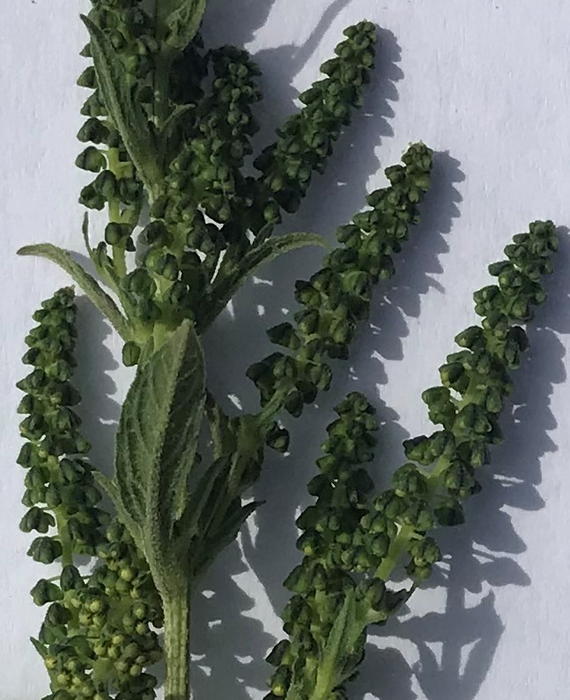
Credit: Adapted from ACS Earth and Space Chemistry, 2023, DOI: 10.1021/acsearthspacechem.3c00014
For millions of people with seasonal allergies, springtime means runny noses, excessive sneezes and itchy eyes. And, as with many things, climate change appears to be making allergy season even worse. Researchers reporting in ACS Earth and Space Chemistry have shown that common allergen-producing plants ryegrass and ragweed emit more smaller, “subpollen particles” (SPPs) than once thought, yet climate would likely be most affected by their intact pollen grains, which can boost cloud formation.
In addition to annoying sinuses, pollen naturally functions as a way for plants to exchange genetic material and reproduce. When exposed to moisture, these pollen grains can burst into tiny SPPs less than a micron long. Their smaller size allows them to reach the lower respiratory system, where they can last longer and cause more inflammation than their larger counterparts. Both SPPs and whole pollen grains are also thought to act as ice nucleation sites — miniature starting points for clouds. But compared to regular clouds, SPPs and pollen form smaller, more numerous clouds that tend to hold onto their precipitation, helping trap in radiant heat and contributing to climate change. In turn, higher temperatures can extend pollen-release periods, further exacerbating the problem. Previously, Brianna Matthews, Alyssa Alsante and Sarah Brooks studied how oak trees emit SPPs at different humidity levels. But this time, the team wanted to investigate how two other common allergen-producing plants, ragweed and ryegrass, release SPPs under humid conditions, and how those particles could affect ice cloud formation.
The researchers collected samples of ryegrass and ragweed, then placed them into a specialized “pollen chamber.” There, the samples were exposed to different humidity levels and bursts of wind over several hours to simulate real-world conditions.
The group assessed the number of SPPs per pollen grain, as well as the abilities of both to nucleate ice. Surprisingly, the team found that previous experiments on the same types of plants underestimated the amount of SPPs by a factor of 10 to 100. This was likely because the other experiments used a less realistic means of spreading the pollen and generating the SPPs, say the researchers. Ragweed and ryegrass SPPs were very poor ice-nucleating sites, however — barely better than plain water — while whole pollen grains facilitated cloud growth. The researchers say that these updated parameters and numbers of emitted pollen grains and particles could ultimately be used to create more-accurate climate models.
The authors acknowledge funding from the National Science Foundation.
The American Chemical Society (ACS) is a nonprofit organization chartered by the U.S. Congress. ACS’ mission is to advance the broader chemistry enterprise and its practitioners for the benefit of Earth and all its people. The Society is a global leader in promoting excellence in science education and providing access to chemistry-related information and research through its multiple research solutions, peer-reviewed journals, scientific conferences, eBooks and weekly news periodical Chemical & Engineering News. ACS journals are among the most cited, most trusted and most read within the scientific literature; however, ACS itself does not conduct chemical research. As a leader in scientific information solutions, its CAS division partners with global innovators to accelerate breakthroughs by curating, connecting and analyzing the world’s scientific knowledge. ACS’ main offices are in Washington, D.C., and Columbus, Ohio.
To automatically receive news releases from the American Chemical Society, contact [email protected].
Follow us: Twitter | Facebook | LinkedIn | Instagram
Journal
ACS Earth and Space Chemistry
DOI
10.1021/acsearthspacechem.3c00014
Article Title
Pollen Emissions of Subpollen Particles and Ice Nucleating Particles
Article Publication Date
27-Apr-2023