


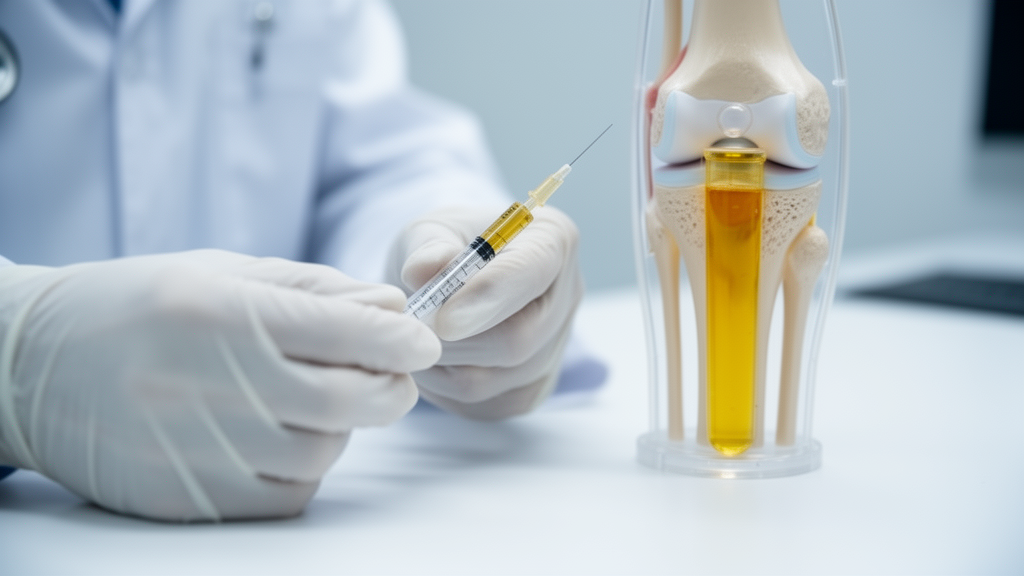
Platelet-rich plasma, the injections increasingly marketed as a way to repair arthritic knees, do not appear to reliably slow the structural deterioration of the joint, according to a systematic review and meta-analysis published in Archives of Orthopaedic and Trauma Surgery. The analysis, led by Eric Pasqualotto and colleagues, pooled data from 12 randomized controlled trials involving 1,200 patients with knee osteoarthritis and focused specifically on what MRI and other imaging measures reveal about cartilage, bone and joint tissue after treatment. The verdict was sobering: platelet-rich plasma demonstrated limited and inconsistent effects on imaging-based structural outcomes, and the authors conclude that the findings do not provide clear evidence supporting the therapy as a structural disease-modifying treatment.
The review comes at a time when platelet-rich plasma occupies an awkward position in orthopedic medicine. The preparation, made by concentrating platelets from a patient’s own blood, is rich in growth factors and cytokines and has attracted growing attention for its theoretical capacity to modulate inflammation, promote cartilage homeostasis and alleviate symptoms. Yet major clinical guidelines, including those from the American College of Rheumatology and the Osteoarthritis Research Society International, recommend against its routine use, citing weak evidence of outcomes, heterogeneous preparation methods and methodological limitations in prior trials. While several earlier systematic reviews reported favorable effects on pain and function compared with saline, corticosteroid or hyaluronic acid injections, the quality of that evidence has remained variable, and whether the injections actually change the course of joint degeneration has stayed an open question.
To address that question, the researchers systematically searched PubMed, Embase and the Cochrane Library from inception to May 2026 for randomized controlled trials evaluating imaging-based structural effects of platelet-rich plasma in knee osteoarthritis. The review followed the PRISMA reporting guidelines and was registered in PROSPERO under number CRD420251243109. The initial search yielded 361 results; after removing duplicates and screening titles and abstracts, 28 full-text articles were reviewed against the inclusion criteria, and 12 randomized trials comprising 1,200 patients made the final cut. Of those patients, 572, or 47.7 percent, were randomized to receive platelet-rich plasma, and the mean age across the pooled population was 59.4 years. Eligible studies had to compare intra-articular platelet-rich plasma with other treatments in patients with clinically or radiographically confirmed knee osteoarthritis and report at least one structural imaging outcome. No restrictions were applied according to the subtype of platelet-rich plasma preparation.
The outcomes of interest spanned ten distinct imaging endpoints, including medial tibial cartilage change, patellofemoral cartilage change, Whole-Organ Magnetic Resonance Imaging Score measures of osteophytes and subchondral cysts, synovitis, cartilage defect progression, bone marrow edema, areas of cartilage thinning, MRI improvement and total WORMS score. For continuous outcomes the analysts used standardized mean differences or mean differences, and for binary endpoints they used risk ratios, all with 95 percent confidence intervals. Heterogeneity was assessed with the Cochrane Q-test and I2 statistics, and all endpoints were pooled with DerSimonian and Laird random-effects models. Leave-one-out procedures were used to identify influential studies for outcomes with three or more contributing trials, and the analyses were performed in R, version 4.5.2.
The pooled results told a mixed story. On the favorable side, platelet-rich plasma was associated with greater improvement in patellofemoral cartilage thickness and volume compared with control treatments, with a standardized mean difference of 0.94 (95 percent confidence interval 0.53 to 1.34; p < 0.01; I2 = 0 percent). The analysis also found a significant reduction in bone marrow edema in favor of platelet-rich plasma, with a standardized mean difference of −0.40 (95 percent confidence interval −0.71 to −0.09; p = 0.01; I2 = 0 percent). But those two signals were outweighed by a series of null results. No significant between-group differences emerged for medial tibial cartilage thickness or volume (standardized mean difference 0.47; 95 percent confidence interval −0.57 to 1.52; p = 0.37; I2 = 92 percent), for cartilage defect progression (risk ratio 1.06; 95 percent confidence interval 0.47 to 2.38; p = 0.89; I2 = 68 percent), for WORMS osteophyte scores (mean difference −0.11; 95 percent confidence interval −0.70 to 0.47; p = 0.70) or for WORMS subchondral cyst scores (mean difference −0.64; 95 percent confidence interval −2.15 to 0.88; p = 0.41). Synovitis, assessed with scoring systems, did not differ overall between groups (standardized mean difference −0.22; 95 percent confidence interval −0.43 to 0.00; p = 0.05).
Individual trials reinforced the inconsistency. Lisi and colleagues reported in 2017 that 48.3 percent of patients treated with platelet-rich plasma achieved at least a one-grade MRI improvement, compared with only 8 percent of controls, a striking difference with a p-value below 0.003. Yet Bennell’s 2021 trial moved in the opposite direction, finding a higher proportion of platelet-rich plasma-treated participants with three or more areas of cartilage thinning relative to placebo, 17.1 percent versus 6.8 percent, corresponding to a risk ratio of 2.71 (95 percent confidence interval 1.16 to 6.34). Tschopp’s 2024 study found no significant changes in morphological parameters between groups at either 3 or 12 months, although it did report regional improvements in T2 mapping values in select compartments when comparing platelet-rich plasma with corticosteroids and placebo. Zhang’s 2025 trial reported similar reductions in total WORMS scores at 12 months in both a combination group receiving hyaluronic acid plus platelet-rich plasma and a group receiving hyaluronic acid alone, with no meaningful difference between the treatments.
The synovitis finding deserves particular scrutiny because of its fragility. In a leave-one-out sensitivity analysis, the authors showed that omitting the Zhang 2025 trial resulted in a statistically significant reduction in synovitis in favor of platelet-rich plasma, which means the pooled null result hinged on a single study. The discussion notes that this sensitivity indicates uncertainty rather than a confirmed absence of effect. Individual trials were themselves heterogeneous on this endpoint: Raeissadat’s 2020 study observed a greater reduction in synovitis in the platelet-rich plasma group compared with an exercise control group, with figures of 28.5 percent versus 52.3 percent, while Bansal’s 2021 trial found low and comparable rates of persistent synovitis between patients treated with platelet-rich plasma and those treated with hyaluronic acid, at 4.6 percent versus 10.2 percent.
The certainty of the evidence underlying all of these estimates was weak. Using the Cochrane Collaboration’s RoB-2 tool, the assessors rated five of the included trials as having some concerns for risk of bias and seven as having low risk of bias, with the domain raising the greatest number of concerns being bias in selection of the reported results, reflecting potential selective reporting or insufficiently pre-specified outcomes. Under the GRADE framework, five outcomes were classified as low-quality evidence: patellofemoral cartilage thickness and volume, WORMS osteophyte scores, WORMS subchondral cyst scores, bone marrow edema and synovitis. Two outcomes fell to very low quality: medial tibial cartilage thickness and volume, and cartilage defect progression. The main reasons for downgrading were the use of different measures to evaluate the endpoints, variation in control groups, the small number of studies reporting each outcome, high heterogeneity and the presence of some concerns for risk of bias.
The authors also catalogued the methodological caveats that temper interpretation of even the positive findings. Many of the included trials had small sample sizes, limiting the power to detect subtle structural changes. Heterogeneity was substantial for some outcomes, especially the medial tibial cartilage measures, and the available data did not allow the researchers to isolate a predominant source. MRI-based structural assessment was not standardized across trials, with differences in acquisition sequences, scoring systems, anatomical regions assessed and quantitative versus semiquantitative measurements. Cartilage thickness and cartilage volume were combined using standardized mean differences, which permits statistical integration of measures on different scales but does not guarantee full biological equivalence between the two parameters. The comparator groups were clinically and pharmacologically heterogeneous, spanning normal saline, hyaluronic acid, corticosteroids, NSAIDs, exercise and microfragmented adipose tissue, and the limited number of studies per comparator category precluded statistically robust subgroup analyses. Platelet-rich plasma itself is not a biologically standardized intervention: leukocyte content, platelet concentration, activation method, injected volume and number of injections varied among the studies, often without complete reporting. Follow-up durations ranged from only 3 to 24 months, which may be insufficient to detect disease-modifying effects in a slowly progressive condition.
On the question of what the favorable signals actually mean, the authors urge restraint. Bone marrow edema, they note, is a known correlate of pain and disease activity, but it represents a biological construct distinct from cartilage preservation. These subchondral and inflammatory imaging features are potentially reversible and considerably more dynamic over time than cartilage morphology, so their improvement should be regarded as a marker of reduced inflammatory or subchondral activity rather than evidence of cartilage preservation or attenuated structural progression of osteoarthritis. The patellofemoral benefit, meanwhile, rests on low-certainty evidence, which limits confidence in its magnitude and generalizability. The authors position their work as, to their knowledge, the first meta-analysis to quantitatively pool structural imaging outcomes of platelet-rich plasma for knee osteoarthritis based exclusively on randomized trials, and they align their null-leaning results with prior studies such as the RESTORE trial, which observed clinical improvement with platelet-rich plasma but found no significant difference in medial tibial cartilage volume compared with placebo, and with work by Zaffagnini and colleagues showing no changes across multiple WORMS components up to 24 months. Their conclusion is that the available evidence does not support platelet-rich plasma as a structural disease-modifying therapy, and that rigorously designed trials with standardized imaging protocols, uniform preparation methods and harmonized structural endpoints are needed before any definitive claim can be made.
Subject of Research: Structural imaging outcomes of platelet-rich plasma injections in knee osteoarthritis
Article Title: Platelet-rich plasma for knee osteoarthritis: a systematic review and meta-analysis of structural outcomes
Article References: Pasqualotto, E., Pasqualotto, T., Lunelli, L., de Sousa, F. B., Funchal, L. F. Z., & dos Reis, F. B. (2026). Platelet-rich plasma for knee osteoarthritis: a systematic review and meta-analysis of structural outcomes. Archives of Orthopaedic and Trauma Surgery, 146(1), Article 381. https://doi.org/10.1007/s00402-026-06543-6
Image Credits: AI Generated
DOI: 10.1007/s00402-026-06543-6
Keywords: platelet-rich plasma, knee osteoarthritis, systematic review, meta-analysis, cartilage thickness, MRI, WORMS, bone marrow edema, synovitis, randomized controlled trials, GRADE evidence quality, disease modification
News Source: Ophelia Keating. (October 28, 2026). Platelet-Rich Plasma Fails to Show Consistent Structural Benefits in Knee Osteoarthritis, Meta-Analysis Finds. Scienmag.



