

• HOME
  • NEWS
  • EXPLORE
    • CAREER
      • Companies
      • Jobs
    • EVENTS
    • iGEM
      • News
      • Team
    • PHOTOS
    • VIDEO
    • WIKI
  • BLOG
  • COMMUNITY
    • FACEBOOK
    • INSTAGRAM
    • TWITTER
Sunday, July 5, 2026
BIOENGINEER.ORG
No Result
View All Result
  • Login
  • HOME
  • NEWS
  • EXPLORE
    • CAREER
      • Companies
      • Jobs
        • Lecturer
        • PhD Studentship
        • Postdoc
        • Research Assistant
    • EVENTS
    • iGEM
      • News
      • Team
    • PHOTOS
    • VIDEO
    • WIKI
  • BLOG
  • COMMUNITY
    • FACEBOOK
    • INSTAGRAM
    • TWITTER
  • HOME
  • NEWS
  • EXPLORE
    • CAREER
      • Companies
      • Jobs
        • Lecturer
        • PhD Studentship
        • Postdoc
        • Research Assistant
    • EVENTS
    • iGEM
      • News
      • Team
    • PHOTOS
    • VIDEO
    • WIKI
  • BLOG
  • COMMUNITY
    • FACEBOOK
    • INSTAGRAM
    • TWITTER
No Result
View All Result
Bioengineer.org
No Result
View All Result
Home NEWS Science News Chemistry

Planetary-scale ‘heat wave’ discovered in Jupiter’s atmosphere

Bioengineer by Bioengineer
September 23, 2022
in Chemistry
Reading Time: 2 mins read
0
Jupiter Heat Map
Share on FacebookShare on TwitterShare on LinkedinShare on RedditShare on Telegram

An unexpected ‘heat wave’ of 700 degrees Celsius, extending 130,000 kilometres (10 Earth diameters) in Jupiter’s atmosphere, has been discovered. James O’Donoghue, of the Japanese Aerospace Exploration Agency (JAXA), has presented the results this week at the Europlanet Science Congress (EPSC) 2022 in Granada.  
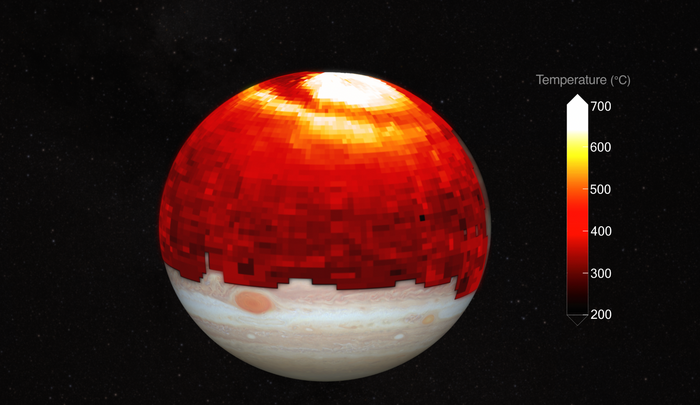
Jupiter Heat Map

Credit: Hubble / NASA / ESA / A. Simon (NASA GSFC) / J. Schmidt. Credit: James O’Donoghue

An unexpected ‘heat wave’ of 700 degrees Celsius, extending 130,000 kilometres (10 Earth diameters) in Jupiter’s atmosphere, has been discovered. James O’Donoghue, of the Japanese Aerospace Exploration Agency (JAXA), has presented the results this week at the Europlanet Science Congress (EPSC) 2022 in Granada.  

Jupiter’s atmosphere, famous for its characteristic multicoloured vortices, is also unexpectedly hot: in fact, it is hundreds of degrees hotter than models predict. Due to its orbital distance millions of kilometres from the Sun, the giant planet receives under 4% of the amount of sunlight compared to Earth, and its upper atmosphere should theoretically be a frigid -70 degrees Celsius. Instead, its cloud tops are measured everywhere at over 400 degrees Celsius.

“Last year we produced – and presented at EPSC2021 – the first maps of Jupiter’s upper atmosphere capable of identifying the dominant heat sources,” said Dr O’Donoghue. “Thanks to these maps, we demonstrated that Jupiter’s auroras were a possible mechanism that could explain these temperatures.”

Just like the Earth, Jupiter experiences auroras around its poles as an effect of the solar wind. However, while Earth’s auroras are transient and only occur when solar activity is intense, auroras at Jupiter are permanent and have a variable intensity. The powerful auroras can heat the region around the poles to over 700 degrees Celsius, and global winds can redistribute the heat globally around Jupiter.

Looking more deeply through their data, Dr O’Donoghue and his team discovered the spectacular ‘heat wave’ just below the northern aurora, and found that it was travelling towards the equator at a speed of thousands of kilometres per hour. 

The heat wave was probably triggered by a pulse of enhanced solar wind plasma impacting Jupiter’s magnetic field, which boosted auroral heating and forced hot gases to expand and spill out towards the equator.

“While the auroras continuously deliver heat to the rest of the planet, these heat wave ‘events’ represent an additional, significant energy source,” added Dr O’Donoghue. “These findings add to our knowledge of Jupiter’s upper-atmospheric weather and climate, and are a great help in trying to solve the ‘energy crisis’ problem that plagues research into the giant planets.”



Share12Tweet8Share2ShareShareShare2

Related Posts

Intelligent Microgrid Management Promises Lower Household Energy Bills and Reduced Diesel Emissions — Chemistry

Intelligent Microgrid Management Promises Lower Household Energy Bills and Reduced Diesel Emissions

July 4, 2026
Graz University of Technology Deciphers the Structural Secrets of MOF Thin Films — Chemistry

Graz University of Technology Deciphers the Structural Secrets of MOF Thin Films

July 2, 2026

Breaking Thermodynamic Limits: Wavelength-Driven Catalysis Advances Ammonia Synthesis

July 2, 2026

From Quantum Mechanics to AI-Powered Materials Discovery: MARVEL Marks 12 Years of Transforming Computational Science

July 2, 2026

POPULAR NEWS

  • Detection of EDCs in Breast Milk and Infant Urine Up to Six Months Highlights Early Exposure Risks

    77 shares
    Share 31 Tweet 19
  • Saying Goodbye to PGY-6: Pediatric Fellowship Realities

    103 shares
    Share 41 Tweet 26
  • New Drug Candidate Developed at McMaster Shows Potential for Treating Brain Cancer

    58 shares
    Share 23 Tweet 15
  • KTU Researchers Explore Ultrasound’s Role in Enhancing Blood Flow Beyond Diagnostics

    53 shares
    Share 21 Tweet 13

About

We bring you the latest biotechnology news from best research centers and universities around the world. Check our website.

Follow us

Recent News

Quasi-Bound States Boost Quantum Well Photoresponse

Lysine Pyruvylation Links Glycolysis to Epigenetics

Multiphysics Coupling: Single vs. Multiple DeepONet Branches

Subscribe to Blog via Email

Success! An email was just sent to confirm your subscription. Please find the email now and click 'Confirm' to start subscribing.

Join 83 other subscribers
  • Contact Us

Bioengineer.org © Copyright 2023 All Rights Reserved.

Welcome Back!

Login to your account below

Forgotten Password?

Retrieve your password

Please enter your username or email address to reset your password.

Log In
No Result
View All Result
  • Homepages
    • Home Page 1
    • Home Page 2
  • News
  • National
  • Business
  • Health
  • Lifestyle
  • Science

Bioengineer.org © Copyright 2023 All Rights Reserved.