Structural characterization of protein-free ribonucleic acids has historically lagged behind the study of protein architecture, leaving major technical gaps in understanding how dynamic transcript conformations drive catalytic and regulatory tasks. While three-dimensional RNA folds are essential for executing splicing, translation, gene expression regulation, subcellular patterning, and signaling, obtaining near-atomic structural models of flexible RNA remains difficult. In the Protein Data Bank as of April 17, 2025, deposited protein structures numbered 230,019 compared to merely 2,086 RNA structures. Protein-free RNA structures determined by cryo-electron microscopy, an imaging approach accessible only during the past four years, totaled just 160 entries compared to 25,892 structures of proteins and protein-nucleic acid assemblies. Most previous cryo-electron microscopy investigations focused exclusively on rigid, stable motifs, whereas dynamic states were largely relegated to chemical probing or low-resolution imaging. To bridge this divide, researchers Shekhar Jadhav and Marco Marcia established a systematic experimental pipeline in BMC Methods that unites native transcript purification, multipronged biophysical validation, and vitrification optimization to resolve both rigid and dynamic non-coding RNAs.
To rigorously evaluate their structural biology workflow, the authors selected two distinct constructs from the Oceanobacillus iheyensis group II intron ribozyme, a well-established metalloribozyme model whose sequential assembly directs self-splicing across bacteria, archaea, and eukaryotic organelles. Functional intron maturation requires 5-prime exon cleavage followed by coordinated exon ligation, relying on conformational shifts of helical domains around conserved hinges to construct a catalytically competent active core. As an experimental proxy for a rigid RNA, the team deployed a previously crystallized, fully active 388-nucleotide construct encompassing domains one through five, designated D1-5, which possesses a theoretical molecular mass of 133 kilodaltons. Conversely, as a representative model for dynamic and flexible transcripts, they generated a 327-nucleotide folding intermediate spanning domains one through three, designated D1-3, having a calculated mass of 113 kilodaltons. Cloned into pBluescript vectors via restriction-free cloning between a T7 promoter and a terminal BamHI cleavage site, both constructs avoided non-native tags or affinity appendices that could distort spontaneous molecular conformations during subsequent structural investigations.
Producing milligram quantities of homogeneous RNA under non-denaturing conditions formed the foundation of the structural pipeline. The authors linearized plasmid DNA templates overnight with BamHI endonuclease and carried out native in vitro transcription using T7 RNA polymerase in a reaction mixture containing 22 millimolar magnesium chloride, 40 millimolar Tris-HCl at pH 8.0, 0.2 millimolar spermidine, 10 millimolar dithiothreitol, and 0.01 percent Triton X-100. Enzymatic digestion using Turbo DNase and proteinase K selectively degraded the DNA template and protein factors without perturbing RNA integrity. Because both ribozyme targets exceeded 50 kilodaltons, successive filtration and dilution cycles using Amicon Ultra-0.5 centrifugal concentrators equipped with 100-kilodalton molecular weight cut-offs eliminated residual nucleotides and small reaction components. The transcripts were simultaneously rebuffered into a stabilization solution comprising 10 millimolar magnesium chloride and 5 millimolar sodium 2-(N-morpholino)ethanesulfonic acid buffer at pH 6.5. Native agarose gel electrophoresis subsequently resolved single, sharply defined migration bands for both D1-5 and D1-3, verifying that neither target suffered from broad conformational heterogeneity or degradation following synthesis.
The researchers next subjected the purified transcripts to rigorous biophysical screening to verify their molecular weights, solution oligomeric state, and polydispersity prior to cryo-specimen preparation. Size-exclusion chromatography utilizing Sephacryl S400 resin packed in 25-milliliter bed volume Tricorn columns yielded sharp, single elution peaks at 16.62 milliliters for D1-5 and 17.17 milliliters for D1-3. Coupling size-exclusion chromatography to multi-angle laser light scattering confirmed exceptional homogeneity and accurate molecular mass calculation for the rigid D1-5 construct, while simultaneously signaling elevated polydispersity for the dynamic D1-3 intermediate. To further confirm the molecular weight and oligomeric state of the samples, the investigators used mass photometry, a technique not yet widely used for RNA analysis. Slides were cleaned with MilliQ water and isopropanol, treated with 0.01 percent poly-L-lysine for 30 seconds, and calibrated with an RNA Century Markers ladder at 10 nanomolar concentration. Across RNA concentrations from 4 to 10 nanomolar, mass photometry measured molecular weights of 133 plus or minus 20 kilodaltons for D1-5 and 109 plus or minus 14 kilodaltons for D1-3. Crucially, monomeric peaks accounted for over 80 percent of both samples.
To delineate how ionic strength modulates the tertiary compactness of flexible transcripts, the authors executed size-exclusion chromatography coupled to small-angle X-ray scattering at the European Synchrotron Radiation Facility BM29 beamline. Purified RNAs were analyzed in a low-salt buffer consisting of 10 millimolar magnesium chloride and 5 millimolar sodium MES at pH 6.5, alongside a high-salt buffer supplemented with 150 millimolar potassium chloride. For the flexible D1-3 intermediate, experimental radius of gyration and maximum particle dimension matched crystallographic coordinates of 3.7 nanometers and 12.2 nanometers exclusively under high-salt conditions. In low-salt buffer lacking monovalent potassium, the measured radius of gyration and maximum dimension expanded 15 percent beyond theoretical values. Crysol comparisons between theoretical scattering curves and experimental profiles yielded a chi-squared value of 1.14 in high ionic strength versus 1.79 in low-salt conditions. Furthermore, ab initio DAMMIF bead modeling derived from low-salt scattering data revealed distinct mobile protrusions extending outward from the compact structural core, directly capturing the dynamic conformer flexibility predicted for early group II intron assembly intermediates in solution.
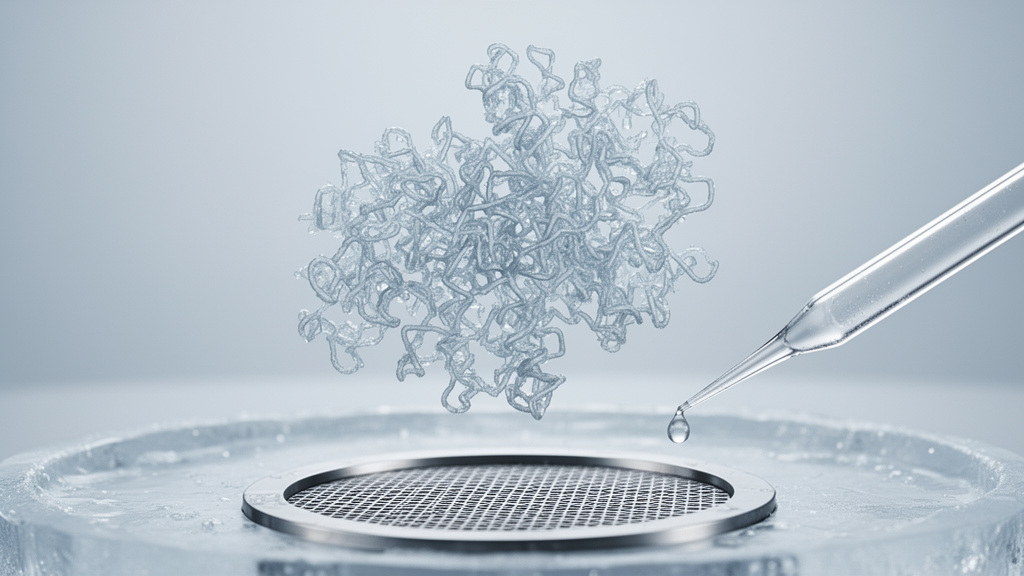
Translating purified RNA to plunge-frozen cryo-electron microscopy grids revealed stark differences in specimen requirements compared to standard protein workflows. Screening on glow-discharged 300-mesh R 1.2/1.3 Quantifoil copper grids at 22 degrees Celsius and 100 percent humidity showed that applying 1 micromolar RNA, a concentration typical for protein complexes, produced completely blank vitreous ice devoid of detectable particles. In contrast, negative staining transmission electron microscopy using 0.1 to 0.2 micromolar RNA on carbon-coated grids treated with 25 milliampere glow discharge for 30 seconds yielded robust particle fields, showing an unexpected 100-fold concentration divergence between negative stain and cryo-EM preparations. Concentration screening established that particles began appearing in vitreous ice at 15 micromolar, with higher concentrations of 18 and 30 micromolar progressively increasing particle density. For these non-coding RNAs, achieving optimal particle field density demanded working concentrations between 20 and 30 micromolar, translating to 2 to 4 milligrams per milliliter, which significantly exceeds the 0.05 to 5 micromolar range common for macromolecular proteins.
Vitrification parameters also exerted profoundly divergent effects on the structured versus flexible RNA constructs during plunge-freezing in liquid ethane using a Vitrobot Mark IV. For the structured D1-5 construct, applying standard protein plunge-freezing parameters, specifically a blot force of minus 7 and a blot time of 1 second, yielded uniformly dispersed particles in vitreous ice without further optimization. Conversely, the dynamic D1-3 construct displayed severe spatial heterogeneity under identical settings, forming clustered aggregates of unfolded particles alongside large empty areas across grid holes. Adjusting the blot force to minus 9 left particle heterogeneity evident and resulted in low particle density. However, tuning the blot force to minus 10 produced homogenous particle distributions throughout the grid openings. Subsequent testing of blot times across 1.0, 2.0, 2.5, and 3.0 seconds revealed that blot times of 2 seconds or higher reintroduced patchy clustering, whereas shortening the blot time to 1 second maximized particle contrast while completely suppressing non-specific aggregation and unfolding.
To evaluate whether plunge-freezing optimization was dependent on electron beam acceleration, the team imaged frozen specimens across three different transmission electron microscopes, comprising a 120 kiloelectronvolt Tecnai T12, a 200 kiloelectronvolt Glacios equipped with a Falcon III detector, and a 300 kiloelectronvolt Titan Krios equipped with a Gatan K3 camera. Raw micrographs recorded at identical specimen parameters across 120, 200, and 300 kiloelectronvolt platforms showed equivalent particle density, crowding, and distribution, proving that primary vitrification settings translate reliably across disparate instrument voltages. For D1-5 frozen at 30 micromolar with minus 7 blot force and 1 second blot time, datasets from both the Glacios and Titan Krios microscopes yielded robust particles that immediately supported high-resolution structural reconstructions, showing that well-folded non-coding RNAs behave robustly when prepared under conditions optimized on lower-voltage screening instruments.
Crucially, the authors uncovered that visual examination of motion-corrected micrographs alone is insufficient to diagnose structural integrity in dynamic non-coding RNAs. While Glacios micrographs of D1-3 frozen at 25 micromolar under either minus 9 blot force with 2 seconds blot time or minus 10 blot force with 1 second blot time appeared superficially acceptable, downstream data processing in CryoSPARC and WARP revealed hidden structural degradation. Particles frozen under the minus 9 blot force and 2-second condition yielded two-dimensional class averages characterized by abnormal, extended tail-like densities projecting from the main particle core. Ab initio three-dimensional volume reconstructions from this suboptimal dataset revealed complete misfolding of domains two and three, which coalesced into an unphysiological, continuous single helix extending from the terminus of domain one. In sharp contrast, data processing from grids frozen under minus 10 blot force and 1 second blot time resolved compact, native architectures wherein domains two and three formed independent stem-loops correctly docked onto the domain one scaffold.
This methodological framework demonstrates that resolving flexible, protein-free non-coding RNAs at high resolution requires coupling native synthesis with rigorous multi-technique biophysical validation and iterative plunge-freezing optimization guided by preliminary image reconstruction. By systematically testing ionic requirements, light scattering behavior, mass distribution, ice thickness, and blotting mechanics, the researchers established reproducible conditions for preserving both rigid and intermediate RNA folding states in vitreous ice, depositing resulting models into the Protein Data Bank under accession codes 9G4L, 9G4J, 9QU7, and 9QU6. Because ongoing functional mapping indicates that countless newly discovered non-coding transcripts rely on dynamic, partially flexible helical rearrangements, this empirical roadmap provides structural biologists with the exact physical parameters required to visualize transient RNA conformations and decipher their underlying molecular mechanisms.
Subject of Research: Cryo-electron microscopy specimen preparation and structural characterization pipeline for dynamic and structured non-coding RNAs
Article Title: Cryo-specimen preparation and imaging of highly-structured and dynamic large non-coding RNAs
Article References: Jadhav, S., & Marcia, M. (2025). Cryo-specimen preparation and imaging of highly-structured and dynamic large non-coding RNAs. BMC Methods, 2(1), Article 26. https://doi.org/10.1186/s44330-025-00045-4
Image Credits: AI Generated
DOI: 10.1186/s44330-025-00045-4
Keywords: cryo-electron microscopy, non-coding RNA, ribozyme, group II intron, vitrification, structural biology, mass photometry, small-angle X-ray scattering, SEC-MALLS, Oceanobacillus iheyensis, RNA dynamics, macromolecular imaging, Vitrobot, sample preparation, CryoSPARC, biophysical characterization
News Source: Jason Bradley. (November 14, 2026). Pipeline Optimizes Cryo-EM Specimen Preparation for Structured and Dynamic Large RNAs. Scienmag.