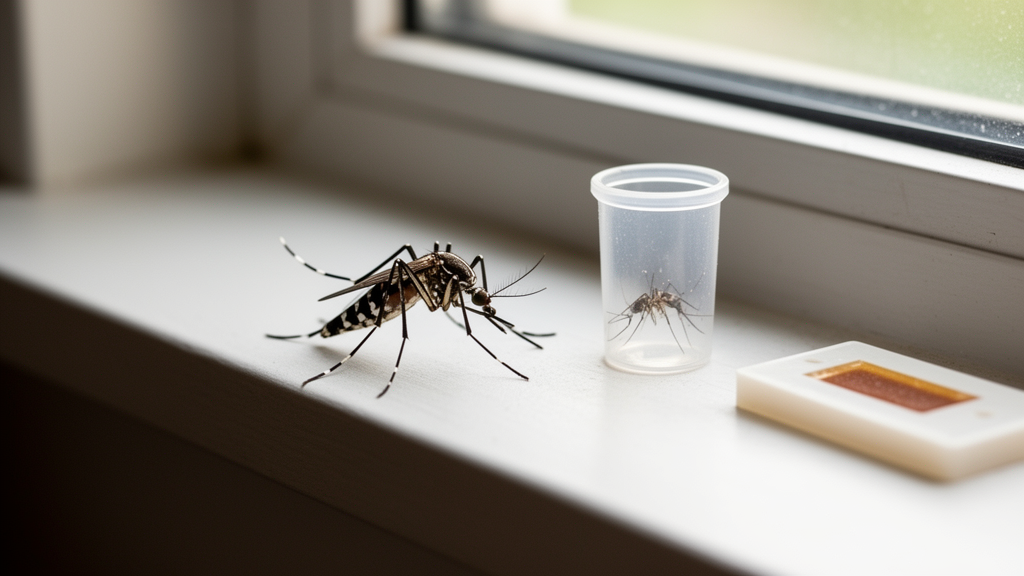
A season-long pilot study in eastern Spain found that 10.9% of female Asian tiger mosquitoes, Aedes albopictus, captured by oviposition traps were found inside houses, providing the first systematic European monitoring of the species’ indoor presence. The investigators sampled eight detached homes in the Montesol residential area of La Eliana, Valencia, from April through December 2025. Ae. albopictus entered every sampled house, although the proportion of females captured indoors varied substantially among households, from 1.41% to 26.13%. The results indicate that house entry was a recurrent behaviour in this Mediterranean suburban setting rather than an isolated event, while also revealing that temperature and household-level conditions were associated with when and where it occurred.
The monitoring used INESTRAP oviposition sticky traps, devices designed to attract gravid female Aedes mosquitoes seeking an oviposition site. Each participating house had one trap outdoors in its garden and another in its living room, with both positioned at ground level and left in place throughout the study. The traps contained water but no chemical or biological attractants, while adhesive cards captured mosquitoes that entered. Cards were inspected and replaced every two weeks, and captured specimens were taken to the laboratory, sexed and identified to species by the same investigator. The design allowed the research team to compare indoor and outdoor abundance through time while using the same sampling method in both environments.
Across the study period, the traps captured 2,425 Ae. albopictus, comprising 2,063 females and 362 males, as well as 84 Culex pipiens, including 49 females and 35 males. Ae. albopictus accounted for 96.7% of the mosquitoes analysed, and outdoor captures were significantly higher than indoor captures in all comparison groups. The observed 10.9% indoor share for Ae. albopictus females was similar to indoor activity rates previously reported from Réunion and Brazil using different sampling methods. This consistency suggests that the behaviour is not unique to the Spanish study area, although the small European sample does not establish its prevalence across the continent.
Seasonal patterns also differed between the two settings. Outdoor activity showed plateaus in May and October, whereas detectable indoor activity ran from May through September and was concentrated most strongly between late July and early August. Indoor and outdoor female populations were positively associated: a Spearman test produced a correlation coefficient of 0.51 with p less than 0.0001, while a general linear model yielded an R-squared value of 0.20, also with p less than 0.0001. The relatively limited explanatory value of the linear model indicated that the two capture series were correlated but did not simply mirror one another, consistent with the possibility that additional factors influence whether mosquitoes crossed a household threshold.
Temperature was the strongest measured environmental variable associated with mosquito abundance. Outdoor activity was generally detected only when minimum temperatures exceeded approximately 3.4–7.6°C, while indoor activity was restricted to periods when exterior minimum temperatures were above 14.4–16.6°C and maximum temperatures exceeded 30.6–32.2°C. Once those thresholds were reached, outdoor capture rates increased with maximum and minimum temperature, with adjusted R-squared values of 0.86 and 0.78, respectively. Indoor capture rates were also positively related to maximum and minimum temperatures, but the corresponding adjusted R-squared values were lower, at 0.54 and 0.43. The highest temperature recorded during the study was 39.5°C.
The researchers also used general additive mixed models, with climatic and environmental variables as fixed effects and household as a random effect, to examine indoor and outdoor female populations. The indoor model explained 56.7% of deviance and had an adjusted R-squared value of 0.53, while the outdoor model explained 68.9% of deviance and had an adjusted R-squared value of 0.64. Average temperature had a non-linear positive relationship with both populations. Hierarchical partitioning attributed 55.72% of observed variance in the outdoor population to average temperature, compared with 25.06% for the indoor population. Minimum atmospheric pressure accounted for 28.30% of the explained variance, while household trapping site was the dominant factor for indoor activity, explaining 74.94% of the observed variance compared with 15.98% outdoors.
These associations do not establish that hotter weather causes mosquitoes to enter houses, because the study was observational and was not designed to isolate the mechanism. The authors noted that extreme heat may encourage shelter-seeking behaviour, but the traps themselves provided visual and olfactory cues associated with oviposition and could not reveal exactly why a female entered a residence. The analysis of captured females also did not determine their gonotrophic status, partly because the adhesive cards were exposed for two weeks and conditions above 39°C in some months likely degraded specimens. Household variation may have included differences in indoor temperature, building features and local garden conditions, but the small number of houses prevented those factors from being separated reliably.
Questionnaires completed by the adult head of each household offered a complementary view of residents’ experiences. All respondents reported Ae. albopictus outdoors and 71.4% reported seeing it indoors. Half reported indoor bites, compared with all respondents reporting outdoor bites. Mean annoyance scores were 8.1 outdoors and 3.4 indoors on a scale with a maximum of 10. Screens were present on some or all windows in 87.5% of homes, and 62.5% reported door protection. Insecticide use against flying insects was more common indoors than outdoors, at 37.5% and 12.5%, respectively. The study observed no correlation between mosquito populations and annoyance or preventive measures, including mosquito netting and indoor insecticide applications. The researchers suggested that the limited sample size of eight households may explain this result, rather than showing that the measures have no possible effect.
During routine trap servicing, researchers also found ten Ae. albopictus larvae in water pooled inside a plant pot at one house. This incidental observation is consistent with the possibility of indoor oviposition under suitable conditions, but it does not demonstrate that the species regularly breeds within homes. The study did not systematically search indoor spaces for larval habitats, and the authors were careful to distinguish a single potential breeding site from sustained indoor colonisation. A more notable signal for Cx. pipiens was that more than 30% of captured females, 15 individuals, were taken indoors. The authors said this could indicate endophilic activity, although they noted uncertainty about how efficiently the Aedes-oriented trap captures Culex mosquitoes.
Overall, the pilot results identify a measurable degree of indoor activity by an invasive mosquito species in a European residential environment, but their broader public-health significance remains uncertain. The work was conducted in one peri-urban neighbourhood with only eight homes, and household entry was quantified through trap captures rather than exhaustive searches for resting or breeding sites. The findings nevertheless challenge the view that Ae. albopictus is almost exclusively peri-domestic and show that surveillance limited to gardens and other outdoor breeding sites may overlook part of its seasonal activity. The authors called for larger studies in representative European settings, including systematic searches for indoor breeding, measurements of female reproductive status, and better assessment of household characteristics that may govern entry, resting and oviposition. Whether the observed increase in indoor activity during extreme heat is a widespread response—and how it might alter human exposure to this arbovirus vector—will require further evidence.
Subject of Research: Pilot study of seasonal Aedes albopictus house entry and its relationship to temperature in eastern Spain
Article Title: Guess who’s coming home: insights into Aedes albopictus house-entering behaviour in Southern Europe
Article References: Alarcón-Elbal, P. M., Gil-Torró, I., López-de-Felipe, M., & Rodríguez-Sosa, M. A. (2026). Guess who’s coming home: insights into Aedes albopictus house-entering behaviour in Southern Europe. Frontiers in Public Health, 14, Article 1843997. https://doi.org/10.3389/fpubh.2026.1843997
Image Credits: AI Generated
DOI: 10.3389/fpubh.2026.1843997
Keywords: Aedes albopictus, Asian tiger mosquito, house entry, indoor mosquitoes, temperature, Mediterranean Spain, oviposition traps, vector surveillance, arbovirus vectors, household mosquitoes, Guess, coming
News Source: Ophelia Keating. (October 25, 2026). Pilot study finds 10.9% of female Asian tiger mosquitoes indoors. Scienmag.