Credit: ©Science China Press
Organic luminescent materials have been highlighted as an exciting research topic owing to their prominent potentials in light-emitting diodes, fluorescent sensors, optoelectronic devices, in vivo imaging, anti-counterfeiting, data storage, and information encryption. However, applications of tunable fluorescent materials in the solid states have been largely hampered because these luminescent systems generally require time-consuming organic synthesis procedures and suffer from reduced photoluminescence (PL) owing to the notorious aggregation caused quenching. Aggregation-induced emission (AIE) has proved a powerful antidote for the universal self-quenching problems in the field of organic luminescent materials. Inspired by the enhanced luminescence achieved by AIE, supramolecular approaches have been proposed and have facilitated the fabrication of a myriad number of smart luminescent materials.
Pillararenes (pillarenes), as an important class of macrocyclic hosts within the scope of supramolecular chemistry, are composed of hydroquinone units bridged by methylene groups at para positions, possessing rigid pillar-like molecular structures and electron-rich hydrophobic cavities. Remarkably, supramolecular fluorescent systems involving fluorescent polymeric materials and supramolecular assemblies have been constructed using pillarenes as seminal building blocks owing to the versatile functionalization and unique host-guest properties. However, apart from merely providing host-guest binding sites, it is expected that pillarenes might straightly serve as the modulators for tuning luminescent properties of chromophores.
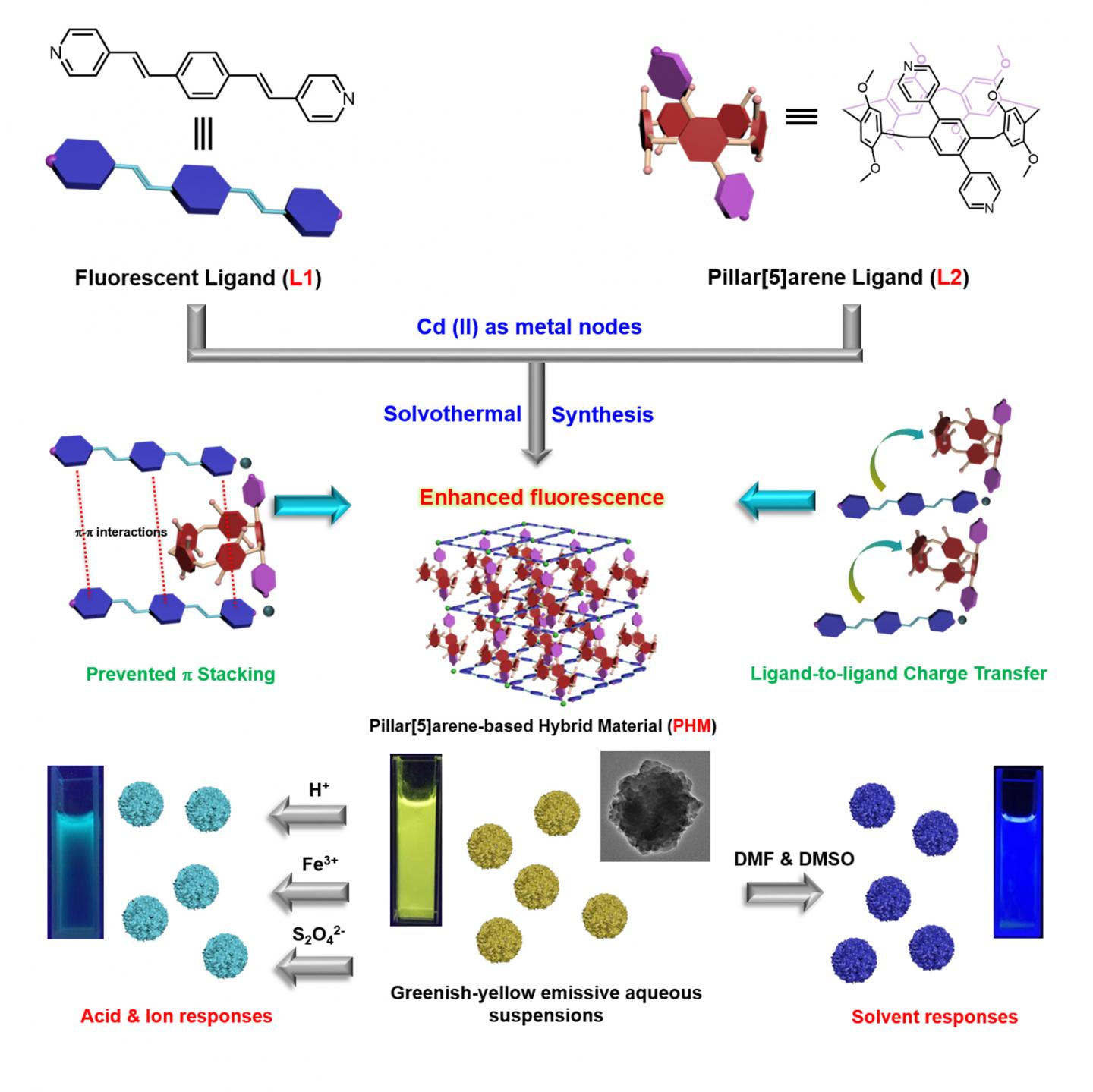
In a research article published in the Beijing-based National Science Review, scientists at Jilin University in Changchun, China, report the successful fabrication of a pillar[5]arene-based multicolor hybrid material (PHM), which possesses enhanced emission in both solid state and solution phases and stimuli-responsive luminescent properties (Scheme 1). A linear π-conjugated chromophore oligo(phenylenevinylene) (OPV) has been chosen as the fluorescent ligand, while the pillar[5]arene rings serves as the rigid macrocycle skeleton. With the two ligands integrated via coordination with Cd (II), the afforded hybrid material can perform desirable optimized fluorescence and well-tuned emission in response to external stimuli including solvents, particular ions, and acid, whereby three emission colors of PHM are obtained, i.e., greenish yellow (pristine), mazarine (solvent variation), and cyan (ions and acid).
The enhanced luminescence of PHM can be explained from two viewpoints involving the molecular packing mode and the changes in the electronic distributions (studied by density functional theory (DFT) calculations), which verified that the existence of pillar[5]arenes can largely minimize the quenching caused by the stacking of the OPV moieties and facilitate the radiative decay pathway. The color-tuning phenomenon of solvent responsiveness can be attributed to the altered intermolecular interactions among OPV ligands. Additionally, the luminescent responses toward Fe3+ and acid are rationally ascribed to the protonation of pyridine nitrogen of the ligands, which causes the interception of charge transfer (CT) processes among the ligands.
This study has paved a new way of adjusting and optimizing fluorescent features of planar dyes via integration with the rigid pillarene rings through coordination, providing a feasible approach for developing solid-state luminescent materials with tunable emission and desired stimuli-responsiveness.
###
This research received funding from the National Natural Science Foundation of China, the Jilin Province-University Cooperative Construction Project-Special Funds for New Materials, and the Jilin University Talents Cultivation Program.
See the article:
Xin-Yue Lou, Nan Song, and Ying-Wei Yang*
A Stimuli-Responsive Pillar[5]arene-Based Hybrid Material with Enhanced Tunable Multicolor Luminescence and Ion Sensing Ability. Natl. Sci. Rev. 2020, DOI: 10.1093/nsr/nwaa281.
https:/
Media Contact
Ying-Wei Yang
[email protected]
Related Journal Article
http://dx.