

• HOME
  • NEWS
  • EXPLORE
    • CAREER
      • Companies
      • Jobs
    • EVENTS
    • iGEM
      • News
      • Team
    • PHOTOS
    • VIDEO
    • WIKI
  • BLOG
  • COMMUNITY
    • FACEBOOK
    • INSTAGRAM
    • TWITTER
Friday, June 26, 2026
BIOENGINEER.ORG
No Result
View All Result
  • Login
  • HOME
  • NEWS
  • EXPLORE
    • CAREER
      • Companies
      • Jobs
        • Lecturer
        • PhD Studentship
        • Postdoc
        • Research Assistant
    • EVENTS
    • iGEM
      • News
      • Team
    • PHOTOS
    • VIDEO
    • WIKI
  • BLOG
  • COMMUNITY
    • FACEBOOK
    • INSTAGRAM
    • TWITTER
  • HOME
  • NEWS
  • EXPLORE
    • CAREER
      • Companies
      • Jobs
        • Lecturer
        • PhD Studentship
        • Postdoc
        • Research Assistant
    • EVENTS
    • iGEM
      • News
      • Team
    • PHOTOS
    • VIDEO
    • WIKI
  • BLOG
  • COMMUNITY
    • FACEBOOK
    • INSTAGRAM
    • TWITTER
No Result
View All Result
Bioengineer.org
No Result
View All Result
Home NEWS Science News Chemistry

Physics professor selected for NASA mission

Bioengineer by Bioengineer
July 5, 2022
in Chemistry
Reading Time: 2 mins read
0
Rick Wilder, assistant professor of physics, The University of Texas at Arlington
Share on FacebookShare on TwitterShare on LinkedinShare on RedditShare on Telegram

A space physicist at The University of Texas at Arlington will play a key role in NASA’s Geospace Dynamics Constellation (GDC) mission.
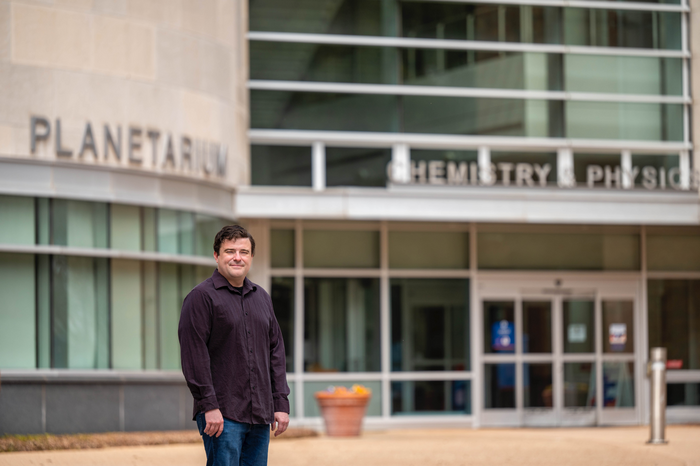
Rick Wilder, assistant professor of physics, The University of Texas at Arlington

Credit: Randy Gentry / The University of Texas at Arlington

A space physicist at The University of Texas at Arlington will play a key role in NASA’s Geospace Dynamics Constellation (GDC) mission.

GDC is a coordinated group of satellites that will provide the first direct global measurements of the region of space enveloping earth known as the ionosphere and thermosphere (I-T) region, according to a NASA press release.

Rick Wilder, assistant professor of physics, will be the lead scientist for an instrument known as the Atmospheric Electrodynamics probe for THERmal plasma (AETHER). AETHER will measure electron density and temperature, allowing researchers to describe the complex nature and structure of the ionosphere. The team’s goal is to understand phenomena that contribute to space weather and its effects on human activity.

When solar flares collide with earth’s atmosphere, the exchange of energy can disrupt satellite operations, communication signals and electrical grids. Changes in the density of the ionosphere can interrupt global positioning systems, which affect navigation for a variety of vehicles.

“Transcontinental communications and satellite signals rely on stable conditions within the earth’s upper atmosphere,” Wilder said. “Understanding the I-T region’s variability and potential for disturbances will allow scientists to develop methods to mitigate negative effects on human activities.”

The investigation team is led by Laila Andersson, principal investigator and a space plasma researcher at the Laboratory for Atmospheric and Space Physics at the University of Colorado. Wilder will work directly with Andersson to define the investigation’s science objectives and oversee the team’s publications to report its findings. Under Wilder’s supervision, a UT Arlington graduate student will assist with data analysis for the investigation.

Wilder is the second UT Arlington faculty member to participate in GDC. NASA named Yue Deng, UT Arlington distinguished professor of physics, as one of the mission’s interdisciplinary scientists. Deng’s team will support GDC with state-of-the-art physical models and ground-based operations, which are important for successful launch, operations and closure of the mission.



Share12Tweet8Share2ShareShareShare2

Related Posts

AI and Physics Collaborate to Design Advanced Hydrogen Storage Materials

June 25, 2026

International Team Including Dresden Scientists Develops Novel Designer Proteins for Advanced Study of Living Tissue

June 25, 2026

New Study Uncovers Key Factors Driving Water Chemistry in Nanoscale Environments

June 25, 2026

Plasma Technology Extends Catalyst Lifespan in Hydrogen Production

June 24, 2026

POPULAR NEWS

  • Saying Goodbye to PGY-6: Pediatric Fellowship Realities

    103 shares
    Share 41 Tweet 26
  • Multi-Hospital Study Reveals Long Covid Burden Is Twice as High as Current Estimates

    92 shares
    Share 36 Tweet 23
  • Detection of EDCs in Breast Milk and Infant Urine Up to Six Months Highlights Early Exposure Risks

    77 shares
    Share 31 Tweet 19
  • New Drug Candidate Developed at McMaster Shows Potential for Treating Brain Cancer

    58 shares
    Share 23 Tweet 15

About

We bring you the latest biotechnology news from best research centers and universities around the world. Check our website.

Follow us

Recent News

Tracking Lanthanide-Labeled Microplastics in Plants

POSTECH Researchers Slash Cost of Reconstituted Cell-Free Systems by 95%

AI and Physics Collaborate to Design Advanced Hydrogen Storage Materials

Subscribe to Blog via Email

Success! An email was just sent to confirm your subscription. Please find the email now and click 'Confirm' to start subscribing.

Join 82 other subscribers
  • Contact Us

Bioengineer.org © Copyright 2023 All Rights Reserved.

Welcome Back!

Login to your account below

Forgotten Password?

Retrieve your password

Please enter your username or email address to reset your password.

Log In
No Result
View All Result
  • Homepages
    • Home Page 1
    • Home Page 2
  • News
  • National
  • Business
  • Health
  • Lifestyle
  • Science

Bioengineer.org © Copyright 2023 All Rights Reserved.