In a very unusual way, the electrical and magnetic properties of a particular crystal are linked together – the phenomenon was discovered and explained at TU Wien (Vienna).
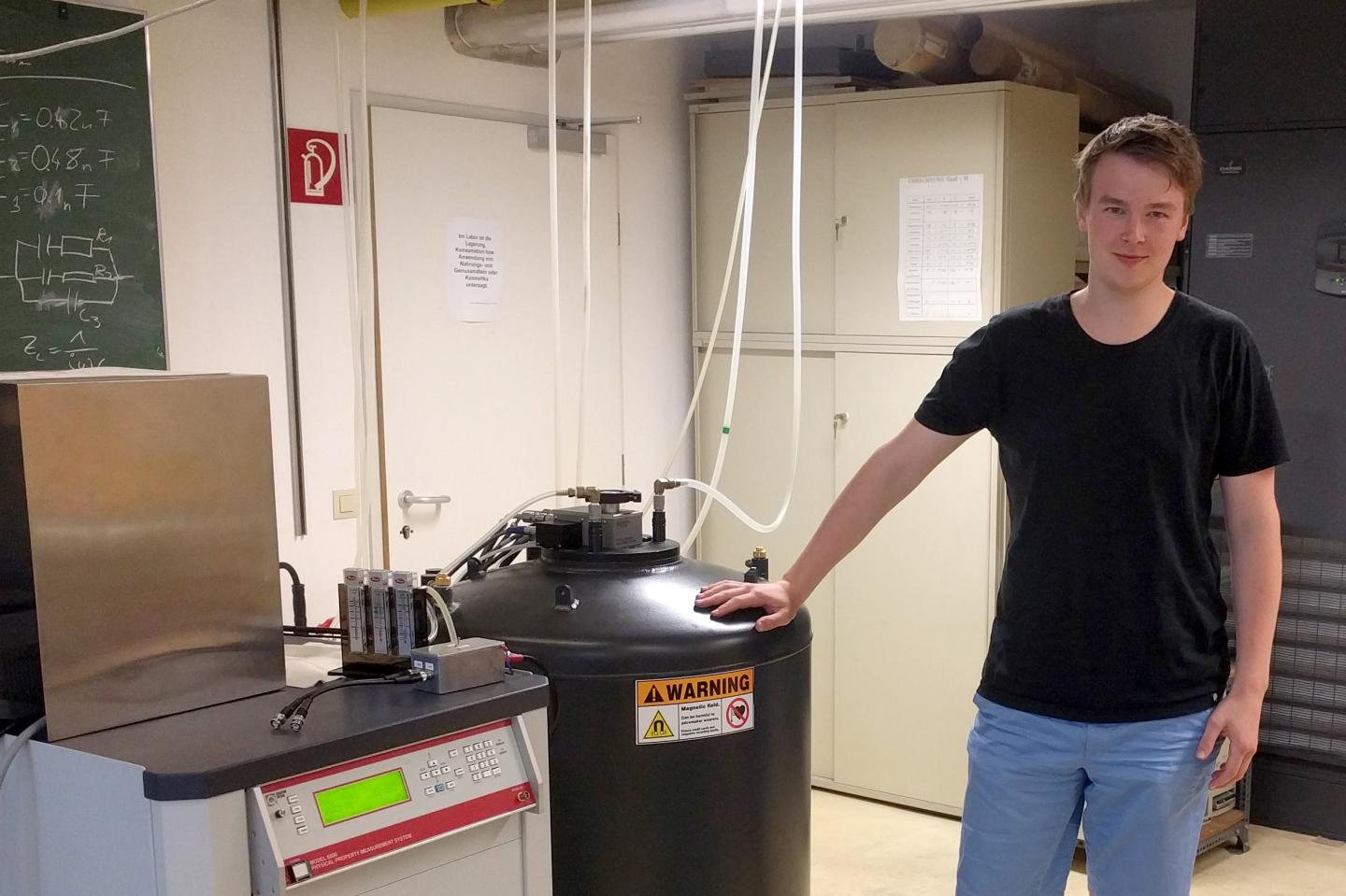
Credit: TU Wien
Electricity and magnetism are closely related: Power lines generate a magnetic field, rotating magnets in a generator produce electricity. However, the phenomenon is much more complicated: electrical and magnetic properties of certain materials are also coupled with each other. Electrical properties of some crystals can be influenced by magnetic fields – and vice versa. In this case one speaks of a “magnetoelectric effect”. It plays an important technological role, for example in certain types of sensors or in the search for new concepts of data storage.
A special material was investigated for which, at first glance, no magnetoelectric effect would be expected at all. But careful experiments have now shown that the effect can be observed in this material, it only works completely differently than usual. It can be controlled in a highly sensitive way: Even small changes in the direction of the magnetic field can switch the electrical properties of the material to a completely different state.
Symmetry controls the coupling
“Whether the electrical and magnetic properties of a crystal are coupled or not depends on the crystal’s internal symmetry,” says Prof. Andrei Pimenov from the Institute of Solid State Physics at TU Wien. “If the crystal has a high degree of symmetry, for example, if one side of the crystal is exactly the mirror image of the other side, then for theoretical reasons there can be no magnetoelectric effect”.
This applies to the crystal, which has now been examined in detail – a so-called langasite made of lanthanum, gallium, silicon and oxygen, doped with holmium atoms. “The crystal structure is so symmetrical that it should actually not allow any magnetoelectric effect. And in the case of weak magnetic fields there is indeed no coupling whatsoever with the electrical properties of the crystal,” says Andrei Pimenov. “But if we increase the strength of the magnetic field, something remarkable happens: The holmium atoms change their quantum state and gain a magnetic moment. This breaks the internal symmetry of the crystal”.
From a purely geometrical point of view, the crystal is still symmetrical, but the magnetism of the atoms has to be taken into account as well, and this is what breaks the symmetry. Therefore the electrical polarization of the crystal can be changed with a magnetic field. “Polarization is when the positive and negative charges in the crystal are displaced a little bit, with respect to each other”, explains Pimenov. “This would be easy to achieve with an electric field – but due to the magnetoelectric effect, this is also possible using a magnetic field”.
It’s not the strength, it’s the direction
The stronger the magnetic field, the stronger its effect on electrical polarization. “The relationship between polarization and magnetic field strength is approximately linear, which is nothing unusual,” says Andrei Pimenov. “What is remarkable, however, is that the relationship between polarization and the direction of the magnetic field is strongly non-linear. If you change the direction of the magnetic field a little bit, the polarization can completely tip over. This is a new form of the magnetoelectric effect, which was not known before.” So a small rotation may decide whether the magnetic field can change the electrical polarization of the crystal or not.
Possibility for new storage technologies
“The magnetoelectric effect will play an increasingly important role for various technological applications,” says Andrei Pimenov. “In a next step, we will try to change magnetic properties with an electric field instead of changing electrical properties with a magnetic field. In principle, this should be possible in exactly the same way”.
If this succeeds, it would be a promising new way to store data in solids. “In magnetic memories such as computer hard disks, magnetic fields are needed today,” Pimenov explains. “They are generated with magnetic coils, which requires a relatively large amount of energy and time. If there were a direct way to switch the magnetic properties of a solid-state memory with an electric field, this would be a breakthrough”.
###
Contact:
Prof. Andrei Pimenov
Institute for Solid State Physics
TU Wien
Wiedner Hauptstraße 8-10, 1040 Vienna
T: +43-1-58801-13723
[email protected]
Media Contact
Florian Aigner
[email protected]
Original Source
https:/
Related Journal Article
http://dx.