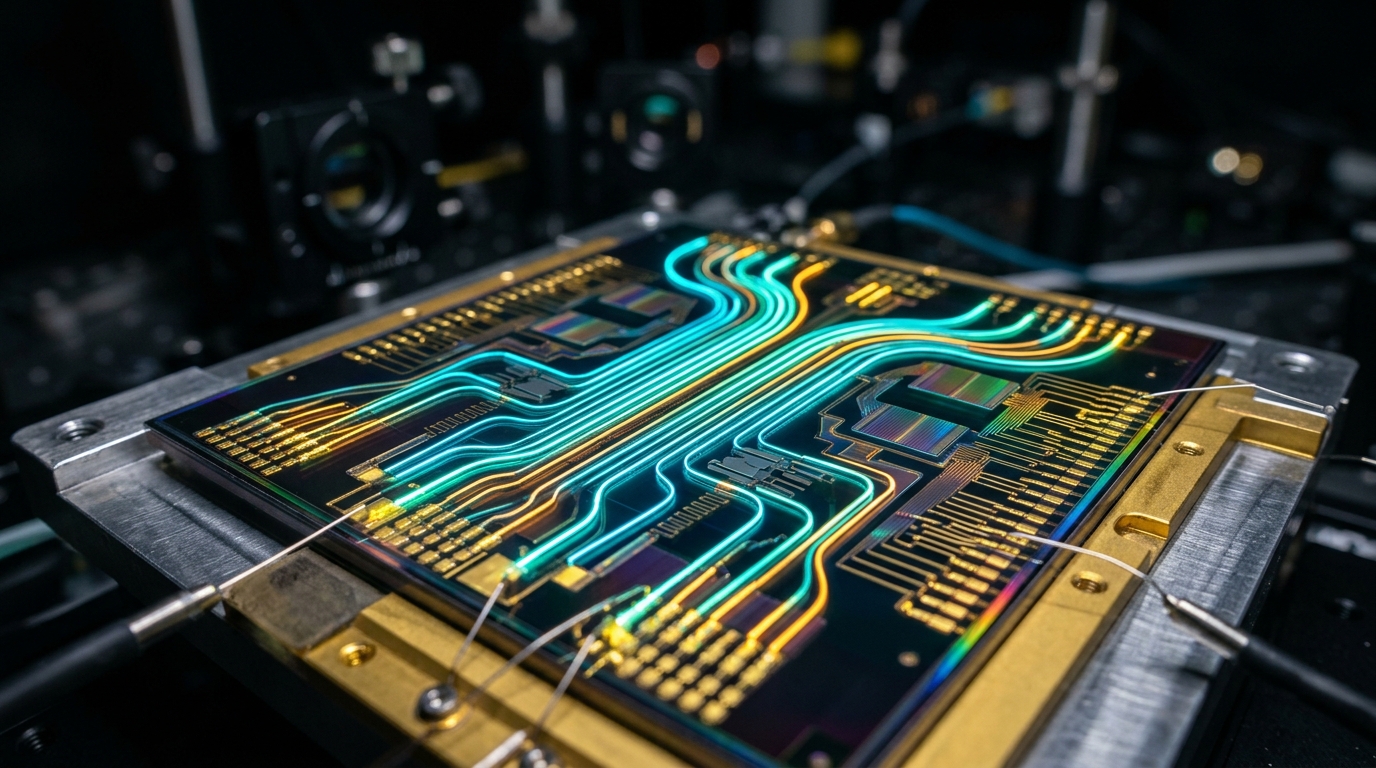
Physicists have built a photonic lattice in which every square micrometre of the device does useful work: light races through the bulk of each lane while the neighbouring lanes themselves act as the insulating walls that keep it there. The design, demonstrated at microwave frequencies by Xiaohan Cui and colleagues in Nature, removes the bulky, transport-inactive cladding regions that have long limited how densely topological waveguides can be packed onto a chip, and opens a route to high-density photonic integration in which the entire footprint carries protected, unidirectional light.
Topological photonics has long promised defect-immune light transport. Its flagship ingredient is the topologically protected edge state, which propagates robustly around imperfections such as fabrication defects that would otherwise scatter light out of its channel, reduce signal intensity, compromise coherence and degrade the signal-to-noise ratio. The catch is architectural. Edge states typically live at interfaces between topologically distinct insulating domains, so a working waveguide needs thick bulk cladding on both sides to accommodate the evanescent decay of the edge mode and to preserve well-defined bulk topological characteristics. In a two-dimensional platform that requirement imposes a substantial footprint penalty: a large supporting area sits idle for every unit of propagation length, and interfacial confinement also constrains the optical wavefront profile, limiting control over the guided signal.
Cui and colleagues sidestep this penalty with a deceptively simple principle: a domain that serves as gapped cladding for one mode can simultaneously act as a gapless guiding core for another. The team realised the principle in photonic graphene, an optical analogue of the Haldane model built from a honeycomb lattice. In the low-energy limit the model offers two independent symmetry-breaking degrees of freedom. Inversion-symmetry breaking arises from the inequivalence of the two sublattices and enters the effective Dirac Hamiltonian as a mass term mP; time-reversal-symmetry breaking is encoded in the gauge phase of the intra-sublattice coupling and enters as a second mass term mT. The design space spanned by these two parameters can be classified by the topological character of the bandgaps at the two inequivalent Dirac points in momentum space, the valleys, quantified by valley Chern numbers C and C′.
The crucial physics emerges at the transition boundaries between distinct phases in this parameter plane. Along those boundaries the two mass terms cancel at one valley while reinforcing each other at the other, producing a nonreciprocal photonic analogue of graphene that supports an unpaired Dirac cone. The researchers call this phase a photonic valley half-semimetal, or PVHSM. Because the bandgap opens in a valley-dependent, nonreciprocal way, and because the Dirac cones at the two valleys carry distinct propagation directions, a single medium can play a dual role: a guiding core for one valley and cladding for the other. Cui’s team proposed assembling topological multilane highways by cyclically arranging four PVHSM phases with alternating valley transport. For any given valley, the gapless Dirac sector carries transport throughout the bulk of each lane, while the gapped sector provides topological confinement for modes in the neighbouring lanes, so the entire device footprint is utilised for robust, unidirectional transport.
The experimental demonstration used honeycomb lattices of magneto-optical yttrium iron garnet rods operating at microwave frequencies. The contrast between two rod diameters breaks inversion symmetry, while a static magnetic bias induces a gyromagnetic response that breaks time-reversal symmetry; tailoring the two contributions yields the four PVHSM domains needed for the multilane highway. The resulting unidirectional transport is robust against sharp bends, a protection that holds provided the relevant valley bandgaps in neighbouring domains remain open and intervalley scattering is suppressed. Simulations further showed that varying the widths and shapes of individual lanes can broaden, compress or displace the guided field without sacrificing directionality, giving engineers far greater control over the mode profile than conventional interface-localized topological states allow.
The advance matters because the photonic industry’s central obstacle is not a lack of bandwidth but fragility. Integrated optics has been pursued for decades to exploit the broad bandwidth and low propagation loss of light and to overcome the bottlenecks of electronic interconnects, a goal given renewed urgency by photonic circuits for artificial intelligence that promise to surpass the bandwidth and energy-efficiency limits of conventional copper wiring. Yet fabrication-induced defects scatter light out of the desired propagation channel, and because compact on-chip optical amplifiers remain under development, that scattering directly limits the reach of reliable transmission. One response is error correction, but conventional feedback-based schemes demand substantial monitoring and control overhead, including extra photodetectors, electrical connections and power consumption. Physical error suppression through band topology is therefore an equally essential strategy, and the new architecture delivers it without the usual spatial tax.
Quantitatively, the work represents a major increase in the total one-dimensional propagation length that can be accommodated within a given two-dimensional footprint, the metric that determines how much waveguide a chip of fixed area can hold. By combining topological robustness with spatial compactness, the architecture could substantially expand the information-carrying capacity of photonic circuits within a given footprint. The authors also point to a second payoff: the long interaction paths could serve optical gain and nonlinear effects, for example by connecting the ends of the multilane channels to form compact, space-filling resonators, addressing both signal degradation and the limited expressivity of photonic circuits.
Significant hurdles stand between the microwave demonstration and photonic integrated circuits, which conventionally operate at near-infrared wavelengths. The central question is how to realise the required time-reversal-symmetry breaking optically. Synthetic gauge fields can be applied without magneto-optical media using coupled-ring networks with phase-engineered link resonators, but the resulting protection relies on the conservation of photonic pseudospin and can be easily compromised by defects that couple counterpropagating modes. Directly extending the magneto-optical approach to the infrared is also difficult: iron-garnet-based devices do enable genuine time-reversal symmetry breaking at telecommunication wavelengths, but their incompatibility with complementary metal-oxide-semiconductor technology, their reliance on heterogeneous integration and their need for an external magnetic bias hinder practical implementation.
A promising alternative identified in the accompanying analysis is spatiotemporal modulation, which synthesises nonreciprocal hopping and an effective magnetic flux without magnetic materials, an approach for which magnet-free nonreciprocity has already proven viable on integrated photonic platforms. Even with a workable nonreciprocity mechanism, the sensitivity of the Dirac cones poses technical challenges: an imbalance between the two mass terms, |mP| ≠ |mT|, reopens the gap and converts bulk-domain transport back into interface-state transport, erasing the space-filling advantage, and next-nearest-neighbour coupling can induce resonant backscattering. Both effects will need careful control in practical implementations.
For now, the demonstration establishes that topological protection and complete spatial utilisation need not be traded against each other. A lattice in which each domain guides one valley while confining another turns the cladding from dead space into active highway, and shows that the defect immunity of topological phases can be delivered across multiple parallel lanes rather than only along isolated edges. Whether the same trick survives the journey from microwave garnet rods to CMOS-compatible near-infrared chips will determine how quickly these topological highways reach the photonic processors they are meant to serve.
Subject of Research: Insulator-free topological photonic transport in multi-lane photonic graphene highways
Article Title: Topological highways for light
Article References: Yu, S., & Park, N. (2026). Topological highways for light. Nature Reviews Electrical Engineering. https://doi.org/10.1038/s44287-026-00339-x
Image Credits: AI Generated
DOI: 10.1038/s44287-026-00339-x
Keywords: topological photonics, photonic graphene, Haldane model, valley Chern number, photonic valley half-semimetal, magneto-optical YIG, unidirectional transport, photonic integration, Dirac cones, nonreciprocity, microwave photonics, CMOS incompatibility
News Source: Denise Maddox. (November 5, 2026). Physicists build insulator-free topological highways that steer light through every lane of a chip. Scienmag.