• HOME
  • NEWS
  • EXPLORE
    • CAREER
      • Companies
      • Jobs
    • EVENTS
    • iGEM
      • News
      • Team
    • PHOTOS
    • VIDEO
    • WIKI
  • BLOG
  • COMMUNITY
    • FACEBOOK
    • INSTAGRAM
    • TWITTER
Sunday, August 16, 2026
BIOENGINEER.ORG
No Result
View All Result
  • Login
  • HOME
  • NEWS
  • EXPLORE
    • CAREER
      • Companies
      • Jobs
        • Lecturer
        • PhD Studentship
        • Postdoc
        • Research Assistant
    • EVENTS
    • iGEM
      • News
      • Team
    • PHOTOS
    • VIDEO
    • WIKI
  • BLOG
  • COMMUNITY
    • FACEBOOK
    • INSTAGRAM
    • TWITTER
  • HOME
  • NEWS
  • EXPLORE
    • CAREER
      • Companies
      • Jobs
        • Lecturer
        • PhD Studentship
        • Postdoc
        • Research Assistant
    • EVENTS
    • iGEM
      • News
      • Team
    • PHOTOS
    • VIDEO
    • WIKI
  • BLOG
  • COMMUNITY
    • FACEBOOK
    • INSTAGRAM
    • TWITTER
No Result
View All Result
Bioengineer.org
No Result
View All Result
Home NEWS Science News Health

Physical activity and good fitness improve cardiac regulation in children

Bioengineer by Bioengineer
October 2, 2019
in Health
Reading Time: 2 mins read
0
IMAGE
Share on FacebookShare on TwitterShare on LinkedinShare on RedditShare on Telegram

IMAGE

Credit: Dr. Aapo Veijalainen, University of Eastern Finland

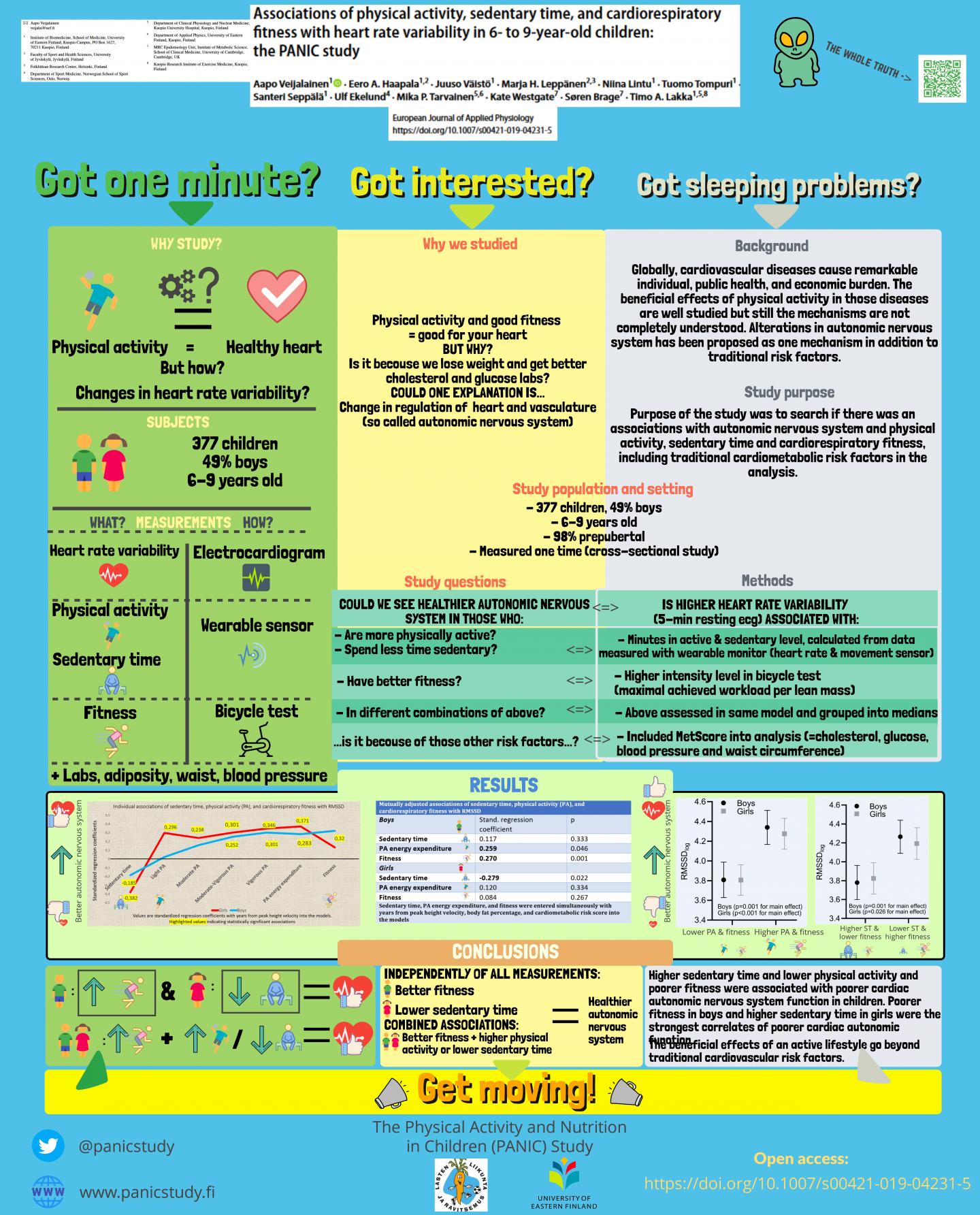
A recent Finnish study showed that more physically active and fit children have better cardiac regulation than less active and fit children. The study also showed that cardiac regulation was better especially in boys with better aerobic fitness and in girls with lower levels of sedentary time. The results, based on the Physical Activity and Nutrition (PANIC) Study conducted at the University of Eastern Finland, were published in the European Journal of Applied Physiology.

Cardiovascular diseases cause a remarkable individual, public health, and economic burden globally. Cardiovascular diseases have their origins in childhood, and physical activity has been found to prevent or postpone the development of these diseases. However, the mechanisms for the beneficial effects of physical activity are not completely understood. Improvements in cardiac regulation by the autonomic nervous system in response to physical activity have been proposed as one of these mechanisms. Nevertheless, there are few studies linking physical activity and aerobic fitness with cardiac autonomic regulation in children.

Altogether 377 children aged 6-9 years participated in the study. Cardiac autonomic regulation was assessed by heart rate variability from electrocardiograms, physical activity and sedentary time by a combined heart rate and movement sensor, and aerobic fitness by a maximal exercise test on a bicycle ergometer. The data were adjusted for maturation, body fat percentage, waist circumference, fasting plasma glucose, plasma lipids, and blood pressure.

The researchers found that higher sedentary time and lower levels of physical activity and aerobic fitness were associated with poorer cardiac autonomic nervous system function in children. They also observed that particularly high levels of vigorous physical activity had a strong relationship to better cardiac autonomic nervous system function. Lower aerobic fitness in boys and higher sedentary time in girls were the strongest correlates of poorer cardiac autonomic nervous system function. These associations were independent of other cardiometabolic risk factors.

“Our study provides novel and valuable information as we were able to study the role of not only physical activity but also sedentary time, aerobic fitness, and other cardiometabolic risk factors as correlates of cardiac autonomic nervous system function in children”, says Dr. Aapo Veijalainen, MD, PhD, from University of Eastern Finland.

We can conclude that the beneficial effects of a physically active lifestyle and good aerobic fitness go beyond traditional cardiovascular risk factors and all measures that get children to move must be supported.

###

Media Contact
Dr Aapo Veijalainen
[email protected]

Original Source

http://www.uef.fi/en/-/liikunta-ja-hyva-kunto-parantavat-lasten-sydamen-saatelyjarjestelman-toimintaa

Related Journal Article

http://dx.doi.org/10.1007/s00421-019-04231-5

Tags: CardiologyMedicine/HealthPediatricsSports Medicine
Share12Tweet8Share2ShareShareShare2

Related Posts

PARP1 Drives Neuropathic Pain Through GPX4-Dependent Ferroptosis in Injured Mice’s Sensory Neurons

August 15, 2026

Genome-wide skin pQTL map reveals genetic regulators and mechanisms underlying skin disorders

August 15, 2026

Levistilide A Drives Ferroptosis via RNF40-HSP90α Axis, Suppressing Colorectal Cancer Lung Metastasis

August 15, 2026

Sintilimab, IBI305, and Chemotherapy Show Promise in First-Line Advanced Gastric and GEJ Adenocarcinoma

August 15, 2026
Please login to join discussion

POPULAR NEWS

  • KAIST develops semiconductor neuron that harnesses noise to selectively process signals

    29 shares
    Share 12 Tweet 7
  • Imagining natural and extra robotic thumbs together strengthens kinesthetic sensorimotor networks

    29 shares
    Share 12 Tweet 7
  • PARP1 Drives Neuropathic Pain Through GPX4-Dependent Ferroptosis in Injured Mice’s Sensory Neurons

    29 shares
    Share 12 Tweet 7
  • Strubbelig–NHL3 Receptor Complex Helps Arabidopsis Respond to Cellulose Deficiency

    29 shares
    Share 12 Tweet 7

About

We bring you the latest biotechnology news from best research centers and universities around the world. Check our website.

Follow us

Recent News

KAIST develops semiconductor neuron that harnesses noise to selectively process signals

Imagining natural and extra robotic thumbs together strengthens kinesthetic sensorimotor networks

PARP1 Drives Neuropathic Pain Through GPX4-Dependent Ferroptosis in Injured Mice’s Sensory Neurons

Subscribe to Blog via Email

Success! An email was just sent to confirm your subscription. Please find the email now and click 'Confirm' to start subscribing.

Join 85 other subscribers
  • Contact Us

Bioengineer.org © Copyright 2023 All Rights Reserved.

Welcome Back!

Login to your account below

Forgotten Password?

Retrieve your password

Please enter your username or email address to reset your password.

Log In
No Result
View All Result
  • Homepages
    • Home Page 1
    • Home Page 2
  • News
  • National
  • Business
  • Health
  • Lifestyle
  • Science

Bioengineer.org © Copyright 2023 All Rights Reserved.