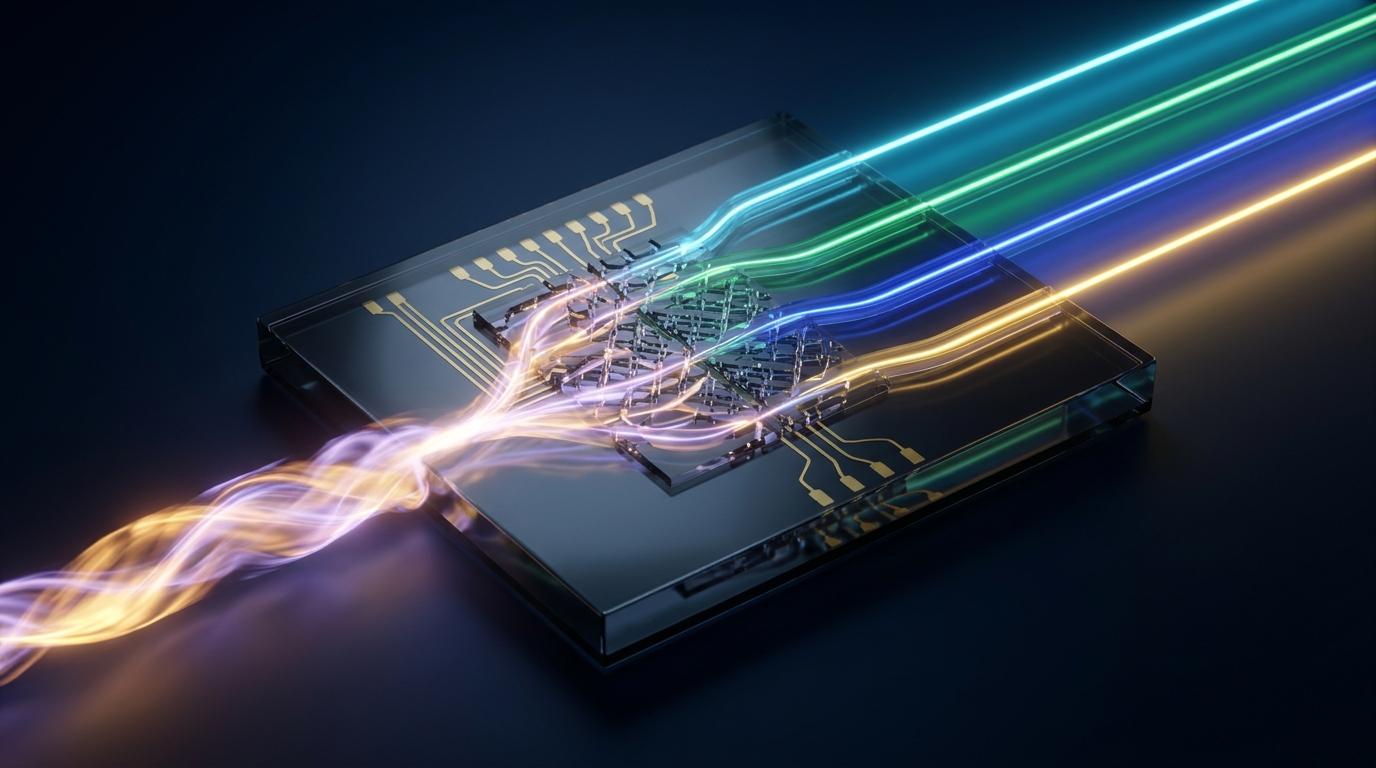
Partial coherence is usually treated as a nuisance in optics, a blurring of interference fringes and a loss of information that engineers work hard to eliminate. A team of researchers has now flipped that problem on its head, building a silicon photonic chip that takes partially coherent light apart and routes its constituent coherence modes to separate outputs automatically. The work, published in Nature Photonics, demonstrates a scalable route to analysing the coherence structure of unknown optical fields directly on a chip, using resources that grow only linearly with the number of modes involved.
The device, called a partially coherent light analyser (PCLA), addresses a long-standing gap in how optical fields are characterized. Techniques based on tomography and numerical reconstruction can estimate the statistical properties of a partially coherent beam, but they do not physically split the field into its coherence modes, the orthogonal and mutually incoherent components that together describe its correlations. The new chip does exactly that: it finds the eigenvectors and eigenvalues of the coherency matrix, the mathematical object that encodes the field’s coherence, while leaving the light itself intact and physically separated once the optimization is complete.
The hardware is a foundry-fabricated silicon-on-insulator circuit with a two-dimensional array of nine grating couplers feeding two self-configuring layers of Mach-Zehnder interferometers. Each interferometer contains two thermally actuated phase shifters and two 50:50 directional couplers, and the full network applies a unitary transformation to the incoming field. Two independent tunable lasers, both operating at a nominal wavelength of 1,534.65 nanometres, provided the mutually incoherent input fields in the main experiments, giving a coherency matrix of rank two. The two topmost waveguide outputs were connected to fibres whose powers were read by photodetectors, with the lasers amplitude modulated at a common frequency so that lock-in amplifiers could reject technical noise.
The separation works through variational optimization rather than calibrated measurement. The first interferometer layer is tuned globally to maximize its output power, then the second layer is optimized in the remaining orthogonal subspace. Because maximizing output power can be formulated as a Rayleigh-quotient maximization, the cost function is convex and the algorithm converges to the global optimum. Gradients of the output power with respect to every phase shifter in a layer, up to 14 in the present device, are measured simultaneously through frequency-multiplexed dithering: each phase shifter is sinusoidally modulated at a distinct frequency within a single octave, and the photodetector trace is demodulated against the known drive signals to yield all gradients in a single measurement step. A representative optimization converged to zero-mean gradients within roughly 50 iterations.
Convergence has a clear optical signature. An on-chip two-mode interferometer measures the fringe visibility between the outputs of the two layers, and this visibility is proportional to the off-diagonal elements of the output coherency matrix. As the optimization proceeds, the network effectively learns the Hermitian adjoint of the eigenvector matrix, and the fringe visibility progressively vanishes, signalling that the output fields have transitioned from partially coherent to mutually incoherent. Crucially, the coherence modes are routed into separate output waveguides before detection, so the separation persists once the device is configured, independently of the photodetectors.
To benchmark accuracy, the researchers compared their variational approach with a complementary mixture-tomography scheme on the same chip, in which each input laser is turned on individually and the full coherency matrix is reconstructed numerically. Comparing the two methods on a four-input-port configuration, they achieved eigenvector fidelities of 97.8 percent for layer 1 and 99.9 percent for layer 2, with eigenvalue estimation errors of 0.29 percent and 3.11 percent respectively. The main experiment separated the two strongest coherence modes from a nine-input sampling of overlapping fields from the two independent lasers, and operation beyond two modes was verified in a separate rank-3 experiment on a fully reconfigurable 9 by 9 photonic circuit, where three optimized outputs became pairwise mutually incoherent after convergence.
The chip also turns coherence into a measurable information quantity. The researchers define a coherency entropy from the normalized eigenvalues of the input coherency matrix, which satisfies a lower bound set by an intensity-only entropy that neglects phase correlations. In a set of beam-overlap experiments, one beam was fixed over the bottom four grating couplers while a second beam was translated across the array. At one position, the intensity profiles of the two beams were indistinguishable, giving an intensity-only entropy near zero, yet the full coherency entropy was about 0.6, revealing two distinct modes arising from phase differences. The entropy peaked near a position approaching the value of 1 expected for two orthogonal modes of equal weight, and a fitted phase tilt of 4.40 degrees between the beams’ arrival angles reproduced the principal features of the measured entropy, confirming that the extra information comes from phase structure that conventional focal-plane arrays cannot access.
A second configuration pushed the device further into demultiplexer territory. Both beams overlapped on all nine input grating couplers, with the angle of incidence of the second beam swept continuously while the beams remained overlapped in real space. At the angle of maximum orthogonality, the two beams were mutually incoherent and orthogonal, and the PCLA functioned as a self-configuring demultiplexer, routing each beam to a distinct output port purely through power optimization, with no prior knowledge of their spatial profiles. The measured cross-talk between the separated beams was as low as minus 13.0 decibels, with an uncertainty of 2.6 decibels propagated from the output-channel measurements. Sweeping the angle and repeating the tomography showed the entropy maximized at the point of orthogonality and falling to about 0.64 when the beams were aligned in phase and amplitude, where the chip detected a single dominant mode with residual entropy arising from phase differences, incoherent background and imperfect power confinement.
The authors emphasize an important conceptual distinction: the device diagonalizes the coherency matrix rather than necessarily recovering the original beams. The incident fields form one incoherent mixture, whereas the coherence modes are the orthogonal eigenvectors of that matrix and generally contain contributions from both inputs; the two coincide only when the incident fields are themselves orthogonal. Because the eigenvalues are obtained directly as optical powers, they are non-negative by construction, avoiding the common problem of reconstructed density matrices with negative eigenvalues. The physical routing also relies only on closed-loop optical optimization, not on a calibrated measurement of the field, making the separation calibration-free, and the in situ optimization can continuously compensate fabrication imperfections and slow drifts.
The researchers point to several directions ahead. The achievable update rate is governed by a trade-off between control-loop bandwidth, gradient signal-to-noise ratio and actuator dynamics, and state-of-the-art Mach-Zehnder network controllers already demonstrate sub-millisecond stabilization per interferometer, rates sufficient for real-time mitigation of atmospheric turbulence in free-space optical communication. With application-specific parallel control electronics and faster electro-optic phase shifters, update rates well beyond the kilohertz regime appear feasible. Numerical simulations in the supplementary material quantify robustness to realistic uniform and non-uniform losses, thermal cross-talk and finite detection signal-to-noise ratio. The same architecture can also run in reverse: injecting mutually incoherent fields into the output ports and running the optimized network backwards synthesizes the previously learned coherence state, effectively forming a hologram for each coherence mode, one per self-configuring layer. Scaling such coherence-aware processors to higher mode counts and faster control could, the authors suggest, enable adaptive front ends for super-resolution imaging, coronagraphy and dynamically reconfigurable optical sensing, where the relevant measurement basis must be learned directly from the field coherence itself.
Subject of Research: On-chip variational separation of partially coherent light into coherence modes
Article Title: Automatic on-chip separation of partially coherent light into its mutually incoherent components
Article References: Mor, P.-A., Kroo, A. R., Valdez, C. G., Šimić, M., Karnieli, A., Cavicchioli, G., Sun, Z., Grimaldi, V., Fan, S., Solgaard, O., Miller, D. A. B., & Roques-Carmes, C. (2026). Automatic on-chip separation of partially coherent light into its mutually incoherent components. Nature Photonics. https://doi.org/10.1038/s41566-026-02035-6
Image Credits: AI Generated
DOI: 10.1038/s41566-026-02035-6
Keywords: partial coherence, coherence modes, silicon photonics, Mach-Zehnder interferometers, coherency matrix, self-configuring networks, coherence tomography, photonic integrated circuits, eigenvalue estimation, optical communication, coherency entropy, demultiplexing
News Source: Denise Maddox. (November 4, 2026). Photonic Chip Learns to Split Partially Coherent Light Into Its Incoherent Modes. Scienmag.