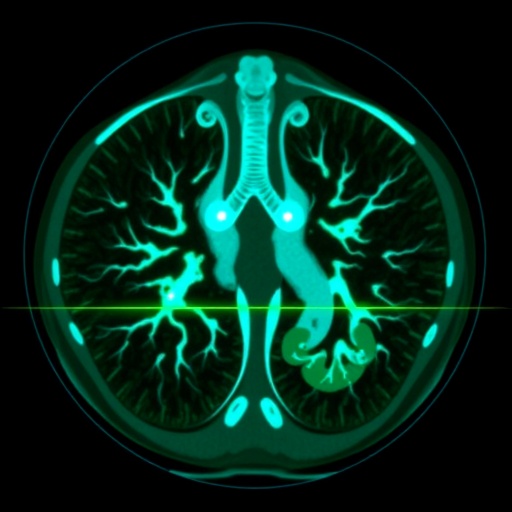
In a groundbreaking advancement in lung cancer imaging, a recent prospective study involving 200 adult patients has demonstrated the superior performance of photon-counting computed tomography (PCCT) over conventional CT scans. Published in the prestigious journal Radiology, this study highlights how PCCT technology not only reduces radiation exposure and adverse reactions but also significantly enhances the image quality and detection of malignant tumor features. These improvements could herald a new era in lung cancer diagnosis and management, promising earlier detection and more precise treatment pathways.
Lung cancer remains the leading cause of cancer-related mortality worldwide, responsible for an estimated 18.7% of all cancer deaths. Due to its high fatality rate, timely and accurate imaging is critical for diagnosis, staging, and monitoring therapeutic response. Traditionally, CT imaging has been a cornerstone in lung cancer evaluation. However, conventional CT methods average incoming X-ray photons, which can limit resolution and contrast detail. In contrast, photon-counting CT directly counts individual photons and measures their energy, yielding images of exceptional sharpness and enhanced tissue characterization.
This technological leap allows for ultra-high resolution imaging with improved differentiation between tumor tissues and normal anatomy. The study’s lead author, Dr. Songwei Yue, a chief physician and professor at The First Affiliated Hospital of Zhengzhou University in China, emphasized the clinical significance of this advance. He stated that improved imaging not only facilitates early and accurate detection of recurrence—which occurs in 60 to 100% of lung cancer cases—but also enhances overall patient survival by guiding more effective treatment plans.
Addressing a critical challenge, the research team underscored the importance of minimizing patient exposure to ionizing radiation and contrast agents, both of which pose risks such as radiation-induced damage and contrast-induced acute kidney injury. These risks are compounded by the frequency of imaging needed for lung cancer follow-up. Although reducing radiation dose has traditionally risked compromising diagnostic accuracy, PCCT offers a solution by providing superior image quality even with substantially reduced radiation levels.
The study meticulously compared contrast-enhanced chest CT images from two evenly matched cohorts of 100 patients each. One group underwent ultra-high resolution photon-counting CT scaled to low radiation doses, while the other received conventional CT scans. Subgroup analyses considered variables like lesion size, categorized as smaller than or equal to 3 cm and larger than 3 cm, along with patient body mass index (BMI), reflecting a broad cross-section of clinical scenarios.
Quantitative and qualitative assessments were performed by experienced chest radiologists using standardized scoring systems evaluating noise levels, anatomical clarity, lesion sharpness, and visualization of intra-lesion structures. Remarkably, photon-counting CT reduced radiation exposure by over 66% and iodine contrast usage by more than 26% compared to conventional scans. These reductions translated into noticeably fewer adverse reactions, including a decreased incidence of acute kidney injury following contrast administration.
The enhanced visualization capabilities of photon-counting CT were particularly evident at a thin 0.4 mm section thickness, where images revealed greater detail and demarcation of necrotic tumor regions, particularly in smaller lesions. Conversely, for larger tumors exceeding 3 cm, slightly thicker sections provided optimal contrast and clarity, aiding precise quantification of necrotic versus viable tissue—information critical for therapeutic decision-making.
The technical superiority of PCCT also manifested in improved detection of malignant features associated with tumor enhancement patterns. Such features are vital for differentiating aggressive cancer subtypes and tailoring personalized treatment strategies. The study demonstrated that this increased diagnostic confidence was uniformly maintained across diverse patient BMIs and tumor sizes, underscoring PCCT’s versatility and robustness in clinical practice.
The implications extend beyond immediate diagnostic improvements. The data suggest that integrating PCCT into routine clinical workflows could revolutionize lung cancer surveillance protocols, minimizing cumulative radiation risks while maximizing the accuracy of tumor assessments. Consequently, this could lead to earlier intervention at relapse and improved longitudinal patient outcomes.
Looking forward, Dr. Yue and colleagues emphasize the need for longitudinal studies to evaluate photon-counting CT’s performance over extended follow-up periods within the same patient cohorts. Such investigations would clarify its utility in monitoring tumor progression, response to therapies, and potential for guiding adaptive treatment strategies in real time.
With its unprecedented combination of dose reduction, image quality enhancement, and improved diagnostic confidence, photon-counting CT represents a paradigm shift in thoracic oncology imaging. As Dr. Yue remarked, the technology is poised to replace conventional CT scanning methods in the near future, reshaping lung cancer diagnostics and potentially saving countless lives through superior imaging precision.
This transformative advancement underscores the continual evolution of medical imaging technology and illustrates how precision engineering can directly impact clinical outcomes. It serves as a beacon of hope for patients, clinicians, and radiology specialists striving for optimal cancer care in an increasingly complex healthcare landscape.
Subject of Research: People
Article Title: Photon-counting CT versus Energy-integrating Detector CT Performance for Various BMI and Tumor Sizes in Lung Cancer
News Publication Date: Not specified in the content
Web References: https://pubs.rsna.org/journal/radiology, https://www.rsna.org/, http://www.radiologyinfo.org
Image Credits: Radiological Society of North America (RSNA)
Keywords: Lung cancer, Medical imaging, Radiology
Tags: conventional CT limitationsearly detection of lung cancerimproved image quality in cancer diagnosislung cancer diagnosis and managementlung cancer imaging advancementsmalignant tumor feature detectionphoton-counting computed tomographyprecise treatment pathways for lung cancerprospective study on lung cancer imagingradiation exposure reduction in CT scanssuperior imaging techniques for lung cancerultra-high resolution imaging technology