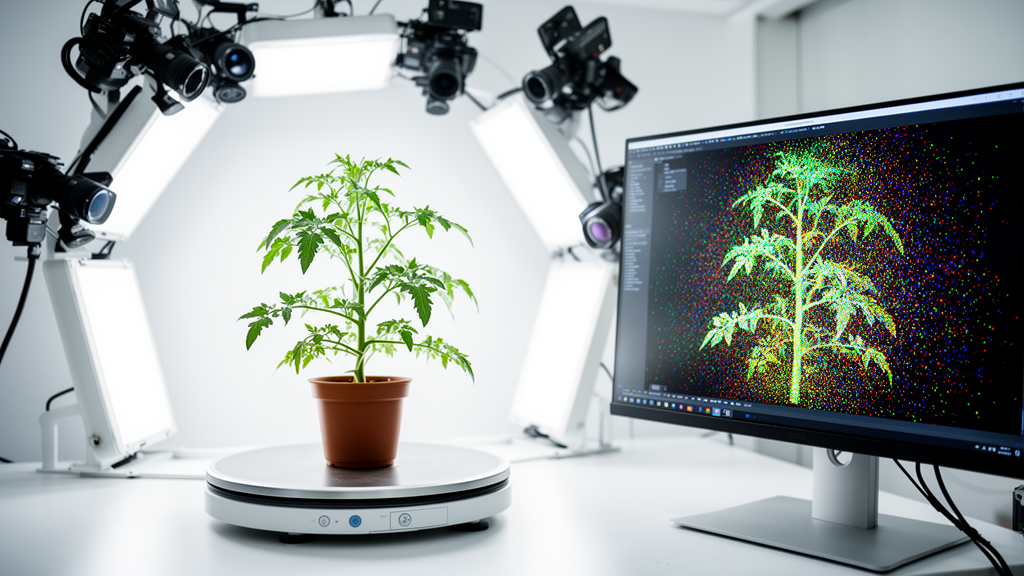
Plants are stubbornly three-dimensional things. Branching architecture, the spiral arrangement of leaves, the curvature of a frond and the hidden geometry of a flower all resist flat photography, because self-occlusion hides crucial surfaces and every viewing angle changes what the camera sees. A new study from the University of Tartu Botanical Garden now shows that a carefully designed, low-cost workflow combining Structure-from-Motion photogrammetry with 3D Gaussian Splatting, a recent neural rendering technique, can digitise living plants across an enormous range of scales, from centimetre-sized flowers to an entire tropical greenhouse, while also capturing growth through time as a genuine four-dimensional sequence.
The core of the demonstration is a fern photographed outdoors on twelve occasions over fifteen days, yielding roughly 8,500 images in total, with between 341 and 1,204 photographs per time point. Rather than reconstructing each day separately and hoping the models line up, the researchers aligned every image from all twelve sessions simultaneously in a single photogrammetric project. Stable background features anchored a shared camera network, so each daily reconstruction inherited identical orientation and scale. After the global alignment was scaled using measured reference distances in the surrounding environment, all twelve models sat in one common metric coordinate system and could be played back directly as a 4D growth sequence without any additional registration step.
The photogrammetric side of the pipeline relies on Structure-from-Motion, which estimates camera positions and a sparse point cloud from overlapping photographs, followed by Multi-View Stereo, which densifies that cloud into millions of points and textured surface meshes. This family of methods is already well established in plant phenotyping: recent studies reported coefficients of determination above 0.90 when photogrammetrically derived traits such as plant height, leaf length and canopy volume in wheat and maize were compared against ground-truth measurements. It has also been used to reconstruct weeds, portable multi-view captures of maize, canopy structure at field scale, and tree height and biomass in forestry, where it offers a cheaper alternative to laser scanning for selected measurements.
The quantitative results from the fern series show what a consumer camera can achieve. Photogrammetric reconstructions produced between 95,698 and 325,415 tie points with root-mean-square re-projection errors of 1.36 to 1.72 pixels. Training the Gaussian splatting models took roughly three hours per time point for 30,000 optimisation iterations, producing peak signal-to-noise ratios of 21.99 to 26.35 decibels and structural similarity values of 0.726 to 0.842 under a one-in-eight image hold-out protocol, in which rendered views are compared against photographs the model never saw. The global alignment of all 8,500 images demanded about seven hours and 48 gigabytes of memory, a reminder that dataset size, not camera price, is the real bottleneck.
The second flagship product is a digital twin of the tropical greenhouse, assembled from fourteen independently acquired image sets totalling approximately 20,000 photographs, each section containing between 546 and 1,643 images. Photogrammetric processing yielded 329,238 to 1,115,847 tie points per section with re-projection errors between 1.49 and 2.35 pixels, while the Gaussian splatting models scored 21.49 to 26.26 decibels in PSNR, 0.695 to 0.846 in SSIM and 0.310 to 0.520 in LPIPS, a perceptual metric where lower is better. After floating splats and background artefacts were removed in an editing tool, the fourteen sections were manually assembled in the Unity game engine into an interactive model. Because the assembly was done by hand using overlapping visual features, the authors stress that the combined twin is intended for visual exploration rather than metric spatial analysis.
3D Gaussian Splatting, introduced in 2023, represents a scene as a cloud of anisotropic Gaussian primitives, or splats, optimised from multi-view imagery and renderable in real time. Where photogrammetry produces explicit meshes suited to measurement, splats excel at photorealistic visualisation of scenes with thin foliage, complex occlusion and view-dependent reflectance. The study’s potted plant made the contrast vivid: long hanging floral structures were only partially reconstructed in the mesh model, but reproduced almost completely by Gaussian splatting. The two techniques are therefore complementary rather than competing, with photogrammetry supplying quantitative geometry and splatting supplying communication-grade realism for digital twins and outreach.
The breadth of the case studies is part of the argument. A greenhouse flower was reconstructed from an entry-level Xiaomi Redmi A3 smartphone with an 8-megapixel camera despite mixed illumination. Two macro datasets, shot with a Canon DSLR and a 100-millimetre macro lens, demonstrated complementary scaling strategies: one used a portable hexagonal calibration marker whose opposing vertices were measured with digital calipers, the other used a direct caliper measurement of a stable floral structure entered as a scale bar, with an independent check on the reconstructed model confirming the scaling accuracy. A drone-based tree, built from 1,044 aerial images captured during a manual orbit with a consumer quadcopter, produced the lowest rendering scores of any dataset yet still yielded a visually interpretable large-scale reconstruction. Notably, all datasets were reconstructed successfully from standard JPEG files, even though RAW capture is generally preferred.
One of the most practically useful findings concerns wind. In a controlled indoor experiment, the same fern was photographed under identical camera settings both stationary and under artificially induced wind. The stationary plant achieved higher PSNR and SSIM values and a lower LPIPS value than the moving plant, demonstrating that even modest leaf movement measurably degrades image-based reconstruction. The authors recommend imaging during calm weather, and note that synchronised multi-camera systems could largely eliminate motion artefacts, albeit at considerably higher cost. Reconstruction quality across all datasets tracked acquisition conditions more than object size: controlled macro captures scored highest, while large outdoor vegetation suffered from self-occlusion, variable illumination and more complex imaging geometry rather than any inherent scaling penalty.
The work situates itself within a rapidly moving field. Multi-temporal photogrammetry has previously been used to measure wheat growth over time, to track traits in greenhouse lettuce, and to generate maize and sorghum time series from drone imagery, but those studies also flagged occlusion, image blur and heavy computational demands as persistent constraints. Recent neural-rendering efforts, including systems for cross-time plant visualisation and pipelines that combine splatting with spatial alignment to create 4D growth models, point in the same direction. The Tartu workflow differs in aiming at a complete, affordable, multi-scale route that ordinary botanical gardens, museums and research groups can adopt with consumer cameras and widely available software, supported by published acquisition guidelines, workflow diagrams and capture-path visualisations in place of tens of thousands of raw images.
The authors are careful about what their metrics do and do not prove. PSNR, SSIM and LPIPS evaluate rendering fidelity against held-out photographs, not geometric accuracy, and the greenhouse twin is explicitly not a measuring instrument. Future work, they write, should address automated registration of greenhouse sections, quantitative validation against independent measurements and tighter integration of the two reconstruction techniques. The broader claim, however, stands on the demonstrated results: photogrammetry and Gaussian splatting together enable affordable, visually rich digitisation of plants from flowers to greenhouses, supporting both quantitative morphology and interactive public engagement. As imaging hardware and software improve, the researchers argue, such workflows could become routine tools for documenting living collections, preserving botanical heritage and widening public access to plant biodiversity, with similar methods already extending to other natural history specimens such as focus-stacked insects.
Subject of Research: Low-cost 3D and 4D plant digitisation using photogrammetry and 3D Gaussian Splatting
Article Title: Photogrammetry and 3D Gaussian Splatting for 4D plant growth capture and greenhouse digital twins
Article References: Ylinampa, T., & Kõljalg, U. (2026). Photogrammetry and 3D Gaussian Splatting for 4D plant growth capture and greenhouse digital twins. Biodiversity Data Journal, 14, Article e191083. https://doi.org/10.3897/bdj.14.e191083
Image Credits: AI Generated
Keywords: photogrammetry, 3D Gaussian Splatting, plant phenotyping, digital twin, 4D reconstruction, Structure-from-Motion, botanical garden, greenhouse digitisation, fern growth, neural rendering, consumer cameras, biodiversity documentation
News Source: Drew Townsend. (October 26, 2026). Photogrammetry and Gaussian splatting bring plants into 4D digital life. Scienmag.