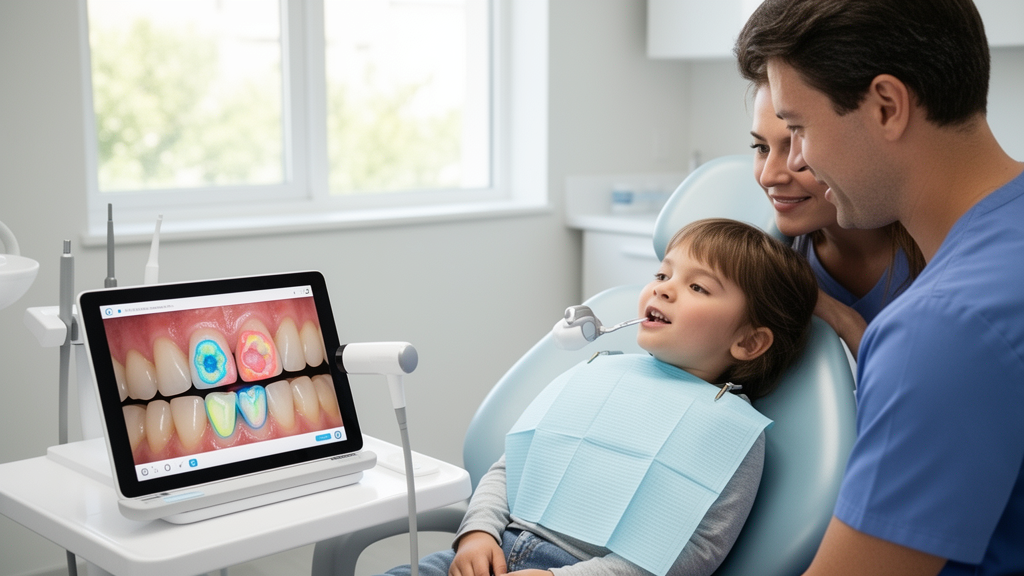
An artificial intelligence pipeline detected and classified visible findings in children’s primary molars from intraoral photographs, achieving 85.9% accuracy in a stricter analysis that kept teeth from the same source photograph together. The study, reported in BMC Medical Imaging , evaluated a sequential system designed to locate primary first and second molars, isolate their images and assign five categories: healthy, stained, decayed, stainless steel crown and amalgam restoration. The research dataset comprised 725 occlusal intraoral photographs from 725 children aged 6 to 12 years.
Its primary target was the posterior primary dentition, specifically the first primary molars, designated D, and second primary molars, designated E. The authors describe the observed performance as encouraging but caution that larger, more diverse and multicentre datasets will be needed to determine how robust and generalizable the pipeline is, particularly in the presence of potentially confounding restorative materials. The first stage used YOLOv8 to locate the target teeth in each photograph.
The 725 images were divided into training, validation and test sets at a ratio of 70%, 15% and 15%, yielding 508, 109 and 108 photographs, respectively. The held-out test set contained 303 annotated teeth. On this set, the detector achieved precision of 0.963, recall of 0.972 and mean average precision at an intersection-over-union threshold of 0.5, or [email protected], of 0.983.
Detected teeth then entered a segmentation stage based on the Segment Anything Model, abbreviated SAM, which isolated the tooth region for classification. A ResNet50 network was used to classify each segmented tooth image into one of the five predefined categories. The analysis separated the pipeline into these linked stages so that the system could first identify individual posterior teeth and then assess the visible condition represented in each tooth’s image.
For the main primary tooth-level classification analysis, the researchers divided 1,946 tooth samples into 1,362 training, 389 validation and 195 test samples, corresponding to a 70%, 20% and 10% split. The ResNet50 classifier achieved 87.7% accuracy on the 195 held-out teeth. In this analysis, teeth originating from the same source photograph were not necessarily restricted to one subset of the data, a design detail that the investigators addressed with an additional sensitivity analysis.
That sensitivity analysis used a 70%, 15% and 15% division of the 725 source photographs, maintaining separation at the patient or source-photograph level. An independently retrained ResNet50 was then evaluated on 290 held-out tooth samples. It achieved 85.9% accuracy, 85.6% macro-averaged precision, 85.7% macro-averaged recall and an 85.6% F1-score.
Agreement between classifications was also substantial, with a Cohen’s κ of 0.822. The lower accuracy than in the original tooth-level test did not erase the overall performance, but it quantified how results changed under the alternative grouping strategy. The researchers also applied Grad-CAM as a qualitative visualization tool.
This technique produced heat maps identifying image regions that contributed to the classifier’s predictions, allowing the team to examine which parts of the segmented tooth images influenced the assigned categories. The visualization was interpretive rather than a separate quantitative test: it showed the features associated with model decisions, but it did not by itself establish diagnostic accuracy or clinical usefulness. Overall, the study provides image-based evidence that a multistage deep-learning pipeline can combine tooth localization, segmentation and classification to assess primary molars in pediatric intraoral photographs.
Its strongest reported results were 0.963 precision and 0.972 recall for detecting D and E teeth, together with 87.7% classification accuracy in the original held-out tooth analysis and 85.9% in the source-photograph-level sensitivity analysis. The authors frame the approach as a potential aid for standardized photographic assessment and workflow efficiency in pediatric dentistry, while emphasizing that broader external validation is still required before its robustness can be assessed beyond the study’s dataset.
Subject of Research: Evaluation of a multistage deep-learning pipeline for detecting and classifying caries and restorations in pediatric primary molars from intraoral photographs.
Article Title: Artificial Intelligence-based multi-stage pipeline for detecting caries and restorations in pediatric primary molars from intraoral photographs
Article References: Kavousinejad, S., Motie, P., Daghighi, Y., Norouzi, A., Rabbani, H., Biglar, N., Ebadifar, A., & Behnaz, M. (2026). Artificial Intelligence-based multi-stage pipeline for detecting caries and restorations in pediatric primary molars from intraoral photographs. BMC Medical Imaging. https://doi.org/10.1186/s12880-026-02975-z
Image Credits: AI Generated
DOI: 10.1186/s12880-026-02975-z
Keywords: artificial intelligence, pediatric dentistry, primary molars, dental caries, intraoral photographs, deep learning, YOLOv8, image segmentation, ResNet50, computer-assisted diagnosis, Artificial, Intelligence-based
News Source: Blake Davidson. (October 20, 2026). Photo-based AI classifies cavities and restorations in children’s primary molars. Scienmag.