A new model suggests a global switch from an animal-based to a plant-based diet would have a substantial impact in stabilizing greenhouse gas levels, equivalent to a significant reduction in CO2 emissions. Michael Eisen of the University of California, Berkeley and Patrick Brown of Stanford University and Impossible Foods present these findings in the open-access journal PLOS Climate on February 1, 2022.
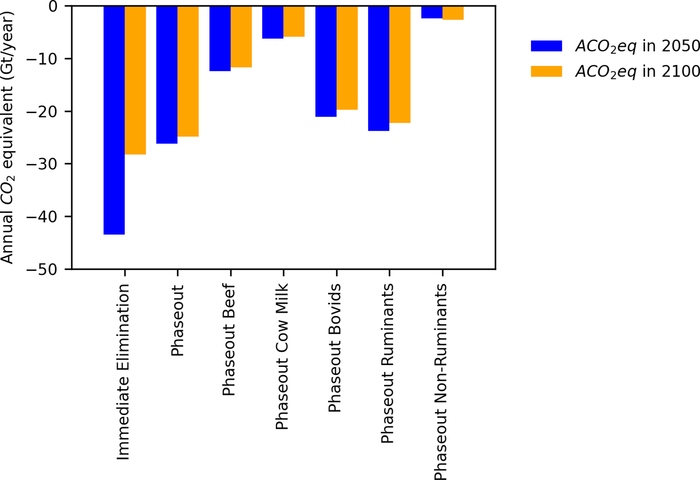
Credit: Eisen and Brown, 2022, CC-BY 4.0 (https://creativecommons.org/licenses/by/4.0/)
A new model suggests a global switch from an animal-based to a plant-based diet would have a substantial impact in stabilizing greenhouse gas levels, equivalent to a significant reduction in CO2 emissions. Michael Eisen of the University of California, Berkeley and Patrick Brown of Stanford University and Impossible Foods present these findings in the open-access journal PLOS Climate on February 1, 2022.
Animal agriculture contributes significantly to global warming because of the methane, nitrous oxide and carbon emissions of livestock and their supply chains, and because carbon-sequestering biomass is often displaced on land used for grazing and for growing animal feed. But unlike emissions from fossil fuel combustion, the emissions from animal agriculture would be largely reversible as that industry diminishes, through biomass recovery on land previously cleared for livestock and spontaneous decay of methane and nitrous oxide. This means that replacement of animals in the global food system could help to put the brakes on climate change.
The authors of the present study use a simple climate model to incorporate the combined effects of reduced emissions and biomass recovery resulting from a global switch to a plant-based diet. Using publicly available data, they examine how this change might affect emissions between 2020 and 2100, relative to current baseline emissions, under scenarios including an immediate switch from animal- to plant-based agriculture, a 15-year phased transition, and a partial change where only certain animal products were phased out.
In this analysis, switching to plant-based agriculture could reduce emissions by the equivalent of 25 gigatons of carbon dioxide per year. A 15-year phased transition could reduce emissions sufficiently to stabilize greenhouse gas levels for 30 years. Impacts of phasing out animal-based agriculture differed greatly by species, with cattle accounting for 71 percent of the benefits to emissions (47 percent through beef and 24 percent through milk). While fully phasing out animal-based agriculture was projected to have the largest impact, replacing ruminants alone could achieve over 90 percent of the reduction in emissions.
The researchers’ model is based on a number of simplifying assumptions. Current greenhouse gas emissions levels form the baseline for both present-day and future projections, whereas baseline emissions may in fact change as technology advances, nations develop and populations evolve. In addition, the researchers made assumptions about the fate of land currently used for animal-based agriculture which would be surplus relative to demand for meat. The validity of such assumptions would affect the extent to which these conclusions would hold if applied in the real world.
The model does not consider the viability – in terms of geographic, cultural and nutritional constraints – of switching to plant-based agriculture worldwide, and some regions, such as the drylands of sub-Saharan Africa, may be unsuitable for culturing crops. Also, the analysis focuses on terrestrial agriculture, excluding aquaculture and fishing.
The authors hope that their work in clarifying the “climate opportunity cost” of animal agriculture “will help policymakers and the public properly prioritize dietary change as a climate defense strategy”.
Mike Eisen notes: “This study shows that a global transition away from the use of animals, especially cattle, to produce food has the potential to rapidly remove large amounts of carbon dioxide, methane and nitrous oxide from the atmosphere, representing a unique opportunity to achieve the negative emissions required to keep temperatures from exceeding 2C.”
DOI
10.1371/journal.pclm.0000010
Method of Research
Computational simulation/modeling
Subject of Research
Not applicable
Article Title
Rapid global phaseout of animal agriculture has the potential to stabilize greenhouse gas levels for 30 years and offset 68 percent of CO2 emissions this century
Article Publication Date
1-Feb-2022
COI Statement
The authors of this manuscript have the following competing interests: Patrick Brown is the founder and CEO of Impossible Foods, a company developing alternatives to animals in food-production. Michael Eisen is an advisor to Impossible Foods. Both are shareholders in the company and thus stand to benefit financially from reduction of animal agriculture. Michael Eisen and Patrick Brown are co-founders and former members of the Board of Directors of the Public Library of Science.