


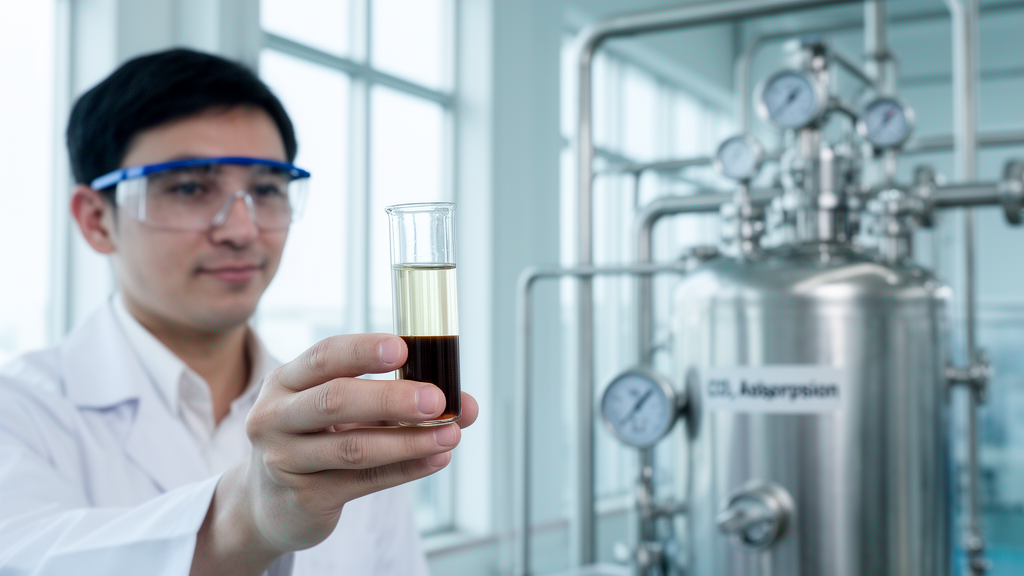
Cutting carbon dioxide out of industrial flue gas has always carried a punishing energy bill. The workhorse of post-combustion capture, a 30 percent aqueous solution of monoethanolamine (MEA), absorbs CO2 efficiently but demands so much heat to release the gas again that regeneration alone drives conventional capture costs above 130 dollars per ton of CO2, accounting for roughly 70 percent of total capture costs. A review published in the journal Carbon Neutrality argues that a family of solvents known as amine-based biphasic absorbents could change that arithmetic dramatically, with laboratory systems reporting regeneration energies as low as roughly 1 gigajoule per ton of CO2, compared with a benchmark of about 3.6 to 4.0 gigajoules for conventional MEA.
The trick behind biphasic absorbents is elegantly simple. As these amine solutions soak up CO2, they spontaneously split into two phases: a CO2-rich phase dense with reaction products, and a CO2-lean phase containing mostly unreacted amine. Because only the rich phase, a small fraction of the total solvent volume, needs to be heated in the stripper, the sensible heat and the latent heat of vaporization, the two components that dominate conventional regeneration, are slashed. According to the review, this phase-splitting strategy can reduce regeneration energy consumption by 30 to 50 percent, while allowing higher stripping pressures that further improve overall energy efficiency.
Each family carries a distinct performance signature. Aqueous systems generally absorb CO2 faster, because water provides a parallel reaction channel in which dissolved CO2 hydrolyzes to bicarbonate, accelerating proton transfer. Non-aqueous systems, by contrast, achieve ultra-low latent heats of regeneration because there is little or no water to evaporate, and certain amines in water-free solvents can bind CO2 in one-to-one adducts, bypassing the half-mole-per-mole stoichiometric ceiling of carbamate formation that constrains aqueous chemistry.
The compiled data reveal striking examples on both sides. The TEPA/DGME/H2O system achieves a cyclic CO2 capacity of 2.70 moles per kilogram, 1.39 times that of 30 percent MEA, while the DETA/n-butanol/H2O system reaches an absorption capacity of 7.52 moles per kilogram, roughly 1.6 times the MEA benchmark, thanks to the multiple amino groups that polyamines provide as reactive sites. On the energy side, the DMCA/N-methylcyclohexylamine system requires only 1.03 gigajoules per ton of CO2 at 323 kelvin, and the non-aqueous DETA/DMSO and PZ/AMP/NMF systems report totals of 0.74 and 0.76 gigajoules per ton respectively, reductions of 50 to 85 percent against the MEA benchmark.
Yet the review is candid that these headline numbers deserve careful interpretation. The ultra-low regeneration heats were measured mostly in laboratory studies under idealized conditions, often using high-purity CO2 rather than realistic flue gas containing 12 to 15 percent CO2. The authors caution that such values represent thermodynamic minima rather than guaranteed industrial performance, since they exclude flue gas compression energy and have not been validated at pilot scale, where long-term solvent degradation and integrated process energy penalties must be counted. Testing with nearly pure CO2, they note, can mask mass transfer limitations and yield thermodynamically optimistic capacity figures.
Practical deployment also faces engineering hurdles that the phase-change chemistry itself creates. The viscosity of the CO2-rich phase is a recurring problem: conventional absorption columns and centrifugal pumps typically require solvent viscosities below 50 to 100 millipascal-seconds, but some non-aqueous systems, such as a TMEDA/MEA/DMSO formulation, develop rich-phase viscosities as high as 2,288 millipascal-seconds, which would be unpumpable in standard equipment. Liquid-solid systems, whose crystalline precipitates concentrate CO2 and physically exclude the bulk solvent, achieve some of the lowest regeneration energies but introduce pipeline clogging, slurry erosion, and pump abrasion, demanding specialized solid-liquid separation units and slurry-handling heat exchangers that eat into the energy savings.
Underneath the macroscopic performance lies a molecular story that the review places at its center. When CO2 reacts with amines, the resulting carbamate products and protonated amines carry dipole moments roughly 4 to 9 Debye larger than the parent amine molecules, driven by ion-pair formation and increased charge separation. These highly polar products attract one another and aggregate, and it is this polarity contrast that triggers phase separation. The review highlights two quantitative tools for predicting the behavior: dipole moment analysis, which is straightforward but struggles with large, hydrogen-bonded molecules, and the molecular polarity index (MPI), a more comprehensive measure that correlates strongly with the solubility difference between phases. In one reported framework, a biphasic state forms before CO2 absorption when the MPI difference between a tertiary and a primary amine exceeds 9 kilocalories per mole.
Spectroscopic evidence anchors these mechanisms in experiment. In an aqueous BDA/EG/H2O system tracked by carbon-13 nuclear magnetic resonance, a new signal at 164.53 parts per million marked carbamate formation at low CO2 loading, while a shift at 161.8 ppm at saturation was attributed to bicarbonate or carbonate, and additional signals revealed alkyl carbonate products. In the non-aqueous AEEA/DMSO/PMDETA system, NMR confirmed that CO2 is captured as carbamate and carbamic acid, with the tertiary amine PMDETA acting not as a CO2 carrier but as a proton acceptor that deprotonates the unstable zwitterion intermediate formed when the diamine AEEA attacks free CO2.
The review also maps the trade-offs that no single solvent has yet escaped. Higher absorption capacity tends to come with higher rich-phase viscosity and lower desorption efficiency; the DMEA/MAE/TGME/H2O system, for instance, reaches a desorption efficiency of 95.5 percent at 373 kelvin but manages a cyclic capacity of only 0.28 to 0.37 moles per liter, while polyamine systems deliver capacities of 2.70 to 2.80 moles per kilogram but often need desorption temperatures around 403 kelvin. Temperature cuts both ways: raising it speeds absorption but lowers equilibrium capacity, and in the DETA/DEEA system a jump from 303 to 323 kelvin cut capacity by 8.2 percent while boosting the absorption rate by 33.5 percent. Stability looms as the decisive industrial question, with oxidative and thermal degradation, corrosion, and the evaporative loss of volatile organic diluents identified as the core bottlenecks, though non-aqueous blends appear to suppress electrochemical corrosion relative to aqueous MEA.
The authors’ roadmap for the field is correspondingly concrete. They call for standardized evaluation using realistic flue gas concentrations, accelerated aging protocols and predictive lifetime models to close the stability data gap, techno-economic and life cycle assessments including 4E frameworks covering energy, exergy, economy, and environment, and the integration of biphasic capture with utilization routes such as electrocatalytic CO2 reduction that skip desorption entirely. Machine learning trained on compiled performance data, they suggest, could accelerate the search for bespoke amines with low reaction enthalpies, anti-degradation functional groups, and low-volatility solvents. If the polarity-driven design principles the review consolidates hold up outside the laboratory, the path they describe, a tiny rich-phase volume, a water-lean environment, and low-enthalpy CO2 adducts, points toward regeneration energies below one gigajoule per ton of CO2, a threshold that would reshape the economics of industrial carbon capture.
Subject of Research: A review of amine-based biphasic absorbents for low-energy post-combustion CO2 capture
Article Title: Advancements in amine-based biphasic absorbents for efficient and low-energy CO2 capture: a review
Article References: Yuan, J., Gao, J., Yan, J., & Wang, L. (2026). Advancements in amine-based biphasic absorbents for efficient and low-energy CO2 capture: a review. Carbon Neutrality, 5(1), Article 33. https://doi.org/10.1007/s43979-026-00186-7
Image Credits: AI Generated
DOI: 10.1007/s43979-026-00186-7
Keywords: CO2 capture, biphasic absorbents, amines, phase separation, regeneration energy, post-combustion capture, molecular polarity, carbon neutrality, solvent design, CCUS, Advancements, amine-based
News Source: Sloane Callahan. (October 29, 2026). Phase-Separating Amine Solvents Could Slash the Energy Cost of CO2 Capture. Scienmag.



